Tarar Defends Constitutional Court at Anniversary
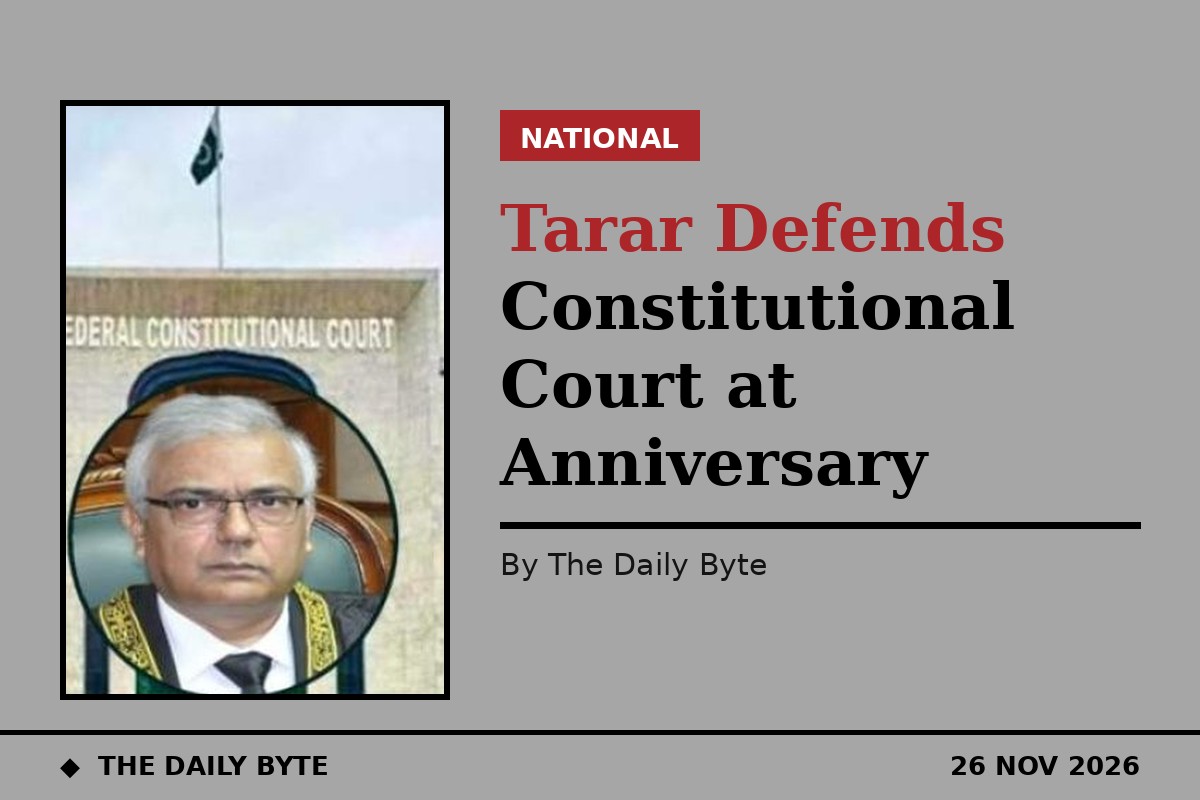
Law Minister Azam Nazeer Tarar has defended the Federal Constitutional Court at a Pakistan Bar Council ceremony marking its first anniversary, as the new court seeks to answer questions about its legitimacy a year after it was created under the 27th Amendment.
Chief Justice Aminuddin Khan told the ceremony that he was working to bring Pakistan's justice system up to global standards. Since the court was established, 24,000 cases have been transferred to it from the Supreme Court, and 9,000 of them were decided in its first year, he said.
The chief justice said the justice system's main purpose was not to keep cases pending for years, but to provide timely justice to the public. He said litigants should not have to wait a long time to obtain justice, and that an effective judicial system is one in which justice is delivered on time.
He added that the transfer of constitutional cases to the new court had given Supreme Court judges the opportunity to hear cases involving ordinary litigants, rather than spending their time on constitutional matters.
Tarar answers Bilawal's criticism
Tarar used the ceremony to defend the court's creation, saying it reflected a longstanding demand from bar associations and councils rather than only the wishes of political leaders. He said extensive consultations had been held with the legal fraternity before the amendment was passed.
He said ordinary citizens were now approaching both the Supreme Court and the new court with greater confidence, and that the institution was performing well.
Tarar was responding to PPP chairman Bilawal Bhutto-Zardari, who questioned the court this month. Bilawal asked whether the court could function while holding the confidence of the government alone, even though his own party voted for the amendments that created it.
The law minister also criticised the previous Supreme Court's use of Article 184(3), arguing that certain interventions had harmed the country. He asked pointedly whether determining the price of food items was also the responsibility of the courts, a reference to a period when suo motu proceedings were used to set prices and direct administrative decisions.
A thin Supreme Court turnout
The attendance at the ceremony told its own story. Only two Supreme Court judges attended, while all the judges of the new court and of the Islamabad High Court were present. No Supreme Court judge commented publicly on the anniversary.
The court marked its first anniversary on 13 November, when the chief justice unveiled a commemorative postage stamp, digitally inaugurated the court's e-court system and unveiled a book recording its early work.
The first year has been a consequential one by any measure. In November the court suspended Article 199 proceedings before the Peshawar High Court, then partially restored them. Cases concerning governor's rule and preventive detention in Khyber-Pakhtunkhwa remain excluded, leaving lawmakers detained under those powers with no route to a high court.
It also rejected a JUI-F claim to a reserved seat on 21 November, a decision the party is now challenging in other forums.
What happens next
Supporters of the new court argue that separating constitutional work frees the Supreme Court for ordinary appeals. Critics argue it allows a government to choose which bench hears challenges to its own actions. Both propositions can only be tested over time.
For now, the court's leadership is presenting its first-year record as evidence of success. Whether that record settles the legitimacy debate will depend on how the court handles the politically charged cases now before it, and on whether the Supreme Court and the new court can work alongside each other without the public split that the anniversary ceremony put on display.
Frequently asked questions
How many cases has the Federal Constitutional Court decided? Chief Justice Aminuddin Khan told the Bar Council ceremony that the court decided 9,000 cases in its first year, out of 24,000 transferred from the Supreme Court.
When was the court created? It was created under the 27th Constitutional Amendment and completed its first year on 13 November 2026.
Why is the court controversial? Critics, including PPP chairman Bilawal Bhutto-Zardari, question whether a court created by the government can act independently of it. The government says its creation was a longstanding demand of the legal profession.