Tarar Calls Misinformation Biggest Threat of Our Age
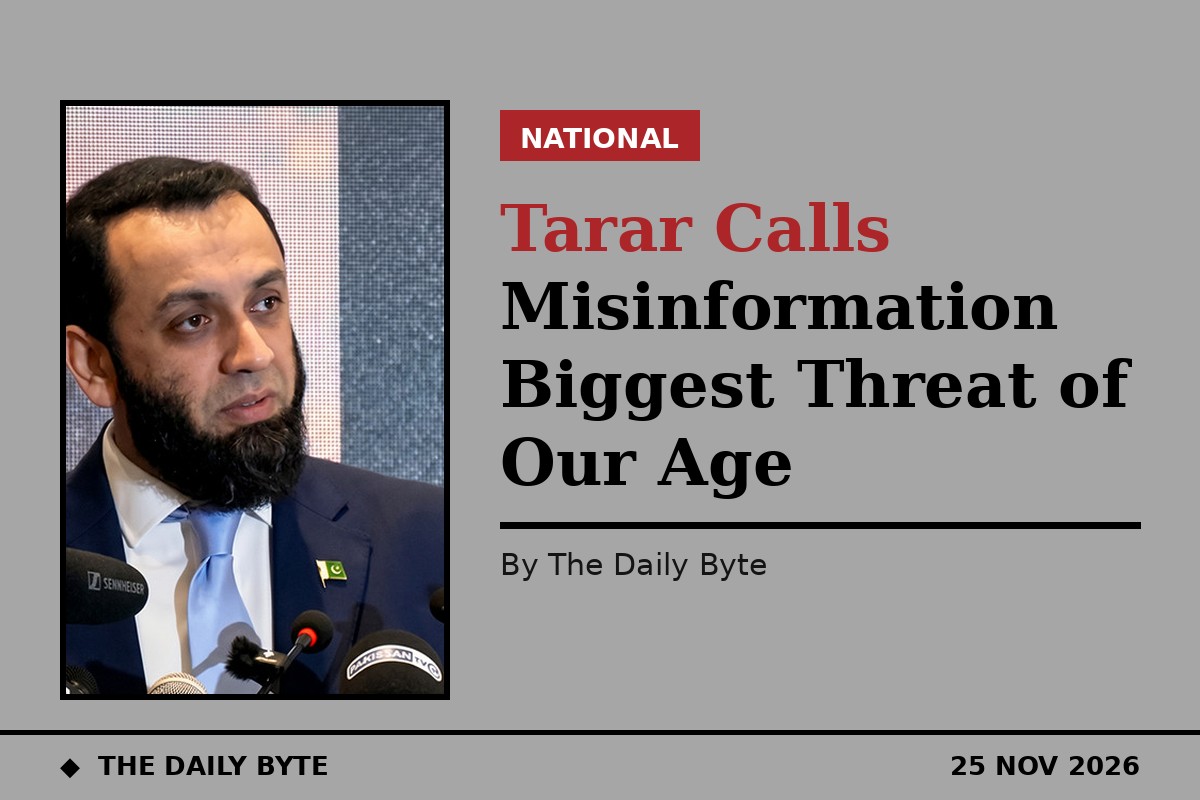
Federal Information Minister Attaullah Tarar has called misinformation and disinformation the biggest threat of the modern age, telling an international seminar in Islamabad that false narratives now spread online faster than anyone can correct them.
Tarar was speaking as a panellist at an international seminar titled Social Media Platforms and the Post-Truth Era, organised by the Sustainable Development Policy Institute (SDPI) in Islamabad on Tuesday. His remarks were reported on Wednesday, 25 November.
Pakistan has almost 100 million social media users and around 160 million smartphone users, Tarar told the seminar, and that scale has changed who counts as a broadcaster. Traditionally, radio, television and other established outlets held that role, he said; now anyone with a smartphone in hand is a broadcaster, and verifying information has become much harder.
Greatest threat is not war or climate change
Citing a World Economic Forum report, Tarar said the greatest threat of the age was not nuclear warfare or destruction caused by climate change, but misinformation and disinformation. When something goes viral, he said, it takes merely minutes and spreads like wildfire, and establishing whether a narrative is false starts with asking where it came from and whether the source is authentic.
He argued that the problem had moved beyond false narratives alone. Viral content is now directly linked to financial incentives, he said, adding that society was effectively financially incentivising terrorism, harassment and child abuse when harmful material earns money through views and virality. In that situation, he said, the question of whether a narrative is false recedes into the background.
Tarar gave the example of a video from the Balochistan Liberation Army, a proscribed organisation that is also on the United States State Department's list of banned organisations. He said the government had taken the video up with certain social media platforms and asked for it to be taken down because its makers were terrorists killing innocent people, but it was not removed. The debate, he said, had gone far beyond what could be declared a false narrative.
Platforms keen to open offices, but rules clash
The minister said the government had engaged with multiple social media platforms over the years, and that the sticking point was compatibility with local law. Pakistani legislation could not compel a platform to follow laws that applied only inside Pakistan, he said, and whenever the government spoke to the companies they showed eagerness to open offices in Pakistan and increase their presence. But there was a policy division inside their own organisations, along with their legal teams, and the rules they operated under did not seem compatible with local laws.
Tarar said the government was ready to work with all social media platforms to help them shape their policies in line with local laws, adding that it could not be one size fits all because every country had its own dynamics and issues. He welcomed the opening of social media platforms in Pakistan and praised compliance steps such as labelling videos generated by artificial intelligence, so viewers could tell that the content was created by AI.
Islamabad Declaration and a national task force
Tarar proposed two concrete steps. He called for an Islamabad Declaration from the forum to bring social media platforms into a working group so that regulations could be cohesive and mutually supportive, and he proposed a joint working group involving the government and the companies to develop a common approach. He also said there was a need for a national task force with representation from federal and provincial governments and the relevant institutions and ministries.
He noted that social media platforms had no built-in system to filter terrorist content at the outset, and that it had to be brought to their notice time and again that a particular post came from a terrorist organisation and needed to be filtered.
Sindh Information Minister Sharjeel Inam Memon, who also addressed the seminar, proposed restricting social media access for children under 16 and called for stronger measures against misinformation and online propaganda. He said tackling the misuse of social media needed collective effort from the government and wider society, and highlighted concerns about militant organisations using digital platforms to influence young people.
No new ban or deadline was announced at the seminar. The proposals on the table are a declaration, a working group and a task force, and none of them has been adopted yet. What the seminar did show is that the government's argument has shifted from asking platforms to remove individual posts to asking them to align their policies with Pakistani law and to open local offices so that complaints can be handled inside the country.