Tarar Calls for UN-Led Dialogue with India at Margalla Forum
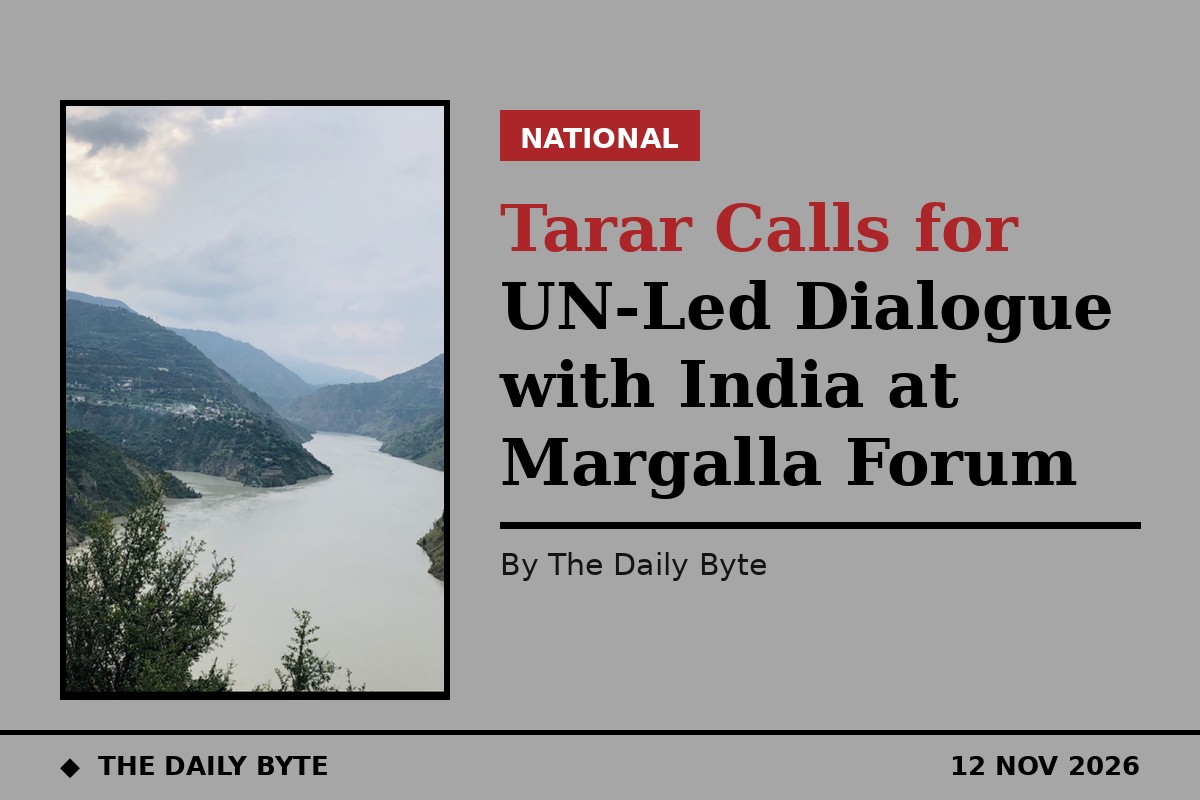
Federal Minister for Law and Justice Azam Nazeer Tarar has called on Pakistan and India to settle their disputes through dialogue and United Nations mechanisms rather than force, telling the Margalla Dialogue in Islamabad that India has no legal ground to suspend the Indus Waters Treaty on its own.
Addressing the forum on Wednesday, Tarar said respect for international law, treaties and established global norms was necessary for lasting peace in South Asia. His remarks came on the second day of the Margalla Dialogue 2026, organised by the Islamabad Policy Research Institute under the theme “Global Order in Transition: Navigating Strategic Uncertainty”.
No unilateral exit from the treaty, Tarar says
Tarar described the Indus Waters Treaty as an agreement that has held for more than six decades through wars and tension. Facilitated by the World Bank, it sets out how the waters of the Indus river system are shared and provides a dispute process running through the Permanent Indus Commission, a Neutral Expert and a Court of Arbitration.
He said the treaty contains no provision for unilateral termination and requires the consent of both parties. India suspended the treaty in the aftermath of the April 2026 Pahalgam attack, a step Pakistan has consistently described as unlawful. Deputy Prime Minister and Foreign Minister Ishaq Dar made the same point in his opening address to the dialogue on Tuesday, saying Pakistan would firmly safeguard its legitimate rights under the treaty and oppose any attempt to weaponise water.
WAPDA warns on Chenab projects
The sharpest warning at the session came from Water and Power Development Authority Chairman Lt Gen (retd) Muhammad Saeed, who told the forum that Indian projects on the Chenab could let India regulate flows to Pakistan's disadvantage. He said India is building five major and 19 smaller projects on the river and pursuing three diversion schemes.
According to Saeed, those projects could raise India's storage and flow-regulation capacity from 12 days to 50 days by 2030, with further storage by 2032, affecting about 10 million people in Pakistan. He said India had cut the flow at Marala to 13,206 cusecs when the first watering of the wheat crop was due, and had stopped sharing river-flow data with Pakistani commissioners.
Calls to engage Kabul as well
Former national security adviser Lt Gen (retd) Nasir Khan Janjua told the dialogue that Islamabad should engage Kabul, directly or through Iran, China and Russia, to end the conflict with Afghanistan. He was speaking in a session on regional security, where speakers also discussed the changing global order and the role of emerging technologies, including artificial intelligence and drone warfare, in modern conflict.
The Margalla Dialogue is Pakistan's leading annual foreign policy and security forum, bringing together ministers, diplomats, military officers and academics from Pakistan and abroad. This year's edition has focused heavily on the pressures facing the international order, from great-power rivalry to disputes over shared rivers. Source: Skardu Times