Taung Child: the fossil rewriting human evolution
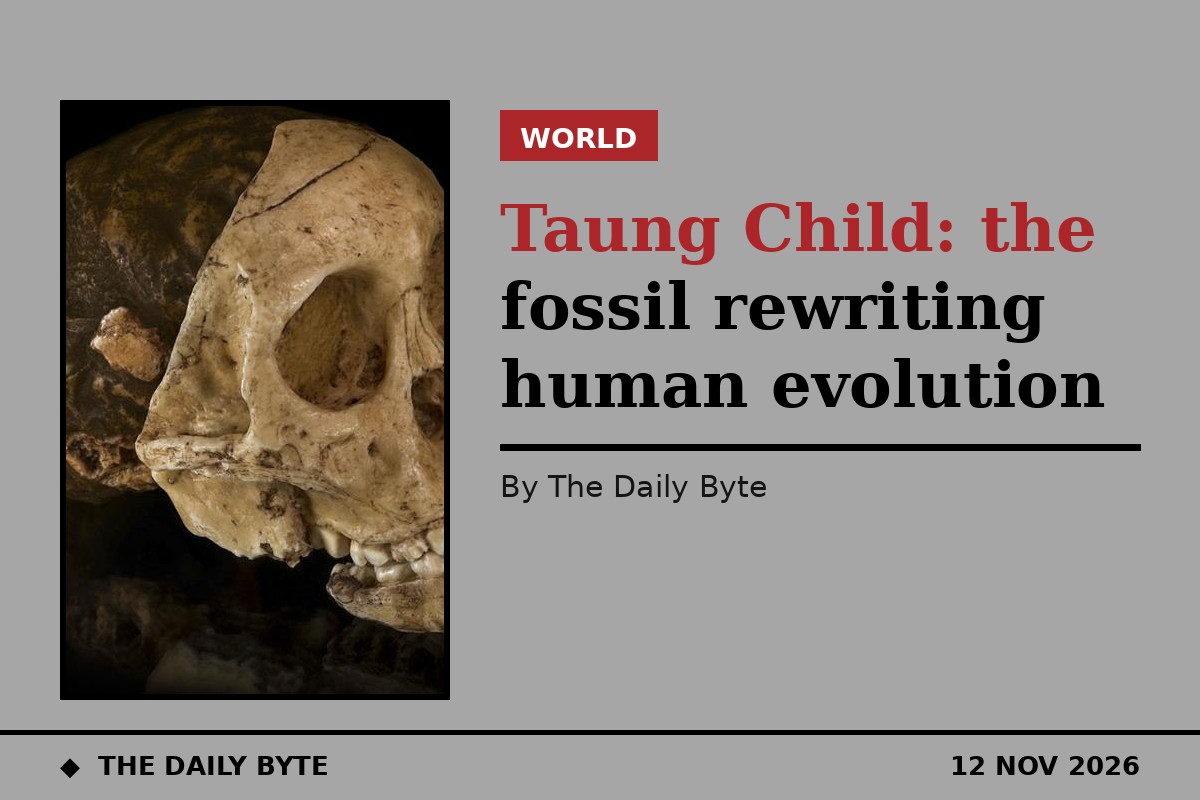
One of the most famous fossils in science has just got older — and more complicated. A new study dates the Taung Child, the 3-million-year-old skull that provided the first hard proof that humans originated in Africa, to between 2.96 and 3.03 million years old, and suggests the early human family tree was far more tangled than textbooks have long shown.
The study, published on 9 November in the journal npj Palaeoecosystems and led by Professor Gabriele Macho of Vrije Universiteit Brussel (VUB) in Belgium, re-examined the fossil a century after its discovery.
What is the Taung Child?
The Taung Child is the fossilised skull of a young child, discovered in 1924 at a limestone quarry near the village of Taung in South Africa. Australian anthropologist Raymond Dart described it in 1925 as Australopithecus africanus, making it the type specimen — the original example — of that species. It provided the first concrete proof of human origins in Africa, redirecting the search for our ancestors away from Europe and Asia.
Because no definitive criteria were ever established for classifying later discoveries under the species, the Taung Child remains the only fossil definitively linked to A. africanus. Fossils from nearby sites such as Sterkfontein and Makapansgat were later grouped with it, but that grouping is exactly what the new study questions.
What did the new study find?
First, a new age. Dating Taung has always been difficult because mining destroyed the fossil's exact original context. The team dated a flowstone layer above the fossil-bearing deposit using a uranium-lead method, and combined that with evidence from the Earth's magnetic field preserved in the rocks, arriving at 2.96 to 3.03 million years — significantly older than the previous estimate of about 2.58 million years.
Second, a more complicated family. By comparing the Taung Child's tooth structure and brain development during growth with adult fossils traditionally grouped under A. africanus, the team found that several of those fossils do not match the Taung Child's developmental trajectory. Differences in brain development suggest multiple distinct hominin species lived alongside or in succession in the Sterkfontein region, rather than one uniform species.
Third, a changing world. Fossilised pollen shows the Taung Child lived in a significantly wetter, forested environment than modern South Africa, with tree species now found hundreds of kilometres to the northeast. The researchers attribute the diversity of early hominins to shifting climate patterns — wet and dry cycles driven by the Earth's orbital cycles — that reshaped the southern African landscape between 4 and 2.5 million years ago.
What does this mean for human evolution?
As Macho put it: "The human family tree wasn't a neat, straight trunk — it was a chaotic, tangled bush driven by climate shifts." The study does not name any new species and does not supply a finished family tree. It shows why the route from southern African australopiths to our own genus, Homo, remains difficult to reconstruct — and why a century-old fossil is still asking new questions.
Frequently asked questions
Does this mean scientists were wrong about human evolution? No. The study refines the picture rather than overturning it: the Taung Child is still the type specimen of A. africanus, but the species may have been defined too loosely, grouping together more than one kind of early hominin.
Why is the Taung Child so important? It was the first fossil to prove our evolutionary line began in Africa, and it remains the only fossil definitively linked to its species — which makes it the benchmark against which all other southern African fossils are judged.
Sources: Vrije Universiteit Brussel; Phys.org.