Thailand Plans Baht Stablecoin Rules for March 2027
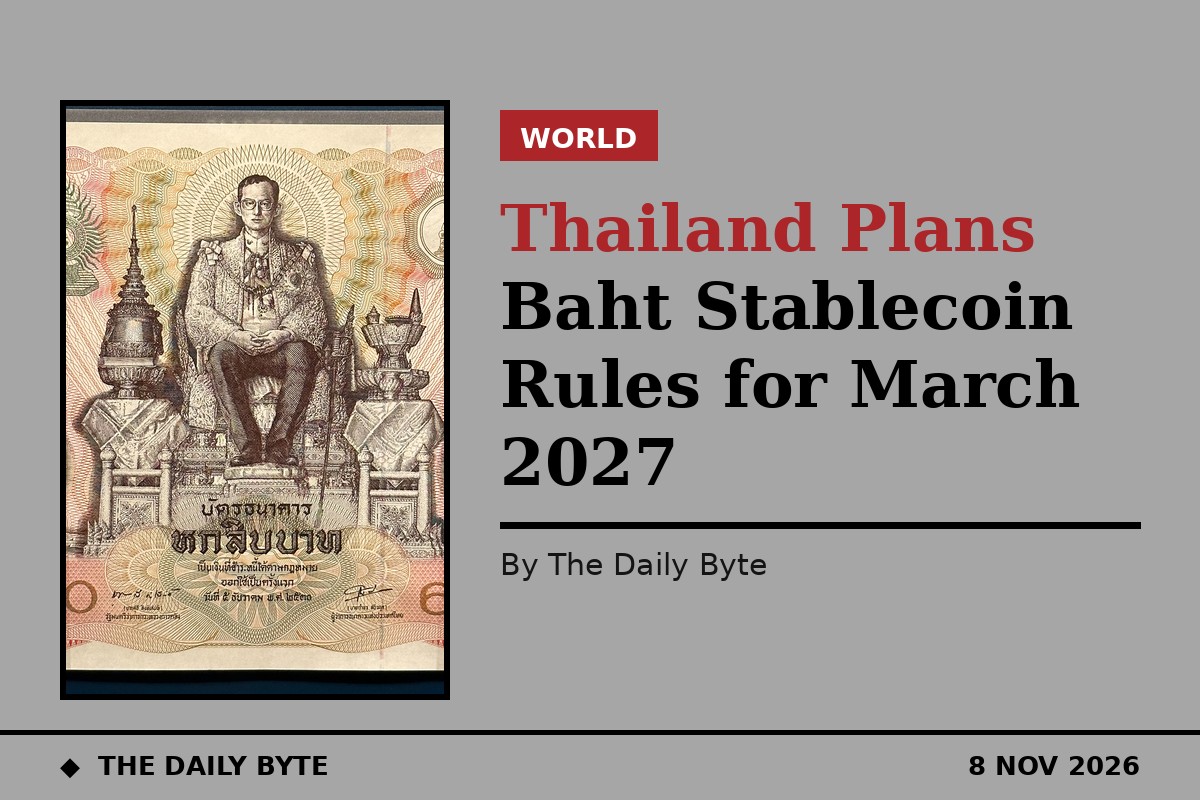
Thailand's central bank plans to issue rules for a baht-backed stablecoin in March 2027, setting out how the digital token would be backed, redeemed and supervised. The Bank of Thailand is consulting on the principles now, with the public consultation running from October 19 to November 17, 2026.
The proposed stablecoin would be pegged one to one to the baht and fully backed by assets. Under the plan, an issuer creating one billion tokens would need one billion baht in backing, held as bank deposits spread across more than one bank. Issuers would have to disclose the number of tokens in circulation and the assets supporting them every day, with an external auditor checking the arrangements at least once a year.
Holders would have the right to redeem tokens with the issuer at one baht each within one business day. Issuers would be prohibited from paying interest or returns to holders, because the product is being designed as a way of holding and moving money rather than as an investment. Issuers would also need the ability to freeze or destroy coins used illegally, and to keep operating through heavy redemption demand, technology failures or an orderly closure.
Governor Vitai Ratanakorn said the main purpose of the project was to strengthen Thailand's financial infrastructure. "The primary objective of a baht stablecoin is to strengthen Thailand's financial infrastructure by improving the efficiency of the country's payment and settlement systems while reducing transaction costs," he said.
One initial use described by the bank is a place for digital asset traders to keep funds after selling Bitcoin or Ethereum, without converting the money back into baht in a bank account or using a foreign-currency stablecoin such as USDT. Wider possibilities include payments, transfers between systems and programmable payments that execute automatically when agreed conditions are met.
The central bank plans to regulate issuers and wallet providers separately. It is considering allowing roughly two issuers at the start, following approaches used in Hong Kong and Singapore, while placing no numerical ceiling on wallet providers that meet its requirements. Wallet licence applications would open in rounds.
Wallet providers would have to verify every user's identity and permit transfers only between wallets that have passed know-your-customer checks. They would need to keep auditable transaction records, keep customer tokens separate from company assets, and help users resolve problems. They would not be allowed to serve digital-asset businesses based overseas, meaning foreign residents and visitors could only hold the coin in a verified Thai wallet.
The stablecoin proposal builds on the Bank of Thailand's Programmable Payment Project, introduced in 2024, in which eight operators have taken part. The consultation was extended from 10 days to 30 days at stakeholders' request, and the bank plans another public consultation on the draft rules before the framework is completed.
Alongside the stablecoin work, the central bank is tightening supervision of currency exchange businesses. It will stop accepting new money changer licence applications during 2027 while it raises standards for existing operators, aiming to prevent the businesses from being used to support illegal activity. Businesses seeking to open exchange operations next year must submit applications between December 1 and 30, 2026, under the current rules. Applications under the new standards are scheduled to resume in 2028, opening twice a year, in March and September, and the bank plans to publish details of the new criteria by December 2026.
The money changer measures follow additional checks introduced by banks on November 1 on cash deposits of five million baht or more, which also cover foreign-currency transactions at the same daily threshold. The Bank of Thailand and the Securities and Exchange Commission are also reviewing USDT use after finding unusually high trading volume in Thailand. The governor has said the stablecoin project itself is separate from the crackdown on illicit funds.