Thinking Machines Releases Inkling 2 Mini for Laptops
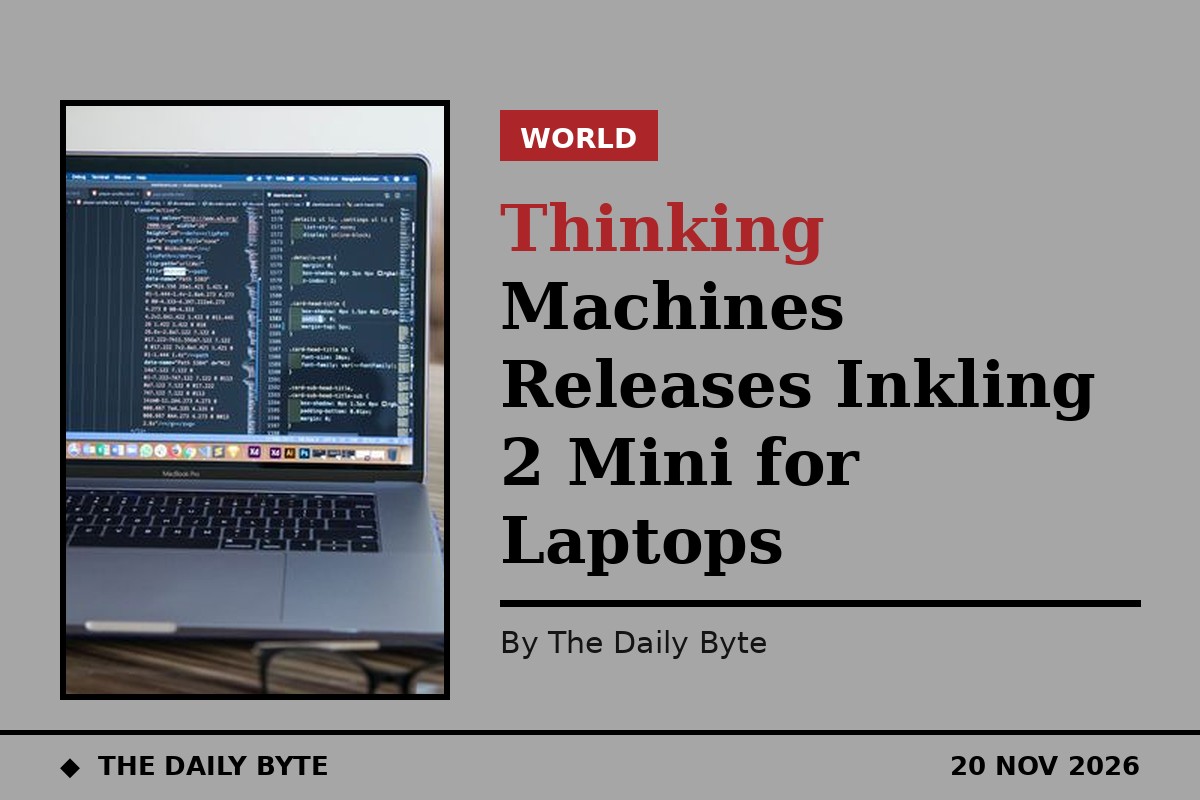
Thinking Machines Lab has released Inkling 2 Mini, a small artificial intelligence model designed to run on an ordinary laptop rather than in a data centre. The lab, founded by former OpenAI chief technology officer Mira Murati, announced the model on Friday, 20 November, releasing it with open weights so developers can download it, run it locally and adapt it.
What sets the model apart is the way it thinks. Inkling 2 Mini is a looped transformer: its 24 layers are arranged in four blocks of six, and the two middle blocks run three times for every token the model generates. That means each token passes through 48 layer visits, letting the model reason for longer without writing its reasoning down. The model has 26.4 billion total parameters, with 3.4 billion active for each token, or 5.4 billion weight activations once the repeated passes are counted.
Small enough for a laptop
The whole model takes up about 20 gigabytes of memory, small enough to run on consumer laptops and desktop AI computers. Most of its weights were trained and deployed in a compact NVFP4 format, with the last four layers in MXFP8. The lab says its researchers took the model on a flight, where it ran offline on a MacBook Pro with an M5 Pro chip and 48 gigabytes of memory and built a playable flight simulator in a few minutes.
At launch the model runs on any Mac with at least 32 gigabytes of memory through Ollama, and it is available for inference and fine-tuning on the lab's Tinker platform. Open-source inference is also supported on SGLang, vLLM, Ollama, Unsloth, NVIDIA Dynamo and TokenSpeed, and the weights are published on Hugging Face under the Apache 2.0 licence. It accepts text and image input and supports a context window of one million tokens.
What the benchmarks say
Thinking Machines says Inkling 2 Mini leads every open-weights model with fewer than 100 billion total parameters on benchmarks including DeepSWE v1.1, where it scored 48.2 percent, and the Vals Index v2.2, where it scored 46.5 percent. It also scored 77.9 percent on the hard 51-task SWE-bench Pro v2 test, and 20.1 on the Artificial Analysis Intelligence Index, matching the much-discussed Qwen3.8-27B. Those figures are the lab's own reported results, and evaluation setups vary between models, so they are a guide rather than an independent verdict.
The model is aimed squarely at long-horizon agentic work: coding agents, browsing systems and tool use, where it leads comparable open models on most tasks the lab measured. It also leads similar-sized open models on search and tool-use tests including BrowseComp, DeepSearchQA and MCP Atlas, which the lab presents as a way around its smaller knowledge base.
The catch: looping does not add knowledge
The lab is open about the limits. Looping helps the model reason, but it does not let its weights store more facts, since knowledge is mostly a function of total parameter count. Its score on AA-Omniscience, a measure of factuality, is in line with other models of the same size. It is also not the strongest small model for multi-turn chat or instructions with many constraints, scoring 50.0 percent on MultiChallenge and 33.4 percent on ComplexConstraints, behind Qwen3.8-27B on both, and it trails larger models on reasoning-heavy tests such as CritPt v2 and HLE-Diamond.
Researchers at Stanford, who tested the model early, measured its intelligence per joule on an NVIDIA DGX Spark at 0.703, well ahead of 0.430 for Qwen3.6-35B, 0.159 for Gemma-4-26B and 0.036 for Qwen3.5-27B. The lab also showed the model running 20 persistent agents at once: all the residents of a tiny pixel town called Thinkyville, managed by Inkling 2 Mini on a single offline MacBook.
A variable-loop research model is being released alongside it, so researchers can study how looping depth changes behaviour. With three loops, the research model's no-chain-of-thought time horizon rose from 16 seconds to 37 seconds, its chain of thought grew shorter but stayed legible, and it did not score higher on tests of agentic sabotage as loops were added. For developers who want a capable coding model they can run themselves, without sending data to a cloud service, Inkling 2 Mini is now the smallest serious option from one of the industry's most watched labs.