Three Banks Favour February for Next Bank Rate Rise
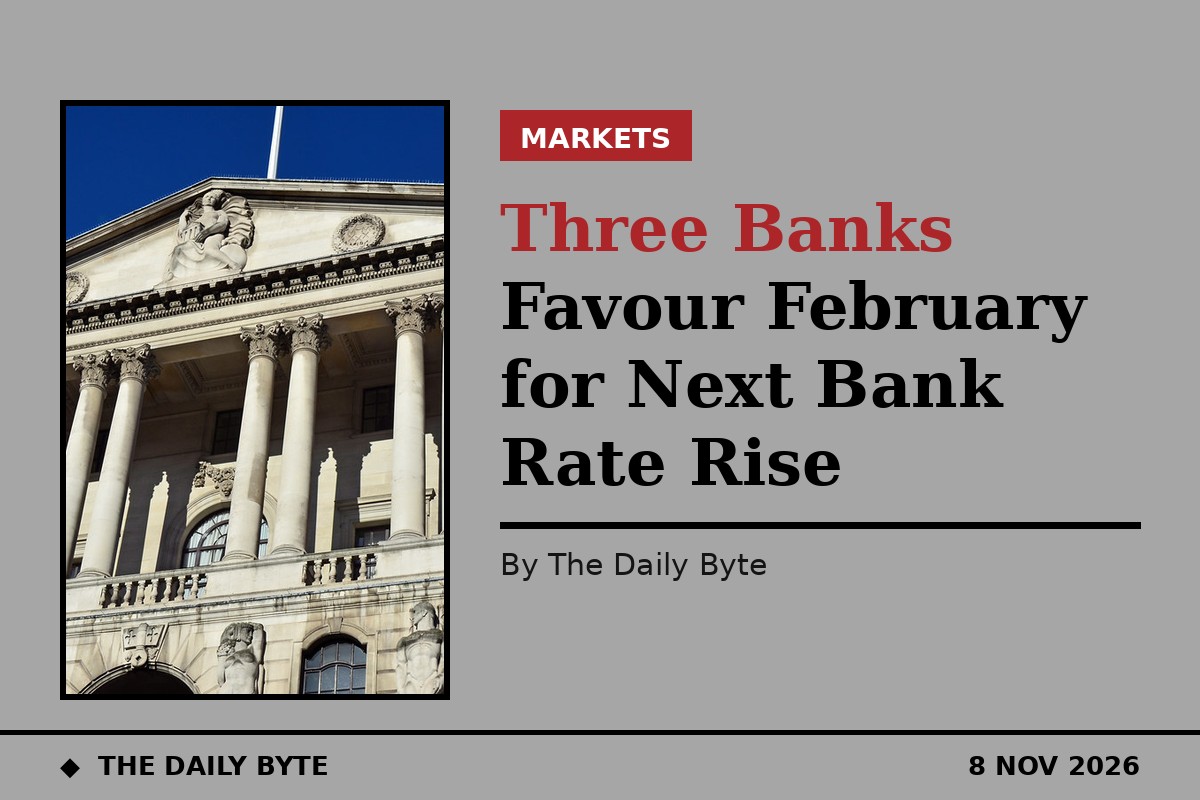
Goldman Sachs, Deutsche Bank and MUFG all favour February over December for the Bank of England's next interest rate rise, after the Bank lifted Bank Rate to 4% last week. Their latest assessments point to a further move to 4.25%, while Pantheon Macroeconomics expects a longer path, with rates reaching 4.50% after increases in February and April.
The Bank's Monetary Policy Committee voted by 8-1 at its meeting ending on 4 November to raise Bank Rate by 0.25 percentage points to 4%, its first increase since August 2023. Catherine Mann, an external member of the committee, voted for a larger half-point rise to 4.25%. UK consumer price inflation stood at 3.5% in September and the Bank expects it to rise to around 5% by the middle of next year, driven largely by higher energy prices from the conflict in the Middle East.
Goldman Sachs had expected two members of the committee to oppose any increase, so the broad support for higher rates was a stronger signal than it had anticipated. Its economists James Moberly and Sven Jari Stehn wrote that commentary from Governor Andrew Bailey indicated a second hike is likely unless the Middle East conflict is resolved, suggesting the bar for the committee to raise Bank Rate again is even lower than they had thought. Even so, they keep February as the more likely date, given the absence so far of higher energy costs feeding through into underlying inflation, and important information still to come, including the Bank's Agents' survey of pay settlements.
Deutsche Bank places the December decision closer to the balance. Its morning briefing said a December rate hike is now finely balanced, but it nevertheless marginally favours February and anticipates a narrow 5-4 vote to leave rates unchanged in December. It retains its view of one more hike, with Bank Rate peaking at 4.25%.
MUFG also retains its February call, while recognising a greater risk of consecutive increases. Its analyst Lee Hardman wrote that the bank has been forecasting the Bank of England will follow up the latest hike with another increase in February next year, but acknowledged there is now a higher risk of a back-to-back hike in December. Energy prices could change the timetable: MUFG argues that if oil prices remain at much lower levels, reflecting progress towards a US-Iran deal after the US midterm elections, the Bank may be more inclined to hold off on hiking again as soon as next month.
Pantheon Macroeconomics offers the most extended path, forecasting increases in February and April to take rates to 4.50%, followed by a hold through the rest of 2027. Its earlier assessment put the neutral rate, which neither stimulates nor restrains activity, at around 3.75%, implying that the new 4% rate provides only modest restraint.
The Bank's own survey of market participants points the same way. The median of responses to the November 2026 Market Participants Survey expected Bank Rate to rise to 4% in November and to 4.25% in February. The committee's next decisions fall on 17 December and 4 February, with the February meeting accompanied by new economic projections. Despite the hawkish decision, the pound stood at 1.1986 euros at 16:49 GMT on Friday, almost unchanged on the day.
The December decision will test how urgent the committee feels another increase is. The inflation and growth evidence in the weeks ahead will determine whether 4.25% is enough, or whether the Bank is drawn into a longer run of rises. Forecasts from banks and markets are not guarantees, and they can shift quickly as new data lands.