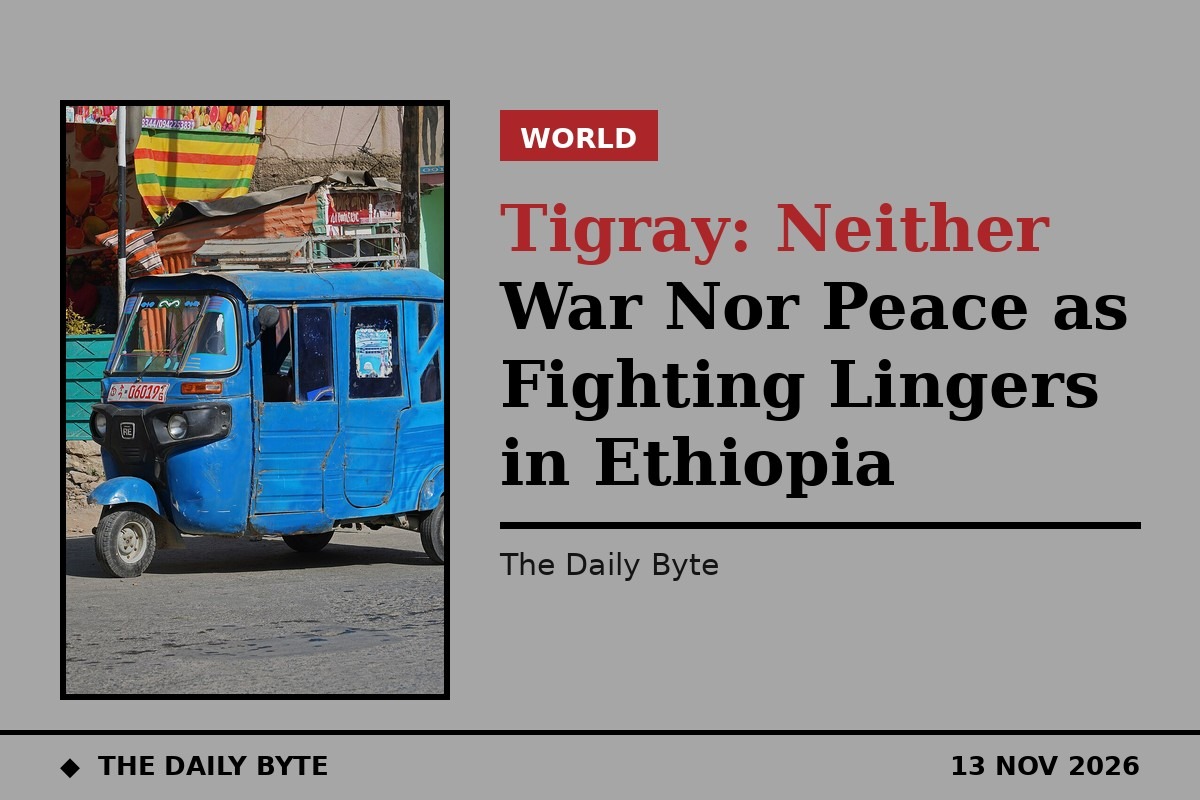
Tigray: Neither War Nor Peace as Fighting Lingers in Ethiopia
Ethiopia's northern Tigray region is caught between war and peace. Federal forces hold the regional capital, Mekelle, after a campaign lasting less than two weeks, yet residents say fighting continues in the hills, and the Tigray People's Liberation Front (TPLF) insists it has not been defeated.
Fighting broke out in late September between the TPLF, the party that ran Tigray for decades, and Ethiopia's national army. It was a resumption of the two-year civil war that officially ended in 2022 with the Pretoria peace agreement. Within less than two weeks, federal forces marched into Mekelle. The TPLF said it had made a strategic withdrawal from the city and Tigray's other main towns, so the army met little resistance.
Hundreds of people are reported to have died in the conflict, including dozens killed by drone strikes and bombing raids by the air force, according to the BBC. The BBC says it is unable to report from Tigray, and verified information from the region is hard to come by.
Life in Mekelle: an uneasy calm
For people in Mekelle, the change of control has not brought normal life back. Firut Me'ar, who runs a hair salon in the city and is a single mother to a 10-year-old daughter, told the BBC that many residents cannot feed their children, let alone think about self-care. She said business was almost non-existent, people had no money and no morale, and above all they were worried about what comes next.
Government says war is over; TPLF disagrees
Ethiopian government officials and their supporters argue that the war is effectively over and that the only remaining task is to clear Tigray of TPLF elements. Getachew Reda, a senior TPLF official who switched sides and is now an adviser to the prime minister, has declared that the war in Tigray has ended and that stabilising the region should now be the immediate priority.
The TPLF rejects that account. Speaking by telephone from an undisclosed location, TPLF spokesperson Mikael Asgedom told the BBC: "This is not a defeat." He described the withdrawal from the towns as a deliberate tactical retreat, saying the TPLF had intentionally allowed federal forces to advance deeper into the heartland of Tigray, where they could be isolated and confronted on favourable terrain. He said the TPLF was preparing a major counteroffensive and that its fighters had already launched attacks against Ethiopian forces in several locations since withdrawing from the towns.
Fighting reported beyond the towns
Residents in different parts of Tigray told the BBC that fighting was continuing in central, northern and north-western parts of the region, with the use of heavy artillery and drone strikes. Eyewitnesses around Sheraro, a town near the Eritrean border, reported heavy fighting involving artillery and ground forces in recent days, with military convoys from both sides moving towards the area.
Analysts split on what comes next
Security analysts agree that unrest is likely to continue for some time, but they disagree about its scale. Yared Tibebu, a well-known Ethiopian commentator based in the United States, told the BBC he saw a situation in which there could be a prolonged war in Tigray, pointing to the TPLF's long history of protracted armed struggle over more than 50 years.
Cameroon Hudson, an analyst and consultant on African peace and security, takes a different view. He argues that the TPLF has lost popular support at home, is fragmented, and does not possess the advanced military technology needed to match the Ethiopian National Defence Forces. Hudson rejects the idea of a prolonged war but agrees the region may not be truly peaceful for some time: in his assessment, the TPLF may continue a low-level insurgency and guerrilla campaign, but that is not war.
Eritrea and the wider alliance
The role of Eritrea has added another layer of uncertainty. In early October, eyewitnesses told the BBC they had seen Eritrean troops in Tigray amid reports they were backing the TPLF, but the troops appear to have returned home. Sources in the Ethiopian army told the BBC that senior members of the TPLF's political leadership were briefly based in Eritrea, but that the authorities ordered them to leave in early November, shortly after President Isaias Afwerki returned from Russia.
For ordinary people in Tigray, the priority is peace. As Firut put it from her salon in Mekelle, peace seems slow in coming, most people are tired of politics, and whatever happens, they only want peace and a chance to rebuild their lives. Source: BBC News report, 13 November 2026, corroborated by a second reproduction of the same BBC report on VidiaNews.