TikTok Faces EU Breach Finding Over Harmful Rabbit Holes
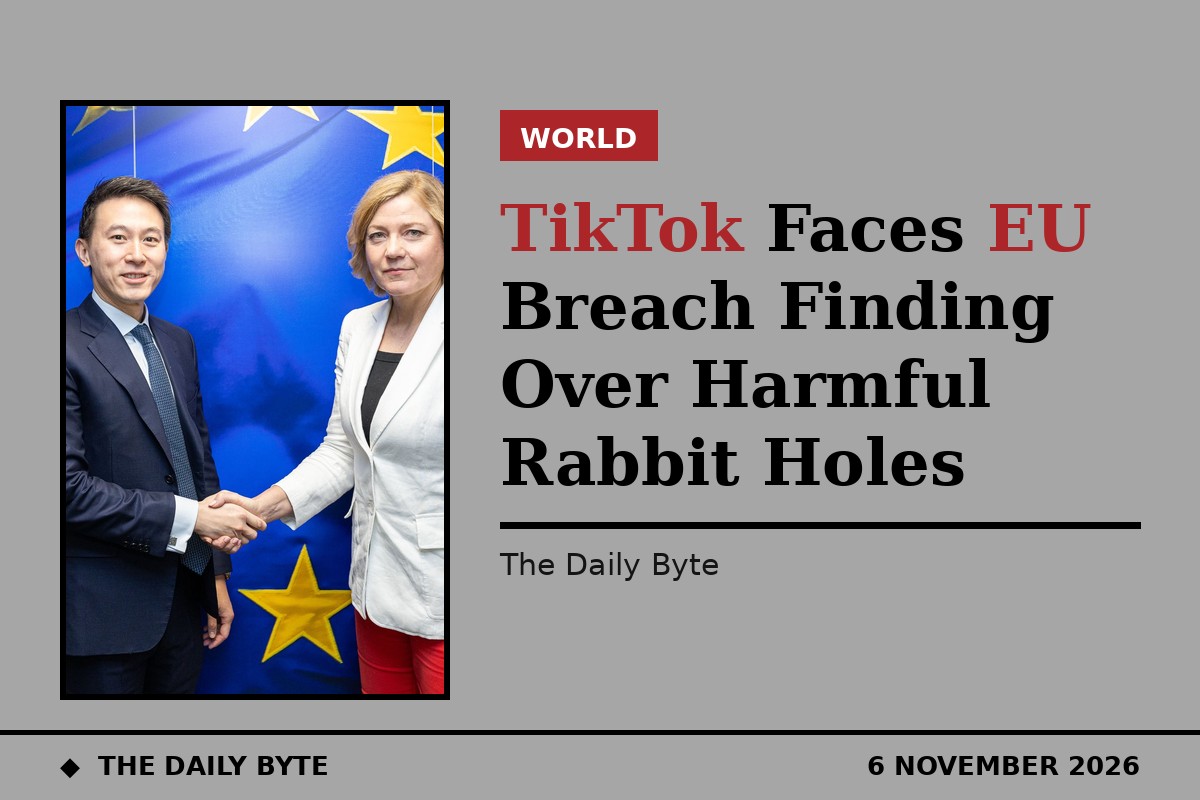
The European Commission has preliminarily found TikTok in breach of the European Union's Digital Services Act, concluding that the platform's For You feed can repeatedly expose users to content about sadness, isolation and body image. The findings were sent to the company on Friday 6 November and focus on how the recommendation system selects the videos each user sees by default.
According to the Commission, the feed can draw people into a pattern known as a rabbit hole, in which engagement with one type of content leads to a growing stream of similar videos that is hard to interrupt. The Commission says this repeated exposure can have a negative effect on mental health, particularly for minors and vulnerable adults. It considers that TikTok did not assess the risk thoroughly enough and that the safeguards it put in place do not work well enough in practice.
What the Commission wants changed
The findings cover two duties under the Digital Services Act: the obligation to assess risks and the obligation to mitigate them. The Commission's view is that TikTok identified the risk but did not analyse it deeply enough, and that measures such as the non-personalised feed and the feed refresh option have only a limited effect. It has suggested design changes, including giving more weight to a user's explicit preferences, such as tapping Not Interested, rather than to viewing time, and testing the recommendation system regularly.
These are preliminary findings and do not prejudge the outcome of the investigation. TikTok disputes the allegations and now has the chance to examine the Commission's file and reply in writing, while the European Board for Digital Services is consulted. If the Commission confirms its view in a final decision, it could impose a fine of up to 6% of the provider's total worldwide annual turnover. This is the third set of preliminary findings against TikTok this year, after findings in February on addictive design and in July on the protection of minors' accounts. Read the Agence Europe report and the PPC Land report for full details.