Tilcayo: first new wild cat species in 100 years
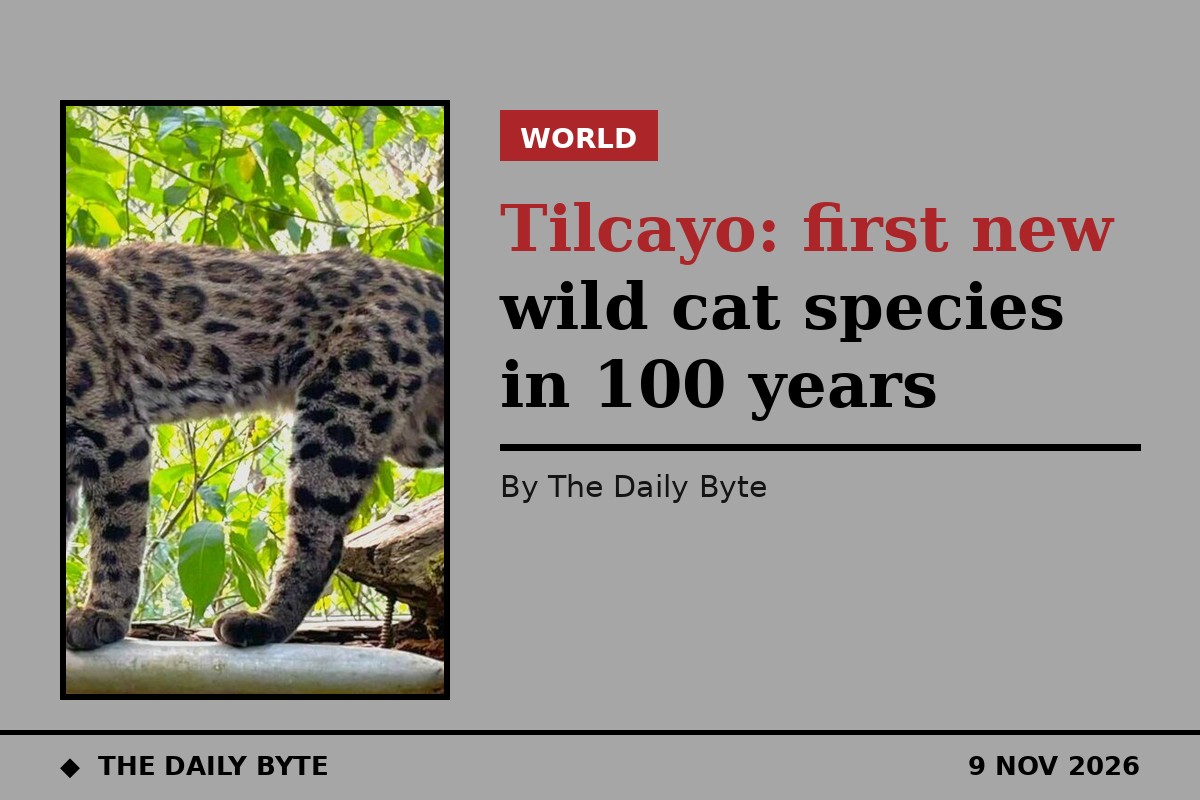
Scientists have formally described the first new living wild cat species in more than a century: the tilcayo (Leopardus tilcayo), a small spotted tiger cat from Bolivia's Yungas cloud forest.
The discovery was confirmed by a genomic study published in the journal Current Biology on 17 September 2026, and reported by the AFP news agency on 7 November. The last time a new living cat species was formally described was in 1923, when the Uruguayan pampas cat was classified as a distinct species.
A cat hiding in plain sight
The story of the tilcayo begins in 2017, when a local man in La Paz found an orphaned kitten in the Yungas forest and tried to keep it as a house cat, feeding it noodles, rice and eggs. When it became clear the animal needed specialist care, it was taken to the Senda Verde wildlife sanctuary near Coroico.
Bolivian biologist Paola Nogales-Ascarrunz, a National Geographic Explorer, was called in to examine the cat. At the time she believed it was an unusual-looking oncilla, a related tiger cat species. It was only in 2019, while she was preparing a booklet of Bolivian cat species, that she realised the animal looked distinct from the oncilla. The cat, a male nicknamed Tigrino, remains at Senda Verde today.
The formal identification came from a five-year international study co-led by Nogales-Ascarrunz and Jonas Lescroart, an evolutionary biologist at the University of Antwerp. The team compared complete genomes from 38 tiger cats, including museum specimens, and found that what had long been treated as a single species, Leopardus tigrinus, is in fact five genetically distinct species: L. tigrinus, L. guttulus, L. emiliae, L. pardinoides and L. tilcayo. The tilcayo's lineage split from its closest relatives about 1.4 million years ago.
Smaller than a house cat
The tilcayo measures about 46 centimetres from head to the base of its tail and weighs about 1.4 kilograms, making it smaller than the average house cat. Its fur is light brown with large, dark rosettes, and it has short, round ears, long whiskers and a scrunched-up face. It is so similar in appearance to other tiger cats that scientists describe it as a cryptic species, difficult to tell apart by looks alone.
So far the species has been genetically confirmed only in Bolivia, in the Yungas, the humid cloud forest on the eastern slopes of the Andes. The scientific description was based on two specimens: Tigrino, and a female that was treated for injuries at a Bolivian wildlife sanctuary and then released.
The name "tilcayo" was already used for the animal by local communities in the Yungas, and the researchers kept it as the scientific name. Aymara speakers have since suggested it may come from "t'ili kayu", meaning "tiny foot". Nogales-Ascarrunz called the discovery "a remarkable event, because a new wild cat species hasn't been described in 100 years".
A fragile future
The tilcayo has not yet been formally assessed by the International Union for Conservation of Nature, which currently lists the tiger cats it recognises as vulnerable. The study team shared its findings with the IUCN ahead of a planned reassessment of the group.
Researchers say the species faces threats from habitat loss, deforestation and mining in the Yungas, as well as hunting when the cats prey on domestic poultry and capture for the pet trade. Since the announcement, visitors from across Bolivia and beyond have flocked to Senda Verde hoping to see Tigrino, but the sanctuary keeps him out of public view because he is easily stressed.
Scientists say much more fieldwork is needed to learn where the tilcayo lives, how many there are and how it breeds, before its conservation status can be established. For now, the tiny cat that spent years hiding in plain sight has given researchers a new reason to protect the cloud forests where it lives.


