Trump says Gulf states asked him to hold off Iran strikes
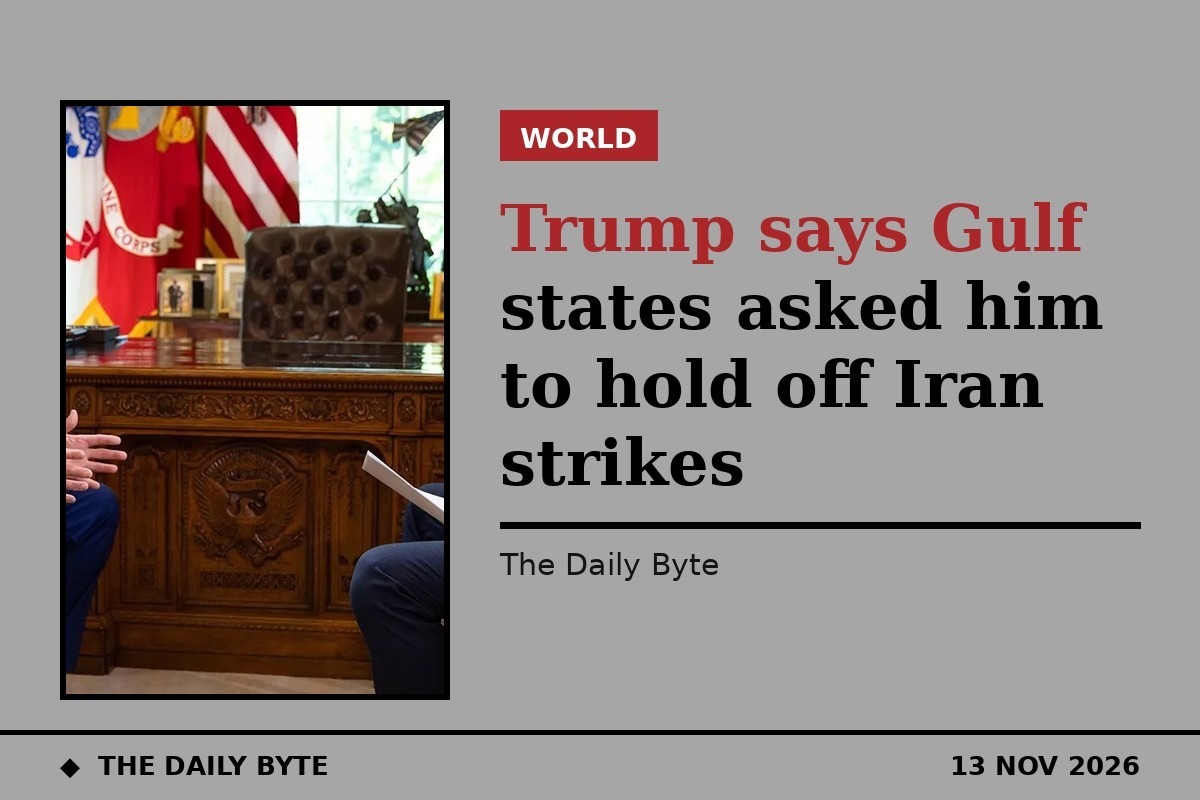
President Donald Trump says Saudi Arabia and four other Gulf states asked him not to resume large-scale strikes on Iran, and that he is holding off at their request.
Trump made the disclosure in an interview with broadcaster Stephen A. Smith at the White House, released on Thursday 12 November. "Saudi Arabia has asked me to please just let it be the way it is now for a while," he said, adding that Qatar, Kuwait, the United Arab Emirates and Bahrain "would much prefer the waiting period".
"I'm not sure I agree with it," Trump added, but said he was acting "at the request of the nations that I'm looking to protect". Asked whether he would have ordered further attacks without those requests, he replied: "Yes, I would."
Three days claim
Trump said he could end the war quickly if he chose to, claiming he could destroy Iran's energy infrastructure, bridges and manufacturing capacity within three days. "In one day, their energy is gone. In one day, their bridges are gone. And in one day, their manufacturing capability is gone," he said.
He also claimed that Iran's economy was in severe trouble, saying the country faced inflation of more than 300 percent and had not paid its guards, soldiers or police. Those figures are Trump's own claims and have not been independently verified.
Trump said the United States had already inflicted heavy damage on Iran and that Washington was maintaining economic and military pressure rather than launching a new large-scale campaign. "We've taken them largely out," he said.
Blockade continues
The remarks came as the United States continued its naval blockade of Iranian ports and its land operation aimed at cutting supply routes into Iran. Trump said on Truth Social that a deal with Iran was "not necessary" to end the war, indicating that the blockade and sanctions would remain in place.
Trump had previously said, after meeting Qatar's prime minister at the White House on Monday, that the Gulf states would prefer the current approach to continue, including the blockade. None of the five governments named in the interview has publicly confirmed or denied Trump's account of their request.
The interview also touched on the political cost of the war at home. Trump acknowledged that the conflict, which began in February, had hurt his Republican Party in this week's midterm elections, in which Democrats took control of both chambers of Congress, although he argued that voters were reacting mainly to higher fuel prices.
Tensions remain high in the Gulf
Hours after the interview was released, Iran's Revolutionary Guards said they had targeted a US early-warning radar in Bahrain, one of the five states Trump named, in retaliation for an alleged strike on a telecommunications tower in Iran. The United States and Bahrain had not immediately commented on that claim.
Shipping through the Strait of Hormuz also remains under threat, with Iran saying on Friday that a tanker carrying liquefied natural gas had struck a mine and exploded in the waterway. The competing claims and counter-claims underline how fragile the current lull in the conflict remains, even as Washington holds off on further large-scale strikes.
Sources: Trends MENA, Shafaqna, Al Jazeera via eGazette.