UK and EU Agree Brexit Reset on Food and Youth Travel
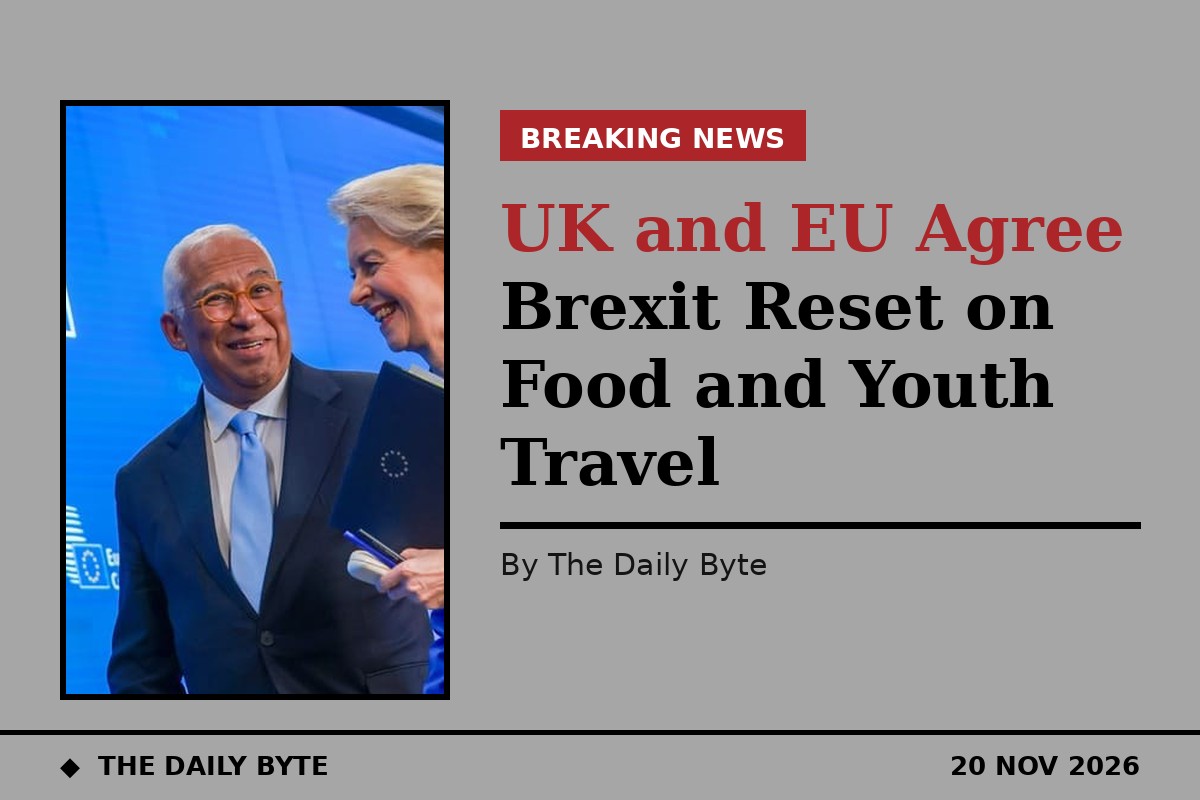
Britain and the European Union have agreed a package of deals easing food trade, opening youth travel and linking carbon markets, at only their second summit since Brexit, in Brussels on Friday 20 November 2026.
Prime Minister Andy Burnham met European Council President António Costa and European Commission President Ursula von der Leyen for just under an hour of talks before a wider plenary session brought British ministers and European commissioners together. Both sides described the meeting as a reset of a relationship worn down by a decade of separation since Britain voted to leave the bloc.
“Britain and Europe share values, interests and a global neighbourhood,” Burnham said ahead of the summit, adding that the agreements would help cut costs, keep prices down and give young people opportunities. “In a more dangerous world, we are stronger together.”
Food, youth mobility and carbon markets
The most significant agreement removes certificates and border controls on cross-border trade in animals, plants and related products, such as sausages and seeds. Britain has estimated the food and farm deal could add up to £5.1 billion a year to its economy, while Burnham has said the package as a whole could add a modest 0.4 per cent to Britain’s economy.
A second agreement links the emissions trading systems of Britain and the EU, which would exempt British and EU goods, such as steel, from each other’s border carbon levies. A third opens a youth mobility scheme allowing up to 100,000 young Britons a year to live, work and study in EU countries for up to three years, with the same number of young Europeans able to come to Britain. Britain had proposed letting in only 50,000, but agreed to 100,000, EU diplomats said.
Von der Leyen told the plenary session that the day marked a “turning point” in EU-UK relations, while Costa said: “We are turning our renewed partnership into concrete results for the benefits of our citizens and businesses, on both sides, and for the benefit of the security of our continent.”
Tuition fees still unresolved
Despite the agreements, final sign-off has been held back by the unresolved question of university tuition fees. EU countries want their students to be eligible for “home fees” at British universities, rather than the international rate, which is typically four times as much. Britain prefers to offer only “significantly reduced” fees, and the two sides have been given six months to resolve the issue before the whole deal can be signed.
Several EU countries, including Italy and Spain, balked at the compromise at a late-night meeting of ambassadors, feeling it gave too much ground to Britain. The timetable for when the food, youth mobility and emissions deals come into force will be set out in a joint statement, with talks on tuition fees continuing separately.
Another sensitive issue is Britain accepting EU rules. A key British demand is special status under the bloc’s “Made in Europe” rules, notably for cars. The EU has indicated it is willing to grant this, but only if Britain aligns with its policies restricting imports of Chinese electric vehicles. The final agreed wording said that, in sectors where cooperation had been agreed, Britain would “ensure outcomes consistent with relevant EU measures”.
A decade after the referendum
The summit had been postponed from July after the resignation of Burnham’s predecessor, Keir Starmer, and follows the first EU-UK summit in London on 19 May 2025. Burnham has said Britain should consider all options for its future relationship, including rejoining the EU, and said this week that “the Brexit we were given has not worked. We have lost more than we gained.” He has stressed that rejoining is far from imminent and would need the backing of British voters and the unanimous support of EU members.
Reform UK leader Nigel Farage said the debate about rejoining had restarted, while von der Leyen said she wanted “a summit of ambition and concrete results”. Beyond trade, the leaders discussed security and defence, support for Ukraine, and efforts to restrict irregular migration, against a backdrop reshaped by Russia’s full-scale invasion of Ukraine, US tariffs and war in Iran.