UK-France subsea power link IFA extension to 2050
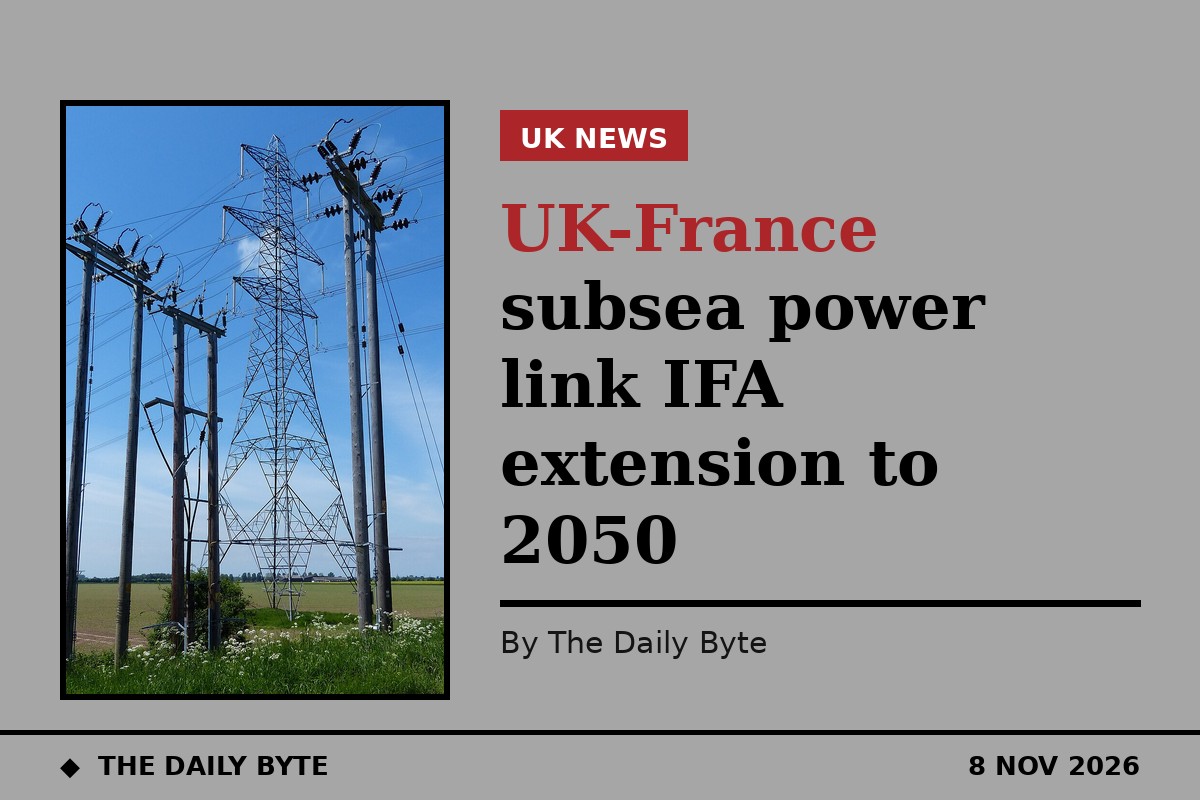
National Grid will invest up to £400 million to keep the electricity link between Britain and France running until at least 2050, the company announced on Thursday 29 October, as the connection marked 40 years in operation.
The link is the Interconnexion France-Angleterre, known as IFA. It is jointly owned by National Grid and the French grid operator RTE, and it is Britain's largest subsea electricity connection by capacity — big enough to carry enough power for around three million homes a year. Here is what the link is, how it works, and what the extension means.
What is the IFA?
IFA is a 2,000-megawatt high-voltage direct current (HVDC) link that began operating in 1986, and was one of the world's earliest HVDC subsea connections. It runs beneath the English Channel between Britain and France, carrying power in either direction depending on where it is needed and where it is cheapest.
Since the link began operating, net imports through it have totalled an estimated 409 terawatt-hours, according to National Grid. Electricity has typically flowed from France to Britain, but the link can also run in the opposite direction. In 2022, for example, electricity exported from the UK helped France during outages across its nuclear fleet, and power is regularly exported on the intraday market as demand patterns differ between the two countries.
What will the £400 million pay for?
The programme will upgrade technical equipment, buildings and facilities at the interconnector site, with the aim of keeping electricity flowing in both directions between the two countries for decades to come. National Grid said the work would strengthen energy security on either side of the Channel.
It is important to be clear about what the investment is not. This is a life extension for an existing cable, not a new route and not a capacity increase: the announcement did not set out a future capacity level, and no construction schedule was given. The £400 million figure is National Grid's planned investment; RTE's own investment in the shared link was not disclosed.
Why extend it now?
National Grid says the link will be needed for the next phase of electricity demand. Rebecca Sedler, president of National Grid Ventures in the UK, said: "I'm proud to announce this new investment which will extend the operation of IFA to meet the next phase of electricity demand, from AI to electric vehicles." She added: "For 40 years, our IFA interconnector has been sharing secure and affordable electricity between Great Britain and France."
Demand is rising as data centres, electric vehicles and heat pumps add load to the grid, while more wind and solar power makes flexible connections more valuable. When UK wind output is high, interconnectors also give Britain a route to export surplus power; National Grid said that as renewable generation grows, interconnectors can provide further opportunities to export electricity when UK supply exceeds domestic demand.
What does it mean for household bills?
National Grid argues that keeping the link open helps consumers directly. Britain can draw on cheaper French nuclear generation when wholesale power prices are high at home, which the company says helps lower prices for British consumers. National Grid analysis has found that its interconnectors have delivered £2 billion in net benefits to British consumers since 2023, compared with traditional gas generation, and the company says IFA alone has made payments of nearly £300 million to UK consumers since 2020.
The IFA programme sits inside a much larger spending plan: National Grid intends to invest at least £70 billion across the group over the five years to March 2031. Britain has 10 operational power links with France, Ireland, Northern Ireland, Denmark, Norway, Belgium and the Netherlands, and net imports through those links supplied around 9 per cent of Britain's electricity last year.
The wider picture
Interconnectors are becoming a bigger part of how Britain keeps the lights on. They let grid operators move power quickly to where demand is highest, a role that grows in importance as more wind and solar capacity joins the system. Extending IFA to 2050 preserves the oldest and largest of those links for another quarter of a century — provided the upgrade programme delivers on time and the equipment lasts as long as National Grid expects.