UK house prices fall at fastest rate since October 2023
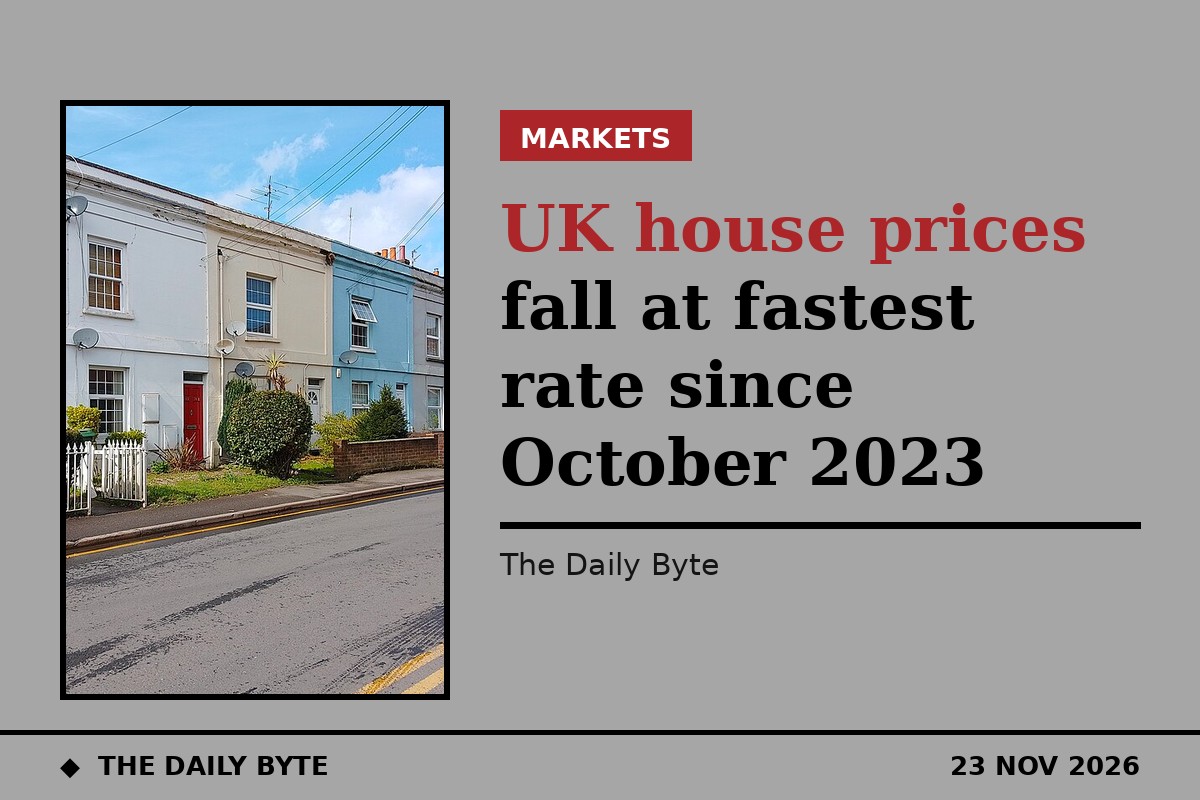
UK house prices fell at their fastest annual rate in three years in October 2026, according to the Lloyds House Price Index. The average UK home cost £296,285 in October, down 0.6% on the month and 1.2% lower than a year earlier — the biggest annual fall recorded by the index since October 2023.
The fall was sharper than markets had expected, with analysts looking for a decline of roughly 0.3%. It follows the Bank of England's decision to raise Bank Rate to 4% on 5 November, its first rise since August 2023, which has pushed mortgage rates higher and cooled demand from buyers.
What the figures show
The two main mortgage-based indices tell a similar story of a market losing momentum. Lloyds, formerly the Halifax index, recorded a 0.6% monthly fall in October and a 1.2% annual fall, with the average price slipping from £298,167 in September to £296,285. Nationwide recorded prices as flat on the month at £273,566, with annual growth of just 0.5% — the slowest since January 2024.
The regional picture is split. London recorded the sharpest annual fall, down 3.1% to an average of £524,892, and the South East and South West each fell 2.4% over the year. Northern markets held up better, with the North East up 2.4% and the North West up 1.9% on the year, and Northern Ireland the only UK nation still in positive annual growth.
The Land Registry's index, based on completed sales rather than mortgage approvals, still showed annual growth of 2.6% to an average of £272,000. But that series runs two months behind, covering September, so it has yet to reflect the autumn slowdown shown by the mortgage lenders.
Why prices are falling
Higher borrowing costs are the main drag. The Bank of England raised Bank Rate from 3.75% to 4% in November and signalled further rises may follow, and swap rates and gilt yields have climbed through the autumn. Surveyors are gloomy: the Royal Institution of Chartered Surveyors house price balance slipped to minus 36 in October from minus 34, its weakest outlook since July 2023, and surveyors expect values to ease by around 1% over the next year.
Buyer demand has stepped back. Zoopla data shows first-time buyer enquiries were 27% lower than a year earlier, sales agreed fell 10.5% in the week to 8 November, and homes for sale rose 8.6%. With more homes on the market and fewer buyers chasing them, sellers are having to accept lower prices.
What forecasters expect next
Savills revised its five-year forecast on 5 November, and now expects mainstream UK prices to fall 1.5% in 2027, completing a peak-to-trough decline of around 3% from the mid-2026 high, with no recovery until 2028. Nationwide had earlier predicted prices could rise by 2% to 4% in 2026, a view the autumn data has now overtaken.
For buyers, the picture is mixed. Lower prices help affordability, but higher mortgage rates offset much of the benefit. For sellers, the message from the surveys is that pricing realistically matters more than it has for three years. As of 23 November 2026, the October indices are the latest house price data available.
Frequently asked questions
How much is the average UK home worth? Lloyds puts the average at £296,285 in October 2026 and Nationwide at £273,566. The two indices use different samples and methods, so their averages differ.
Are house prices falling everywhere? No. London fell 3.1% over the year and the South East and South West each fell 2.4%, but the North East rose 2.4%, the North West 1.9%, and Northern Ireland remained in positive annual growth.
What do forecasters expect for 2027? Savills expects mainstream UK house prices to fall 1.5% in 2027, with no recovery until 2028.
Sources: Which? and Fox Davidson, reporting the Lloyds and Nationwide house price indices for October 2026.