UK Leads 10 Allies in Hunt for Russian Submarines
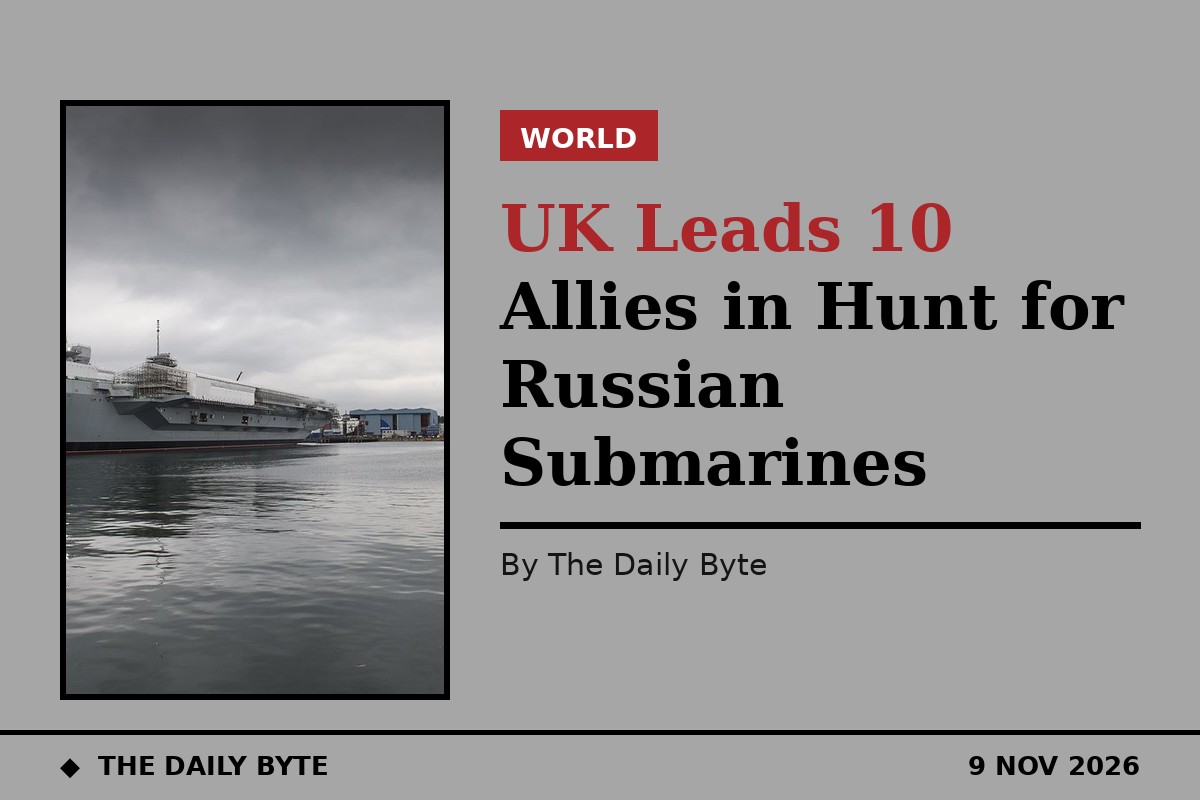
Britain and nine Northern European allies are preparing to step up joint military operations against Russian submarines suspected of spying on critical undersea infrastructure, according to the Financial Times.
The ten countries, Britain, Denmark, Estonia, Finland, Iceland, Latvia, Lithuania, the Netherlands, Norway and Sweden, will strengthen naval, air and land operations through the UK-led Joint Expeditionary Force, known as the JEF. Member states are expected to formalise the arrangement on Tuesday, 10 November, aboard the British aircraft carrier HMS Prince of Wales, expanding their existing military cooperation rather than forming a new alliance.
The move responds to growing concern over Russian naval activity near undersea communication cables, pipelines and shipping routes linking Europe, North America and Africa. Melting Arctic ice is opening new maritime routes, raising the strategic value of the North Atlantic and the Arctic, where many of the cables carrying internet traffic and financial data lie on the seabed.
Submarines tracked near cables
Britain's latest step follows an operation in April 2026, when its military tracked three Russian submarines near critical undersea cables and pipelines in the North Atlantic. The vessels included an Akula-class attack submarine and two specialised submarines belonging to Russia's Main Directorate of Deep-Sea Research, known as GUGI.
British Defence Secretary John Healey said Royal Navy warships and RAF surveillance aircraft monitored the submarines for more than a month, warning that the specialised vessels could survey underwater infrastructure and potentially sabotage it during a conflict. Addressing President Vladimir Putin, Healey said: "We see you, we see your activity over our cables and pipelines."
A Reuters investigation published in September reported that Britain, Norway and the United States had also confronted Russian deep-sea vessels near Norway's Svalbard archipelago. Two Western officials said the Russian vessels were testing technology designed to disable undersea communication cables without leaving identifiable evidence. Allied forces disrupted the exercise, forcing the Russian vessels to withdraw before completing the operation, although no undersea cables were damaged.
Most dangerous period, says defence chief
Britain's Chief of the Defence Staff, Air Chief Marshal Sir Richard Knighton, told the Financial Times that the current security environment was the most dangerous period of his adult life, and acknowledged that the UK needed to "catch up with our European allies" in responding to Russia.
An inquiry conducted in October also uncovered 17 Russian fishing boats that carried out more than 500 erratic or unusual movements close to submarine cable lines connecting the UK to continental Europe and America, raising further concern about reconnaissance of the cables.
The JEF already coordinates military readiness across Northern Europe, bringing together the UK, the Netherlands, the Nordic countries and the Baltic states. The agreement due to be signed on HMS Prince of Wales will deepen that cooperation, with the allies sharing surveillance and stepping up patrols intended to track and deter Russian submarine activity across the North Atlantic, the Arctic and the Baltic Sea.


