What Is the Sentencing Act 2026?
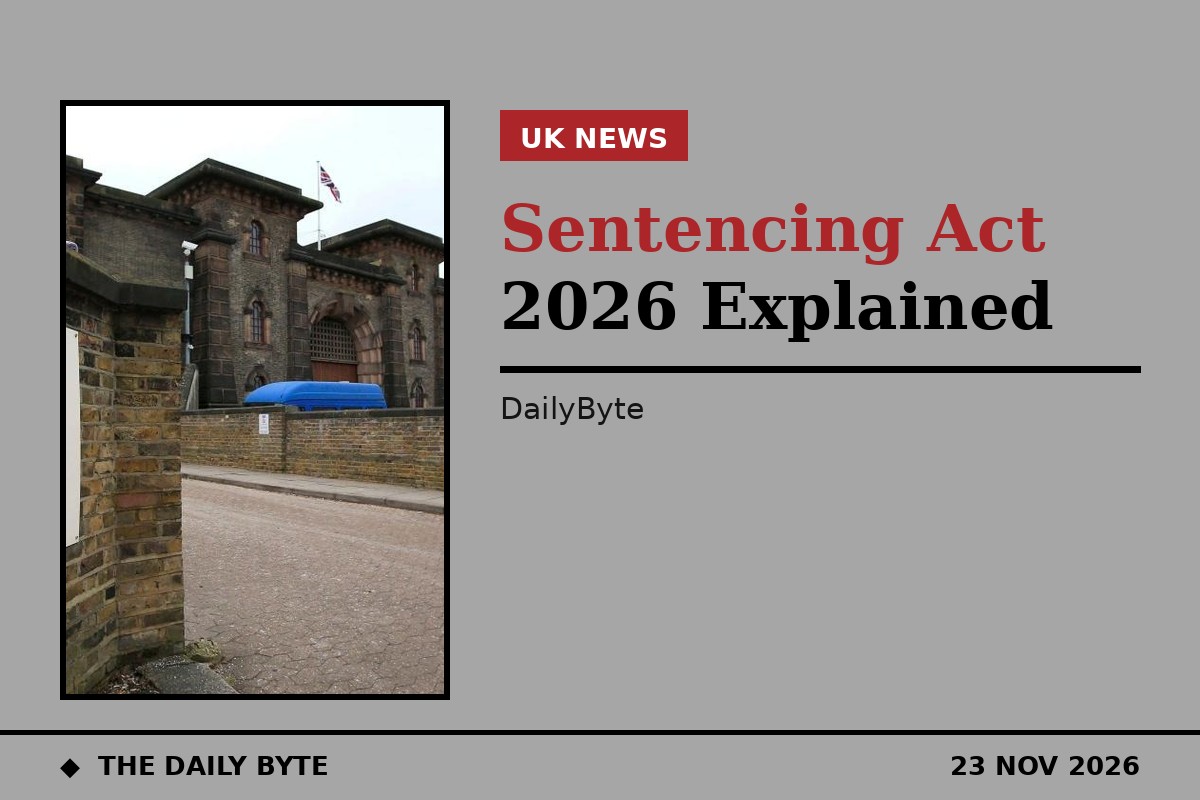
The Sentencing Act 2026 is the law that changed how and when prisoners are released in England and Wales. It received Royal Assent on 22 January 2026, and its central reform, a new earned progression model for standard determinate sentences, came into force on 1 October 2026. Under the new model, release is no longer automatic at a fixed point in a sentence: prisoners must earn earlier release through good behaviour, and those who behave badly can be kept in prison for longer, in some cases for the whole of their sentence.
The Act was passed in response to a prison capacity crisis, with jails in England and Wales close to full. It is the latest in a series of changes to early release since 2022, and it replaces the emergency measures that came before it with a permanent system. This article explains what the Sentencing Act 2026 does, how the progression model works, who is excluded from earlier release, and what the timetable for releases looks like.
What is the Sentencing Act 2026?
The Sentencing Act 2026 is an Act of the UK Parliament that reforms sentencing and release arrangements in England and Wales. It was introduced as the Sentencing Bill in September 2025 and received Royal Assent on 22 January 2026. The Act covers the threshold for immediate short custodial sentences, the point at which prisoners are released from standard determinate sentences, the requirements courts can attach to community orders and suspended sentence orders, and the governance of the Sentencing Council.
Its best-known change is the progression model, which replaces automatic release for prisoners serving standard determinate sentences. A standard determinate sentence is a fixed-term prison sentence with a set release date, as opposed to a life sentence or an extended determinate sentence, where release depends on a Parole Board decision. Most people in prison in England and Wales are serving standard determinate sentences, so the change affects a large share of the prison population.
The Act applies in England and Wales only. Scotland and Northern Ireland have their own sentencing and release arrangements, and the changes described here do not apply there.
What is the progression model?
The progression model is a new three-stage structure for a standard determinate sentence. The three stages are custody, a period of intensive supervision in the community, and a final licence stage. The model was designed to replace automatic release with earned progression: release is no longer guaranteed at a fixed point, and behaviour in prison determines when a prisoner becomes eligible to leave custody.
Under the model, the earliest point at which a prisoner can be released depends on the type of sentence. For most standard determinate sentences, where the automatic release point was previously 40 or 50 per cent of the sentence, the earliest release point is now one third of the sentence. For more serious standard determinate sentences, known as SDS+, where the automatic release point was two thirds, the earliest release point is now one half of the sentence. The Government's own factsheet describes this as a minimum release point of one third for standard determinate sentences and 50 per cent for the more serious cases.
The crucial difference from the old system is that earlier release is not automatic. It is conditional on the prisoner not behaving badly in custody. If an offender seriously breaches prison rules, an independent adjudicator may impose additional custodial days, delaying release, and the number of days that can be added for each adjudication has been doubled. The Government has said that prisoners who are violent or break prison rules can be kept in custody for longer and, in some circumstances, for the whole of their sentence.
After release, the prisoner enters a period of intensive supervision in the community. During this stage, probation can impose restrictive conditions, including bans on driving, attending public events such as sporting events, and entering pubs, clubs and bars, and can drug-test offenders on licence. In the final stage, the licence stage, the highest-risk offenders continue to be supervised for the final third of their sentence. All offenders remain on licence until the end of their sentence, and breaching licence conditions can lead to recall to prison.
| Sentence type | Old automatic release point | Earliest release under the progression model |
|---|---|---|
| Standard determinate sentence (SDS) | 40% or 50% of the sentence | One third of the sentence |
| Standard determinate sentence plus (SDS+) | Two thirds of the sentence | One half of the sentence |
| Extended determinate sentence (EDS) | At least two thirds, by Parole Board decision | Unchanged |
| Life sentence | Parole Board decision | Unchanged |
Who is excluded from earlier release?
Not everyone serving a prison sentence can benefit from the earlier release points. The most dangerous offenders are excluded entirely. Prisoners serving life sentences, extended determinate sentences and sentences for offenders of particular concern remain subject to the existing arrangements, with release decided by the Parole Board. They will not be released any earlier than they are now, and those on extended determinate sentences can only be released after serving at least two thirds of their custodial term when the Parole Board deems it safe.
Following a review in the summer of 2026, the Government also excluded a series of specific offences from the new arrangements. Rape, serious child sexual offences and certain grooming offences are barred from the progression model, along with unlawful killing and indecent assault. The Government has said that more than 18,000 offenders serving more serious sentences are consequently excluded from the early-release provisions, and that prisoners convicted of those offences will continue to follow their existing release rules.
The exclusions were added after public objections, including from the widow of murdered police constable Andrew Harper, who objected that two of her husband's killers would become eligible for earlier release under the new rules. The Government also announced a 10 million pound package of support for victims alongside the review's conclusions, and said that rape and serious child sex offenders would face up to 12 months of GPS monitoring after their full sentence ends.
What happens after a prisoner is released?
Release under the progression model does not mean a sentence is over. Prisoners who are released remain subject to licence conditions and must continue serving the remainder of their sentence in the community under supervision. If they breach their licence conditions, probation can recall them to prison.
There is a presumption that prisoners released under the scheme will be fitted with electronic monitoring equipment, including GPS tags, according to Government officials, and some of the highest-risk offenders will face tighter supervision after leaving custody. The Act also introduces restriction zones for the most serious sexual and violent offenders, enforced by electronic monitoring, which can limit where a person can travel, which places they can visit and whom they can contact.
The recall system has also changed. The Act introduces a new 56-day fixed-term recall, replacing the old 14-day and 28-day recall periods for most standard determinate sentence offenders. Victims who are eligible and have opted into the Victim Contact Scheme are notified of an offender's release, in line with existing practice, and can make representations about licence conditions such as exclusion zones and no-contact orders.
What else did the Sentencing Act 2026 change?
The Act made several other changes alongside the progression model. It introduced a presumption against immediate prison sentences of 12 months or less, meaning courts are expected to consider alternatives to short custodial terms. It also gave courts three new requirements that can be attached to community orders and suspended sentence orders, allowing courts to restrict an offender from driving for a specified period, attending certain public events, or entering pubs, bars or other specified drinking establishments.
The Act also changed the governance of the Sentencing Council, the body that produces sentencing guidelines for courts in England and Wales. These changes took effect alongside the release reforms, with the main package coming into force on 1 October 2026.
Why was the Sentencing Act 2026 passed?
The Act was passed because the prison system in England and Wales was running out of space. As at 30 June 2026 there were 85,858 prisoners in England and Wales, and the Government has described the Sentencing Act as part of its response to the prison capacity crisis, intended to avoid a breakdown of law and order by addressing the expected shortfall in prison places against growing demand.
Early release has changed repeatedly since 2022, almost entirely because of sustained pressure on prison capacity. Emergency measures included the End of Custody Supervised Licence scheme launched in October 2023, which released some prisoners up to 18 days early, and the SDS40 scheme, which brought forward the release point for some standard determinate sentence prisoners from half of their sentence to 40 per cent. The Sentencing Act replaces those emergency arrangements with a permanent model, and the Government has presented it as a more sustainable solution than repeated short-term fixes.
The phased release of existing prisoners is also a matter of capacity management. Rather than releasing a large number of prisoners at once, the Government is bringing the new law into force for different cohorts in stages, based on sentence length, so that probation services and other agencies can manage the releases in an orderly way.
What is the timetable for releases?
The progression model came into force on 1 October 2026. For prisoners already in custody, release dates are being recalculated, and where they are eligible, releases are being phased through a series of implementation tranches running from October 2026 to June 2027. There are ten tranches in total, each bringing the new law into force for a different cohort of offenders based on sentence length.
The first tranche took place on 1 October 2026 and the second on 13 October 2026. A third phase began on Tuesday, 10 November 2026, when around 650 more prisoners were due to leave jail early. That group included prisoners serving sentences of more than 882 days and fewer than 1,163 days, covering custodial terms of roughly two years and five months to three years and two months. Two earlier rounds in October released around 650 prisoners each, serving shorter sentences.
The Government expects approximately 5,000 prisoners to be released early over the next year under the revised arrangements, with the phased programme continuing into June 2027 and groups serving progressively longer sentences becoming eligible at different stages. The Ministry of Justice has published modelled estimates of the number of prisoners expected to be released on the first day of each tranche, and has stressed that these are estimates rather than precise numbers, because eligibility can change if prisoners are sentenced, face further proceedings or receive added days for bad behaviour.
What happened during the review in summer 2026?
The rollout of the progression model was paused shortly before it was due to start. On 23 July 2026, the Prime Minister announced a review of the model, triggered in large part by public objections to the prospect of earlier release for some offenders convicted of serious crimes. The review concluded on 4 August 2026, and the Government announced that rape, serious child sexual and grooming offences would be barred from the progression model, and that the rollout would be delayed to 1 October 2026, with a staggered release timetable for existing prisoners running through to 8 June 2027.
The review also confirmed that offenders who are violent or break prison rules can now serve 100 per cent of their sentence, and that the enhanced package of support for victims would be provided. The changes announced in August 2026 are the ones that took effect on 1 October, and they are the reason the exclusions listed above are part of the law as it now operates.
Frequently asked questions
What is the Sentencing Act 2026? It is the law that introduced an earned progression model for standard determinate sentences in England and Wales, replacing automatic release with release that must be earned through good behaviour. It received Royal Assent on 22 January 2026.
When did the progression model start? The progression model came into force on 1 October 2026. Releases of prisoners already in custody are phased through ten tranches running to June 2027.
How early can a prisoner be released under the Act? For most standard determinate sentences, the earliest release point is one third of the sentence. For more serious standard determinate sentences, it is one half. Bad behaviour in prison can delay release, and in some cases a prisoner can serve the whole sentence.
Who cannot be released early? Prisoners serving life sentences or extended determinate sentences are excluded, as are people convicted of rape, serious child sexual offences, grooming offences, unlawful killing and indecent assault. More than 18,000 offenders are excluded in total.
Does early release mean the sentence is cancelled? No. Released prisoners remain on licence until the end of their sentence, must comply with licence conditions, can be fitted with GPS tags, and can be recalled to prison if they breach those conditions.
This article explains the law as it stands in England and Wales on 23 November 2026. It is general information, not legal advice. Anyone affected by a specific case should speak to a solicitor. Sources: GOV.UK: Sentencing Bill progression measures factsheet; GOV.UK: Rape, serious child sex and grooming offences barred from sentencing changes; UK Parliament: Written answer on the Sentencing Act 2026; Clinks: Sentencing Act 2026, next stage of implementation.