Erasmus+ UK Return: What It Means for Students
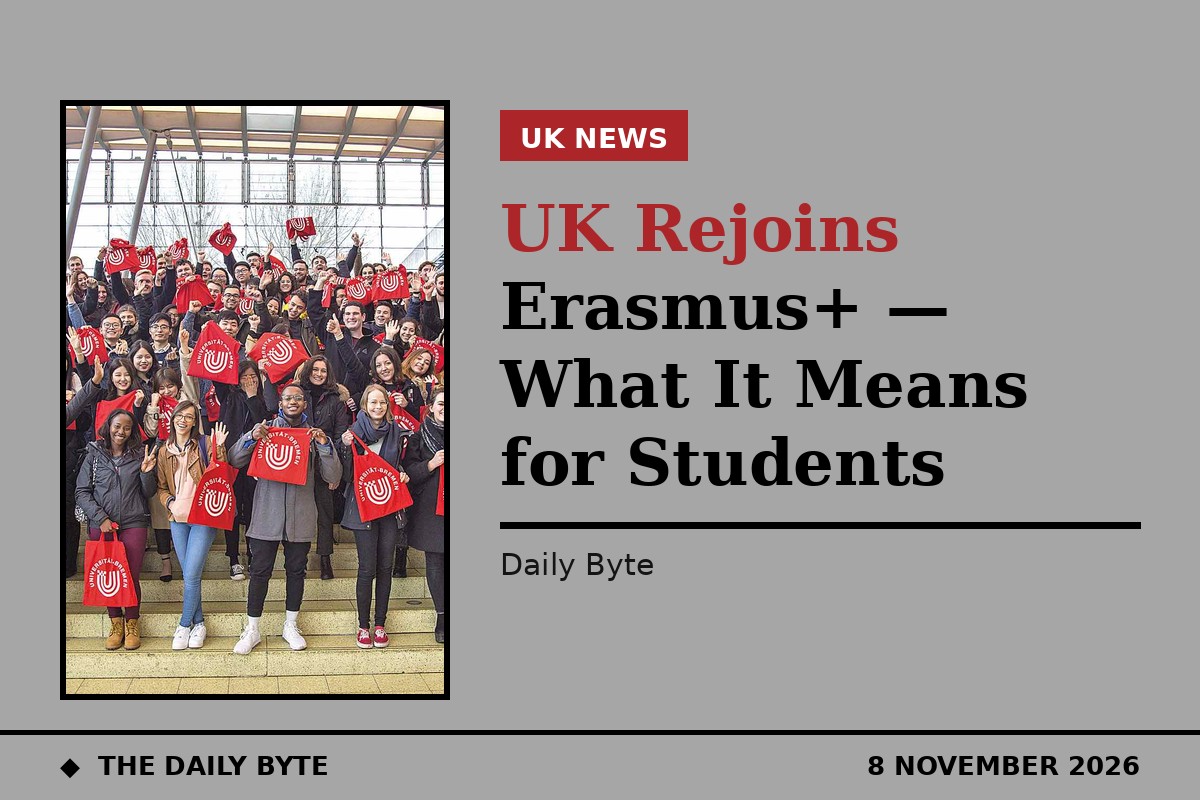
The UK will rejoin the Erasmus+ student-exchange scheme from January 2027, Culture Secretary Lisa Nandy announced on Remembrance Sunday, 8 November 2026. Up to £400 million will be routed through the British Council to support schools, universities, youth groups and sports teams taking part. It means British students and young people will once again be able to study, train and gain work experience across the European Union, six years after the UK left the scheme.
The announcement was made in a government statement issued over the Remembrance Sunday weekend, with Ms Nandy saying Erasmus+ would “give a new generation the chance to build connections across Europe”. Applications are expected to open later in November, according to reports of the announcement. This explainer sets out what Erasmus+ is, why the UK left, what changes in January, and what students should do next.
What is Erasmus+?
Erasmus+ is the European Union’s flagship exchange programme. It funds students, trainees, apprentices, teachers, youth workers and sports staff to study, train, volunteer or gain work experience in another participating country, usually for a term or a year, with grants towards travel and living costs. The programme began as Erasmus in 1987 and became Erasmus+ in 2014, when it was widened beyond higher education to cover vocational training, youth exchanges and sport.
For students, the practical point is simple: instead of arranging and funding a year abroad alone, you apply through your school, college or university, and the programme helps pay for it. For institutions, it funds partnerships with counterparts abroad, joint courses and staff exchanges. More than 30 countries take part, including all EU member states and several non-EU countries that pay to join.
Why did the UK leave Erasmus+?
The UK left Erasmus+ at the end of 2020 as part of the Brexit deal negotiated under Boris Johnson. The government of the day said the scheme was too expensive and replaced it with a domestic programme, the Turing Scheme, launched in 2021.
The Turing Scheme funded UK students to study and work abroad, including outside Europe, but it worked in one direction only: it did not fund students from other countries to come to the UK, and it did not cover the full range of youth and sport exchanges that Erasmus+ provides. Universities and student groups argued for years that the loss of two-way exchange made the UK a less attractive partner and cut off a route that had brought large numbers of European students to British campuses.
What changes from January 2027?
From January, UK organisations can take part in Erasmus+ again on the same basis as other participating countries. The government says up to £400 million will flow through the British Council, which will administer the UK’s participation, supporting schools, universities, youth groups and sports teams.
| Question | What we know on 8 November 2026 |
|---|---|
| When does the UK rejoin? | From January 2027 |
| Who runs it in the UK? | The British Council, with up to £400 million in funding |
| Who can take part? | Schools, universities, youth groups and sports teams |
| When do applications open? | Expected later in November 2026 |
| What happened to the Turing Scheme? | Scrapped when the new Erasmus+ deal was announced |
| Travel help for disadvantaged young people? | Reports say disadvantaged 18-year-olds may get free rail travel across Europe |
The precise eligibility rules, grant rates and application deadlines have not yet been published in full. Students and institutions should check the British Council’s Erasmus+ pages and GOV.UK for the official guidance as it appears, because details can change between announcement and launch.
How much will it cost?
The headline figure is the up-to-£400 million to be routed through the British Council. The government also says it secured a 30 per cent discount on the 2027 participation costs, which Labour estimates will save about £240 million. Critics have disputed the figures, with opponents highlighting larger cost estimates for the overall deal.
What is not in dispute is that participation in Erasmus+ costs the UK a fee, paid to the EU, in the same way as other non-EU participating countries. The government’s argument is that the exchange, skills and soft-power benefits outweigh that fee; opponents argue the money could be spent better at home. That is a political judgement, and the numbers will become clearer when the full funding breakdown is published.
Why was the announcement controversial?
The row is about timing and wording, not the policy itself. In the statement announcing the return, Ms Nandy linked the scheme to Remembrance Sunday, saying: “As we remember the immense courage of those who served our country, we honour them by building the best opportunities for the next generation through closeness and collaboration with our allies.”
Conservative critics called the link tone-deaf and accused the minister of using the commemorations to promote the government’s reset in relations with the EU. Speaking on Sky News’ Sunday Morning programme, Ms Nandy rejected the criticism, saying: “I strongly, strongly disagree, and it’s Remembrance Sunday, it’s not a time for politicking.” She added that the announcement was about widening opportunities for young people.
What about the under-30 youth mobility scheme?
The Erasmus+ return is separate from a wider youth mobility deal that is still being negotiated. UK and EU negotiators are working on a two-way scheme that would let under-30s live, work, study and travel on both sides of the Channel, ahead of a summit on 20 November. Fee parity and quotas remain disputed, and ministers have warned that large reciprocal access could become an electoral issue. Nothing about that scheme has been finalised yet, and it should not be confused with Erasmus+, which is now confirmed.
What should students do next?
If you are a student, or a parent of one, the practical steps are straightforward. First, ask your school, college or university whether it plans to take part in Erasmus+ from January, and when its own application window opens. Second, watch the British Council’s Erasmus+ pages, where the official guidance, deadlines and grant details will be published. Third, remember that this is an announcement, not the full rulebook: eligibility, funding rates and deadlines will be set out in the official guidance, so check the official pages before making plans or spending money. Rules can change, and this article is a summary of what has been announced, not personal advice.
Frequently asked questions
When does the UK rejoin Erasmus+? From January 2027. Applications are expected to open later in November 2026.
Who can take part? Schools, universities, youth groups and sports teams, through the British Council. Exact eligibility will be set out in the official guidance.
What happened to the Turing Scheme? The Turing Scheme was scrapped when the government announced the new Erasmus+ deal.
Will EU students be able to study in the UK again? Yes, in principle. Rejoining restores the two-way exchange, so students from other participating countries can again come to the UK under the scheme, just as UK students can go abroad.
Does this affect the under-30 youth mobility scheme? No. That is a separate deal still being negotiated ahead of a summit on 20 November 2026.
Sources: The Gazette (8 November 2026) and Particle News (8 November 2026). Check the British Council and GOV.UK for the official guidance, which may change.