Vulcan returns to flight with Amazon Leo launch
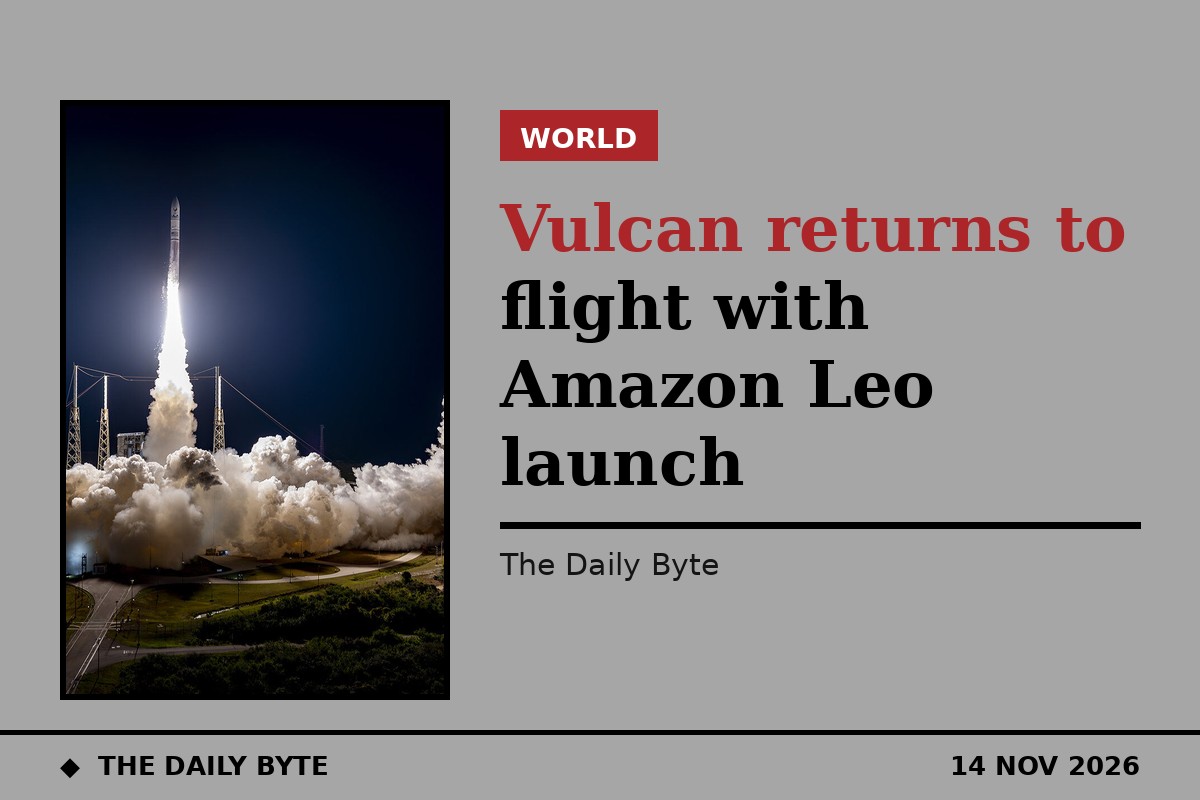
United Launch Alliance's Vulcan rocket is due to return to flight today, Saturday 14 November, carrying 40 Amazon Leo broadband satellites into low Earth orbit from Cape Canaveral in Florida. The launch window opens at 12.32pm Eastern time, a day after Friday's countdown was scrubbed about three hours before lift-off.
The mission, known as Amazon Leo 1, is the first Vulcan flight since a booster anomaly on 12 February grounded the rocket. The 215-foot-tall Vulcan, fitted with six solid rocket boosters for extra power, will fly a north-easterly path over the Atlantic before releasing its satellites. ULA said the rocket and the spacecraft remained healthy after Friday's scrub.
Why Friday's launch was scrubbed
Friday's countdown was halted while fuelling was under way after a power interruption at the Air Liquide gaseous nitrogen plant that supplies the launch site, which affected the facility's high-pressure pumps. The launch was then retargeted for Saturday, with a 29-minute window running to 1.01pm Eastern time. Forecasters gave a 95 percent chance of favourable weather for the new attempt, with broken cloud and no rain expected at the site.
The rocket was assembled inside Amazon's new vertical integration facility south of the launch pad, then carried about 2.7 miles by rail to Space Launch Complex 41 for the countdown. It is the first time Vulcan has been used to deliver a batch of Amazon Leo satellites to orbit.
Amazon's rival to Starlink
Amazon Leo, formerly known as Project Kuiper, is a mega-constellation of satellites in low Earth orbit designed to offer broadband internet access around the world. The full network is planned to hold 3,276 satellites across 98 orbital planes, in layers at 590, 610 and 630 kilometres, and is managed by Kuiper Systems, a subsidiary of Amazon. It is intended as a direct competitor to SpaceX's Starlink service, bringing fast internet to communities that are unserved or underserved today.
The Vulcan Centaur is a two-stage, heavy-lift rocket developed by ULA, a joint venture of Boeing and Lockheed Martin, principally to meet the US government's National Security Space Launch programme. It is set to replace the Atlas V and Delta IV Heavy rockets as those older launchers retire.
Reporting by Florida Today and Space Launch Schedule confirmed the scrub, the new launch time and the mission details.