UN Rights Chief Urges Imran Khan's Release
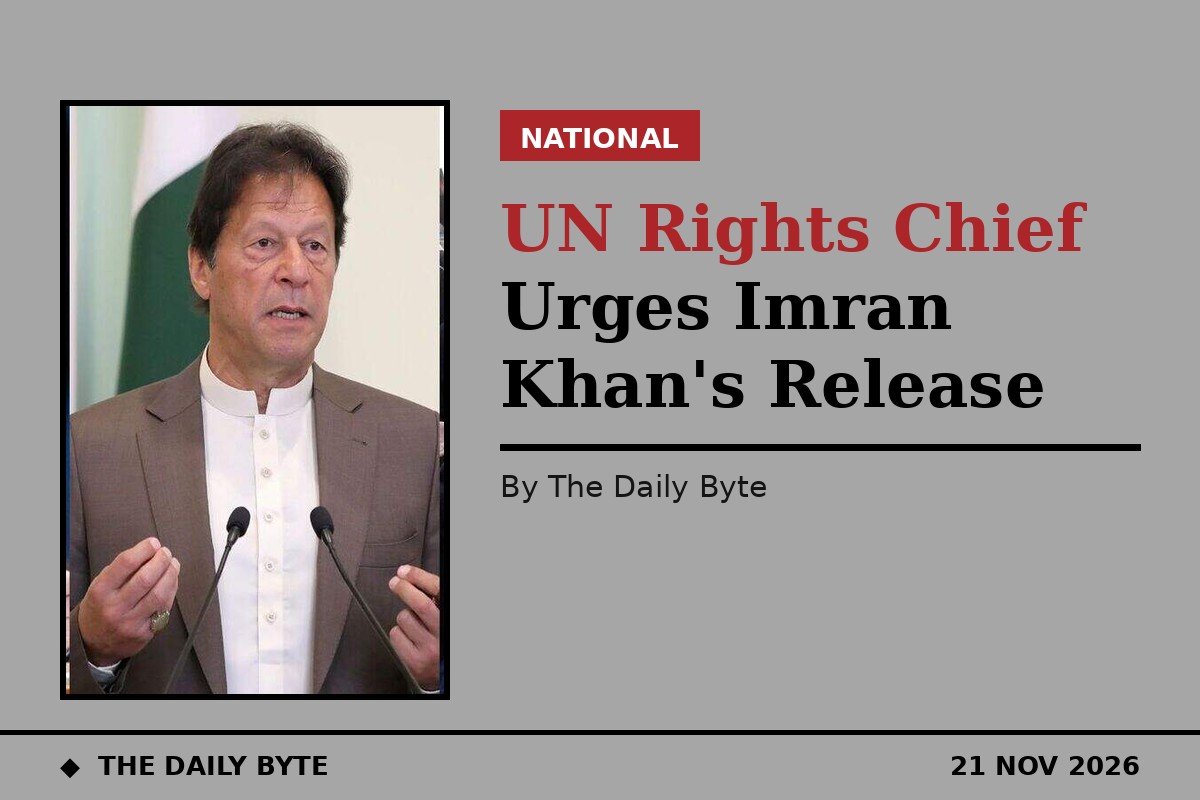
United Nations human rights chief Volker Turk has called for the release of former prime minister Imran Khan, urging Pakistani authorities to ensure his proper treatment and take steps to ease the political tensions surrounding his detention.
Turk made the appeal in an interview with CNN's Christiane Amanpour on Thursday, 19 November. "I call for [Imran Khan's] release. I call for his proper treatment, and I actually call for de-escalation," he said. "We need to diffuse the political tensions that are around this case, which means that a confidence-building measure between the opposition and the government could be his immediate release."
Asked what the UN could do to help, Turk said the organisation needed to continue engaging with Pakistani authorities and stressed that they must respect international legal standards governing detention. He said confidence-building measures should include allowing family visits, ensuring access to lawyers and medical assistance, and releasing people who should not be in prison.
A broader warning on detentions
Turk placed the case in a wider context, saying it was not only about one prominent prisoner. "There is a broader context, I have to say, because it's not just one very prominent case," he said, adding that human rights defenders, journalists and people in the political opposition were also facing arbitrary detention.
"It's absolutely clear, as I said, we need de-escalation, we need proper dialogue, and we need to respect international legal standards that apply to people who are media workers, who are human rights defenders, or who are in the political opposition," he said.
Health concerns at the centre of the appeal
Turk's appeal came days after Khan urged the country's top judges to ensure the implementation of Supreme Court orders concerning his medical treatment and prison conditions. In an open letter issued from Adiala Jail on 16 November, Khan warned that his health was deteriorating and that he could reach a point from which he might not "return alive". He said he faced a potentially fatal medical emergency and that his wife, Bushra Bibi, risked permanent blindness behind bars.
Amnesty International and its South Asia Regional Office have separately urged Pakistani authorities to provide adequate healthcare to Khan and Bushra Bibi, restore their regular access to family members and lawyers, and end what the organisation described as the political persecution of Khan's family. Amnesty said Khan had not been allowed to meet his family since December 2025, except for two meetings with his sister in August 2026, and had been denied telephone contact with his sons since March 2026.
The organisation said the 74-year-old had been kept in solitary confinement and increasingly isolated from human contact, affecting his mental and physical health, and had experienced severe blood pressure problems. It said his family had reported that he was denied access to independent doctors despite an August order by the Supreme Court directing that he be taken to a private hospital. Bushra Bibi, Amnesty said, was suffering from an eye condition that could lead to the loss of her eyesight, and had been denied adequate medical care.
The cases keeping Khan in jail
Khan and Bushra Bibi remain incarcerated at Rawalpindi's Adiala Jail. They were sentenced to 17 years in prison on 20 December 2025 in the Toshakhana-II case, which concerns allegations that they unlawfully retained a Bulgari jewellery set gifted by the Saudi crown prince during an official visit to Saudi Arabia.
Khan has been in custody since August 2023 and is serving a sentence in a 190 million pound corruption case. He also faces pending trials under the Anti-Terrorism Act in connection with the May 9, 2023, protests. Amnesty also expressed concern over the detention of members of Khan's family, saying three of his sisters were detained on 20 and 21 September under Section 3 of the Maintenance of Public Order Ordinance, 1960, over a planned march on Islamabad by his party, the Pakistan Tehreek-i-Insaf. Two of his sisters have since been released, while Aleema Khan remains in detention at Kot Lakhpat prison in Lahore.
Turk cannot order a release; as UN High Commissioner for Human Rights he can only call for one. The Pakistani government maintains that Khan is receiving appropriate medical care. Whether his public appeal changes anything on the ground remains to be seen.