UN Security Council to Meet on Middle East Crisis
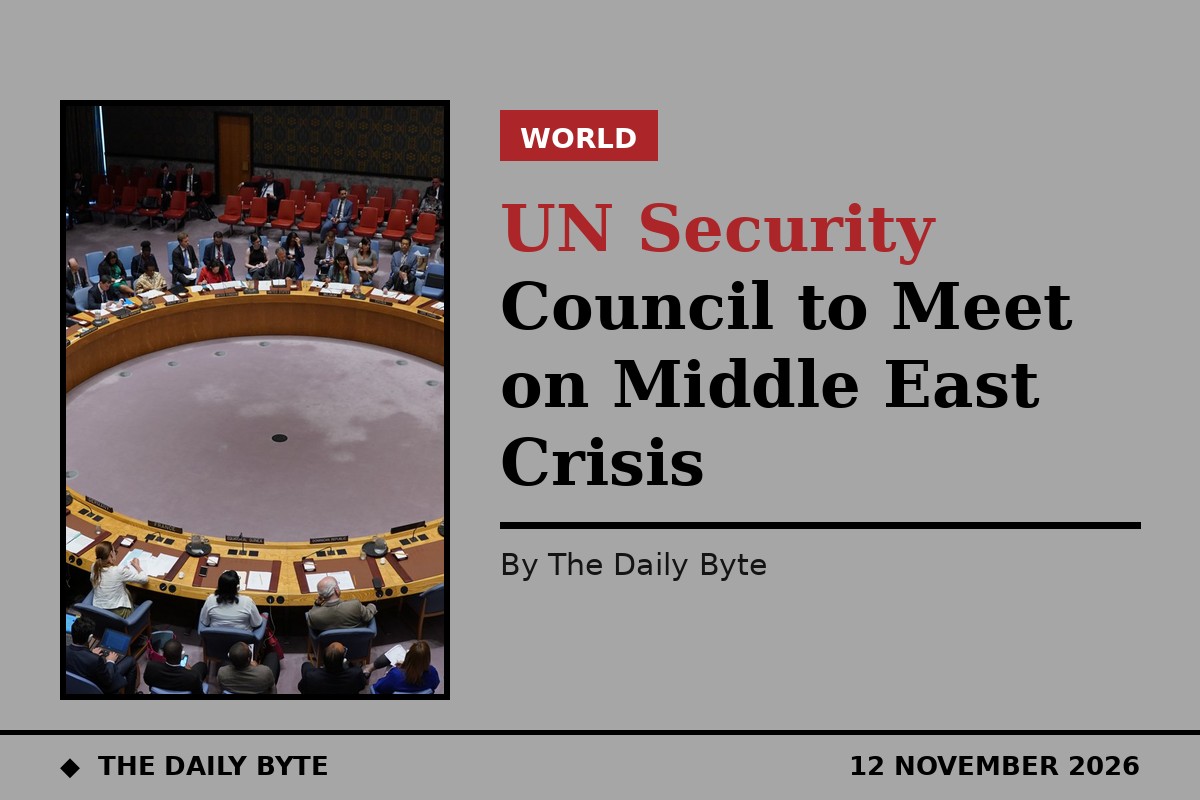
Bahrain has formally requested an urgent meeting of the United Nations Security Council on the situation in the Middle East, Al Jazeera reported early on Thursday, 12 November. The session is scheduled for Thursday at 3.10pm New York time, corresponding to 8.10pm GMT.
The meeting comes as tensions across the Gulf remain high, with fighting between Saudi Arabia and the Houthis in Yemen, repeated incidents involving shipping in the Strait of Hormuz, and a deadlock in negotiations between Iran and the United States. The United Nations has listed the session in its broadcast schedule as the 10270th meeting of the Security Council, under the agenda item "The situation in the Middle East".
Who is expected to brief the council
According to Al Jazeera, the independent research organisation Security Council Report, which monitors the council's proceedings, has indicated that formal briefings are expected from Gulf Cooperation Council Secretary-General Jasem Mohamed AlBudaiwi and a senior representative from the United Nations Department of Political and Peacebuilding Affairs.
United Nations broadcast schedules indicate that no speakers have yet been formally registered or included on the roster for the session. That is not unusual for a meeting called at short notice, and the list of speakers may be confirmed closer to the start of the session.
The Gulf Cooperation Council groups Bahrain, Kuwait, Oman, Qatar, Saudi Arabia and the United Arab Emirates. Its secretary-general is expected to set out the Gulf states' concerns about regional security, including the safety of shipping and the risk that the conflict widens further.
Why Bahrain called the meeting
Bahrain is a Gulf state at the centre of the region's security concerns. The wider Middle East is experiencing overlapping military, political and humanitarian crises following the outbreak of US-Israeli military operations targeting Iran in February 2026, a conflict now in its eighth month.
Since then, the region has seen repeated strikes on energy infrastructure, attacks on shipping in the Strait of Hormuz, and fighting that has spread to Lebanon and Yemen. Saudi air defences have intercepted Houthi missiles and drones aimed at Riyadh, Mecca and other regions, while Iran has warned that it will retaliate against any new attack, including by striking US bases in Europe if they are used against it.
Diplomatic efforts to end the war have so far failed to produce a settlement. Iran has set out seven conditions for talks, including the lifting of sanctions, the release of frozen Iranian funds and an end to the US naval blockade of its ports. Washington has insisted that Iran's nuclear programme must be addressed in any agreement, while Tehran has refused to send its enriched uranium abroad.
What the council can and cannot do
The Security Council is the United Nations body with primary responsibility for international peace and security. It can call on parties to end fighting, demand humanitarian access, and pass resolutions, although any permanent member can veto a draft resolution.
No draft resolution has been reported in connection with Thursday's meeting, and no outcome has been announced in advance. The session has been called for briefings and discussion, rather than for a vote, according to the reports available at the time of writing.
That does not make the meeting unimportant. An urgent session requested by a Gulf state, with the Gulf Cooperation Council's secretary-general expected to brief members, puts the region's concerns directly before the council at a moment when military preparations and diplomatic efforts are moving in opposite directions.
A tense backdrop
The meeting was called against a backdrop of fresh warnings on both sides. Israel's security cabinet has ordered the military to step up preparations for a possible new attack on Iran, according to Israeli public broadcaster KAN, while US President Donald Trump has said new military action does not seem necessary for now and that US forces remain "locked and loaded".
Qatar has been mediating contacts between Washington and Tehran, and Iran's foreign minister has met Qatari mediators in New York. But the two sides remain far apart on the timing of any steps and on who should move first.
Thursday's session will give council members a chance to hear directly from the Gulf states and from the United Nations' political affairs team. Whether it leads to any agreed action will become clear only once the meeting has taken place.