UN Council Warns of TTP Threat from Afghanistan
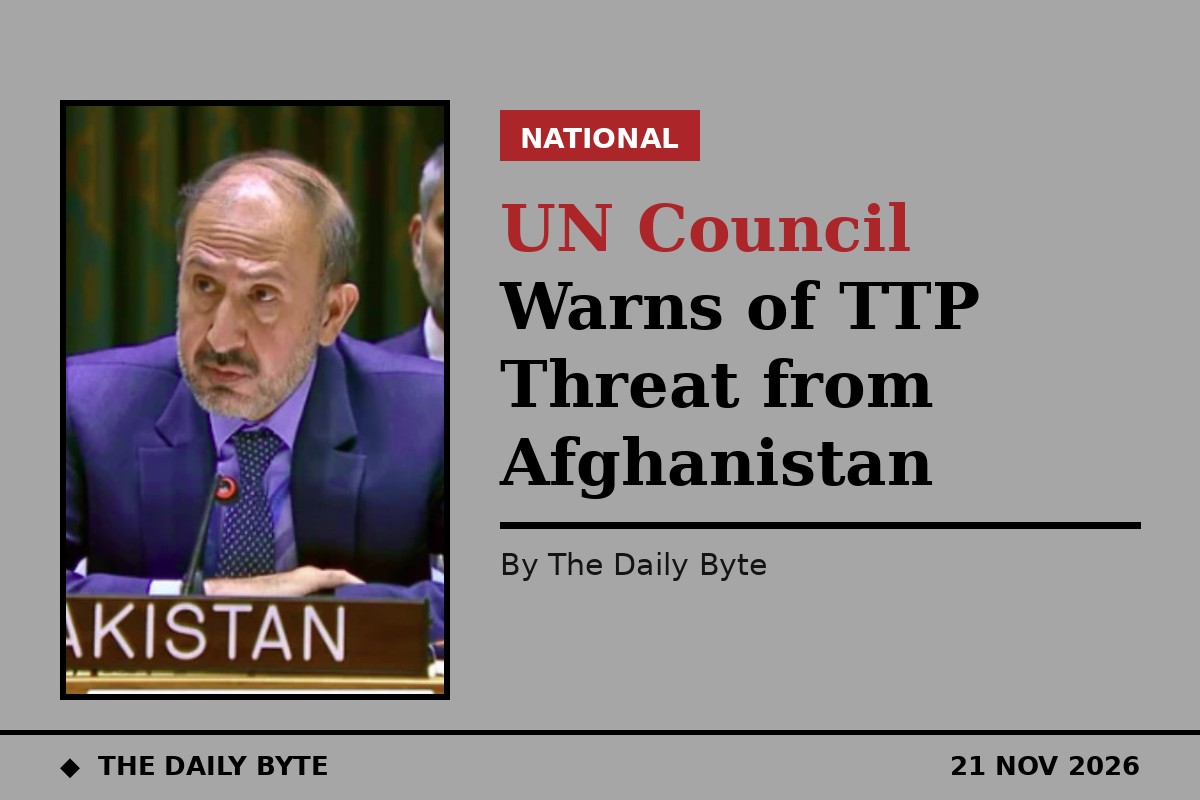
The United Nations Security Council has been told that terrorist groups operating from Afghanistan continue to threaten regional and international security, with the banned Tehreek-e-Taliban Pakistan (TTP) emerging as a major threat and Islamic State Khorasan Province (ISKP) maintaining an external focus.
Briefing the 15-member Council, its president for November, Sanita Pavļuta-Deslandes, warned that terrorist groups operating from Afghanistan continued to threaten regional and international security. The briefing highlighted the logistical and operational support provided to the TTP by the Afghan Taliban, and noted that the group had carried out several deadly attacks in Pakistan from Afghan territory.
Pakistan urges sanctions reform
Pakistan's Permanent Representative to the UN, Ambassador Syed Haider Shah, called for reforms to the UN's counterterrorism architecture, arguing that existing mechanisms, particularly the Security Council's sanctions regime, were not adequately equipped to address the evolving nature of terrorist threats.
He said the sanctions framework under Resolution 1267 must be expanded to list individuals and entities regardless of religion, nationality or ethnicity, and that the Council currently had no mechanism to sanction violent far-right, ultranationalist, xenophobic and Islamophobic movements targeting minorities. Listing and delisting decisions, he said, must remain fair, transparent and impartial, free of narrow political interests, and the Office of the Ombudsperson should be given greater financial resources, staff and autonomy.
Marking 25 years since the adoption of Security Council Resolution 1373, the ambassador warned that terrorist groups were increasingly exploiting the internet, the dark web, cryptocurrencies and digital wallets to recruit, incite violence and evade financial oversight. He called for stronger regulation of social media platforms, artificial intelligence and digital payment systems, and encouraged the Counter-Terrorism Executive Directorate to prioritise the countries worst affected by terrorism.
Highlighting the human cost, he said Pakistan had suffered more than 90,000 casualties and billions of dollars in economic losses in its fight against terrorism, and that more than 4,700 Pakistanis had been killed over the past three years by attacks originating from Afghanistan. He said Pakistan's security forces were combating terrorism emanating from Afghanistan, where he said groups including ISIL-K, the TTP and its affiliates, the Balochistan Liberation Army and its Majeed Brigade, and the East Turkestan Islamic Movement were operating with the patronage of their hosts.
China urges BLA listing
China's acting Permanent Representative to the UN, Sun Lei, urged the Council to expedite the listing of the Balochistan Liberation Army and its Majeed Brigade under the UN sanctions regime, while condemning a recent suicide attack in Pakistan. He warned that Islamic State Khorasan was expanding its capabilities and carrying out cross-border attacks, and urged the Taliban administration to honour its counterterrorism commitments and take decisive action against all terrorist groups operating in Afghanistan, including those designated under Resolution 1267.
Representatives of several other countries, including Denmark and Iran, also urged the Taliban to dismantle terrorist networks, including Al-Qaeda and the TTP, and to ensure Afghan territory was not used to threaten neighbouring states. The United States representative urged the Council to formally warn the Taliban over the lack of progress on its counterterrorism pledges.
The session was a briefing by the chairs of the Security Council's subsidiary committees, rather than a vote, and no new sanctions were adopted at the meeting. The discussion underscored growing international frustration over the Taliban's record on counterterrorism, with speakers agreeing that lasting regional peace would remain out of reach unless sanctuaries inside Afghanistan were dismantled.