UN Adopts Pakistan's Three Resolutions by 180 Votes
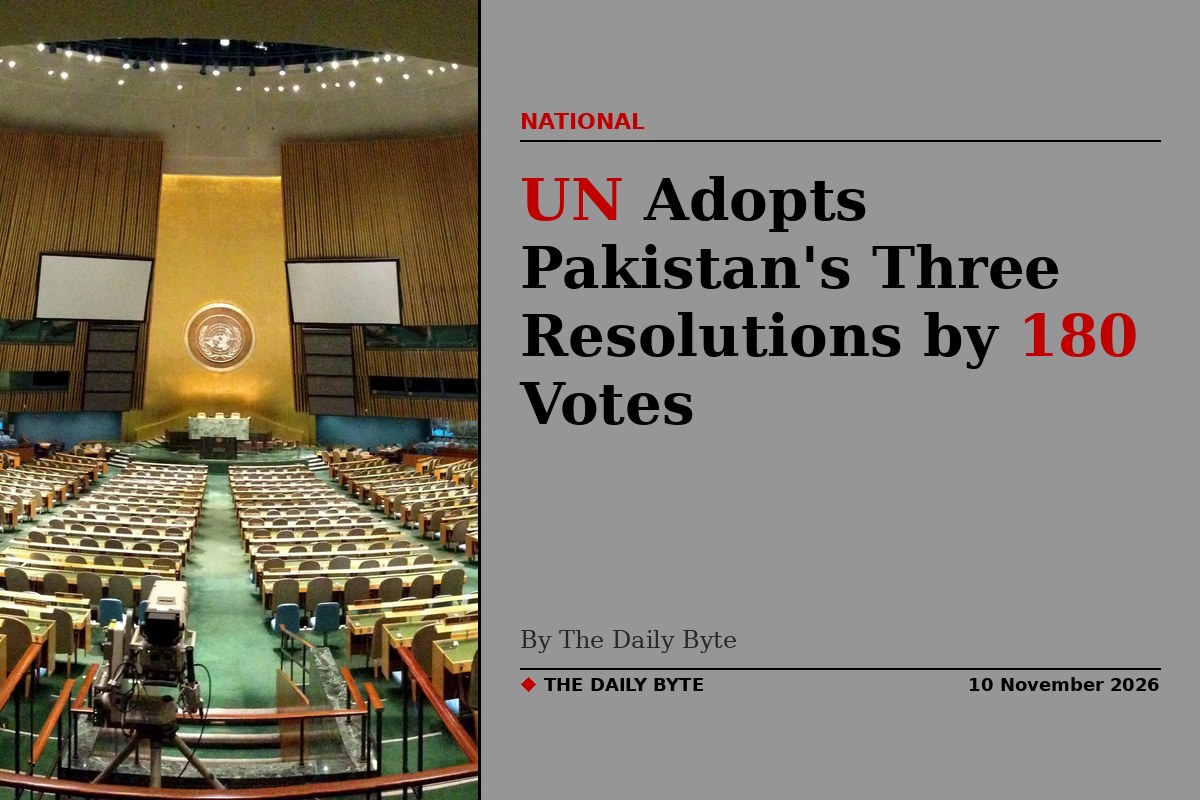
The First Committee of the United Nations General Assembly has adopted three resolutions sponsored by Pakistan, in a week of diplomatic gains for Islamabad at the world body. The committee, which deals with disarmament and international security, approved the texts on 3 November 2026, and the Foreign Office in Islamabad announced the outcome on 6 November.
Foreign Office spokesperson Ambassador Sajjad Haider Khan said the result showed the international community's continued support for Pakistan's longstanding work on security assurances for non-nuclear-weapon states and on regional approaches to arms control and confidence-building. The three resolutions cover confidence-building measures, conventional arms control and assurances against the use of nuclear weapons.
What the three resolutions say
The resolution on confidence-building measures in the regional and subregional context was adopted without a vote, meaning no member state called for a recorded vote against it. The resolution on conventional arms control at the regional and subregional levels was adopted with an overwhelming majority of 180 votes in favour and two against, with no abstentions. The resolution on effective international arrangements to assure non-nuclear-weapon states against the use or threat of use of nuclear weapons was adopted by 122 votes, with none against.
The three texts are part of a package Pakistan has tabled at the United Nations for decades, arguing that regional security is best built through dialogue, restraint and agreed rules rather than through arms build-ups. The resolutions themselves are not legally binding, but they set out a shared position that member states can point to in later negotiations.
The 180-vote result
The conventional arms control resolution, tabled jointly by Pakistan and Belarus, drew the widest support of the three. India and Israel were the only two countries to vote against it in the 193-member body. India's First Secretary at its Permanent Mission to the UN, Anmol Sher Bedi, said countries' security concerns could not be confined within regional boundaries and could not be addressed through narrowly defined regional arrangements.
The draft argued that conventional arms control should primarily be pursued at the regional and subregional levels, because most threats to peace and security in the post-Cold War period arise among countries located within the same region. The 180 votes in favour left the two opponents isolated, and the Foreign Office described the result as an overwhelming majority.
What Pakistan says it means
Announcing the outcome, the Foreign Office said the adoption of the three resolutions reflected the international community's continued backing for Pakistan's initiatives on disarmament and international security. The spokesperson said Pakistan had for decades led initiatives at the United Nations on conventional arms control, confidence-building measures and regional disarmament, and that the latest votes showed that work still commanded broad support.
The resolutions on confidence-building and on assurances for non-nuclear-weapon states were also adopted with strong support. The assurances text, which seeks international arrangements to protect states without nuclear weapons from the use or threat of use of nuclear weapons, passed with 122 votes and no votes against.
A week of gains at the UN
The First Committee outcome came two days before another diplomatic result for Pakistan at the United Nations. On 5 November, the UN Security Council adopted by consensus a Pakistan-initiated presidential statement on the role of diplomacy during active hostilities, building on Security Council resolution 2788, which was adopted unanimously during Pakistan's presidency of the Council in July 2025.
The statement underlines the importance of sustained diplomatic engagement, including mediation, good offices and open channels of communication, to help bring about ceasefires, de-escalation and durable political settlements. Together, the two outcomes gave Pakistan a visible week at the United Nations, with its initiatives winning support in both the General Assembly's disarmament committee and the Security Council.
The committee's decisions are recommendations that now go to the full General Assembly for final adoption. The Foreign Office said Pakistan would continue to press its case for dialogue, diplomacy and the peaceful resolution of conflicts at the United Nations.