US Congress Returns for Lame-Duck Funding Fight
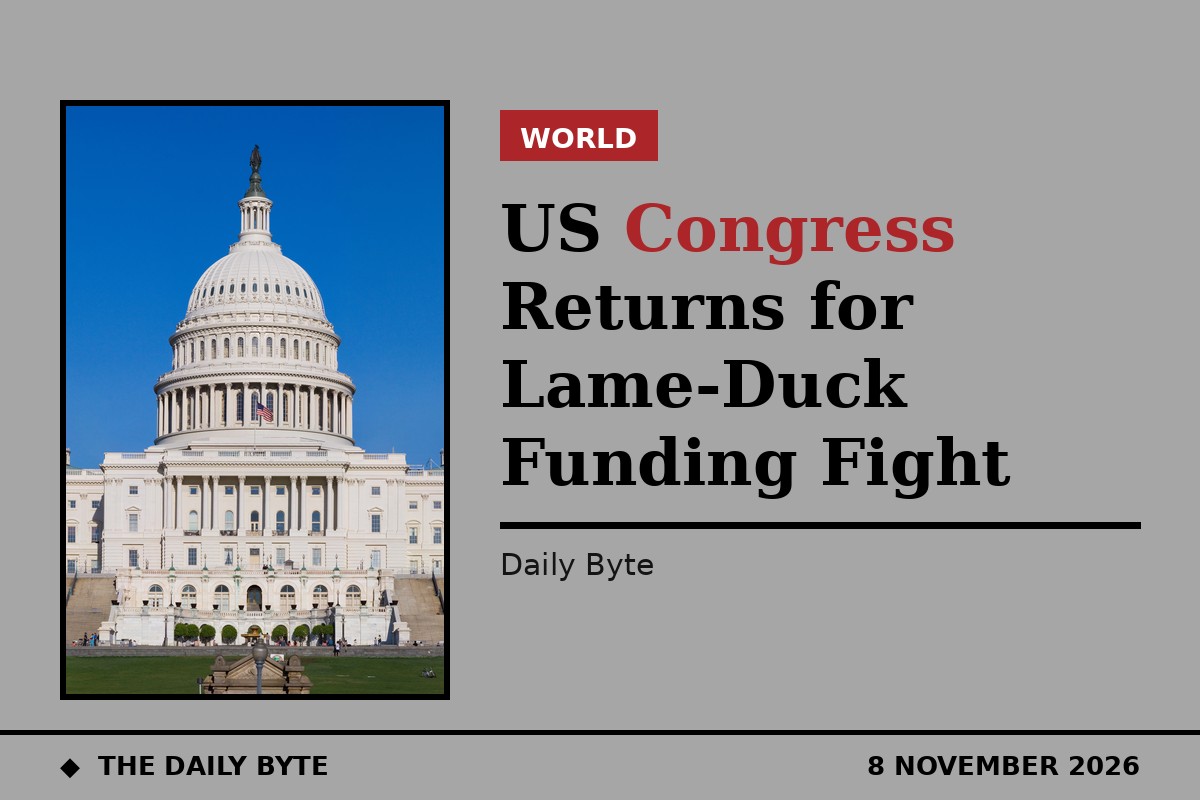
The United States Congress returns to Washington on Monday 9 November for a lame-duck session with a hard deadline hanging over it: the stopgap funding law that has kept the federal government open expires on 11 December, and failure to agree on a replacement would trigger a government shutdown just before Christmas. Both the House of Representatives and the Senate return on the same day, according to the American Institute of Physics.
The session spans the period between the 2026 midterm elections, which concluded on 3 November, and the seating of the 120th Congress in early January 2027. Democrats swept the midterms and are projected to take control of both chambers in the new year, giving the outgoing Republican majority only a few weeks to finish its unfinished business, as reported by Reuters.
Funding deadline is the first test
The most pressing item is the temporary funding measure passed in September, which kept the government running through Election Day. It runs out on 11 December. Lawmakers must decide whether to pass the remaining full-year spending bills for fiscal year 2027, agree a full-year continuing resolution, or settle for another short-term extension. The country went through a 43-day shutdown last autumn, the longest in modern history at the time it ended, and analysts warn that a shutdown is likely if Congress does not enact further appropriations.
Defence spending is the biggest sticking point. The Trump administration requested a record sum of about 1.5 trillion dollars for defence, which Senate Democrats have called a non-starter. Some Republicans have also called for a third reconciliation bill in the lame-duck session to provide more military spending, a step that proved too difficult before the election.
Defence, farm and science bills all unfinished
Beyond funding, the agenda includes the annual National Defense Authorization Act, which sets military policy and runs to about 1.15 trillion dollars, and the Farm Bill, covering crop supports and food assistance programmes. Both stalled ahead of the midterms and remain unfinished. Science-related tasks include reauthorising the National Quantum Initiative, which would extend the research and education effort across science agencies until 2034, and reauthorising the CHIPS Act, whose semiconductor manufacturing incentives expire this year.
Also in play is a White House rule on federal grantmaking that was paused by the September stopgap law. The pause expires in December, and the rule would turn the White House budget office's guidance for federal financial assistance into binding regulation, reshaping control of some 1.2 trillion dollars in federal grants. Science organisations have broadly opposed it as an overreach that injects politics into decisions previously based on merit, and analysts say the election result very likely kills the rule one way or another.
A tense handover
The politics of the session are expected to be tense. Republican leaders want to advance President Donald Trump's priorities before the majority flips, while Democrats, who will hold power from January, have little incentive to cooperate with the outgoing leadership, a position that gives them significant leverage. Mr Trump has threatened to veto legislation that does not align with his agenda.
Senator Susan Collins of Maine, who lost her re-election bid last week, remains chair of the Senate Appropriations Committee for the lame-duck session. In the new Congress, Representative Zoe Lofgren of California has said she will seek to chair the House Science Committee, with priorities including restoring science agency funding and investigating administration officials. Her Democratic colleague Robert Garcia, ranking member of the House Oversight Committee, has already told administration figures to "lawyer up" ahead of next year.
Congress is expected to sit for about six or seven weeks, running until Christmas with a break for Thanksgiving. Whether it leaves Washington with a funding deal, or with a shutdown looming over the holidays, will be the first test of a Capitol in transition.