US Reaffirms Wartime Command Transfer to South Korea
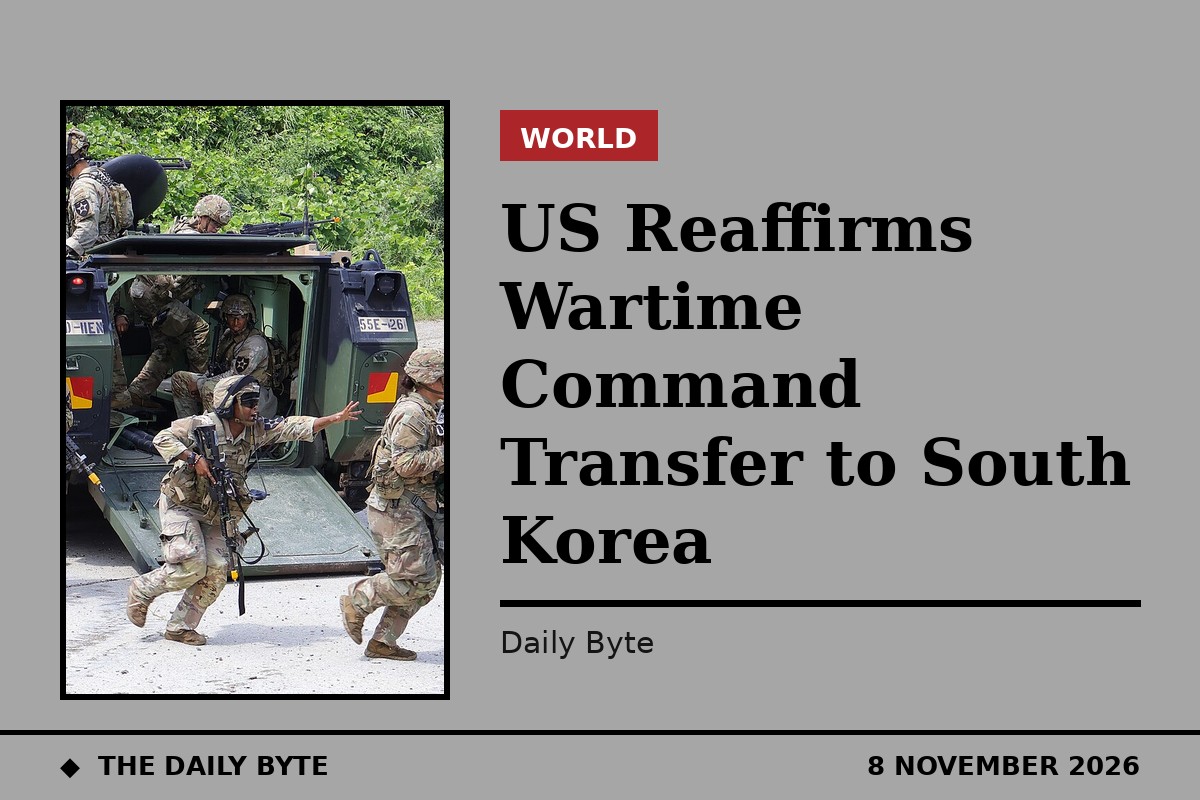
The United States has reaffirmed its commitment to a conditions-based transfer of wartime operational control, known as OPCON, to South Korea, a senior South Korean lawmaker said on Sunday after talks with US military officials in Hawaii.
Rep. Jin Sung-joon of the ruling Democratic Party, who chairs the National Assembly defence committee, told a press conference that the existing agreement remains intact and the conditions have not changed. His delegation visited US Pacific Command and subordinate commands in Hawaii from 1 to 5 November.
Jin said US officials acknowledged that policy-related factors could affect the transfer after the delegation conveyed Seoul's strong commitment, but reaffirmed that the agreement on a conditions-based transfer currently remains unchanged.
The US side also explained that postponing the Korea-US Security Consultative Meeting until early next year had nothing to do with differences over the transfer and was simply a scheduling matter. A separate defence ministerial meeting will be held in Washington in December, the first time since 1998 that the annual security meeting will extend into the following year.
South Korea handed operational control to the US-led United Nations Command during the 1950-53 Korean War. It passed to the Korea-US Combined Forces Command when that command was launched in 1978, and Seoul retook peacetime control in 1994, but wartime control remains in Washington's hands. President Lee Jae Myung's administration seeks to regain it before its term ends in 2030, or earlier.
The talks also covered recent differences between the two militaries over North Korea's missile launches, with Seoul reporting more than ten short-range ballistic missiles on 29 October while US Pacific Command counted only two. Pacific Commander Samuel Paparo described South Korea as a reliable model ally, and Pacific Fleet Commander Steven T. Koehler welcomed Seoul's plans for nuclear-powered submarines.