US Treasury 10/23/2026 5.00% Explained: What the Rate Means
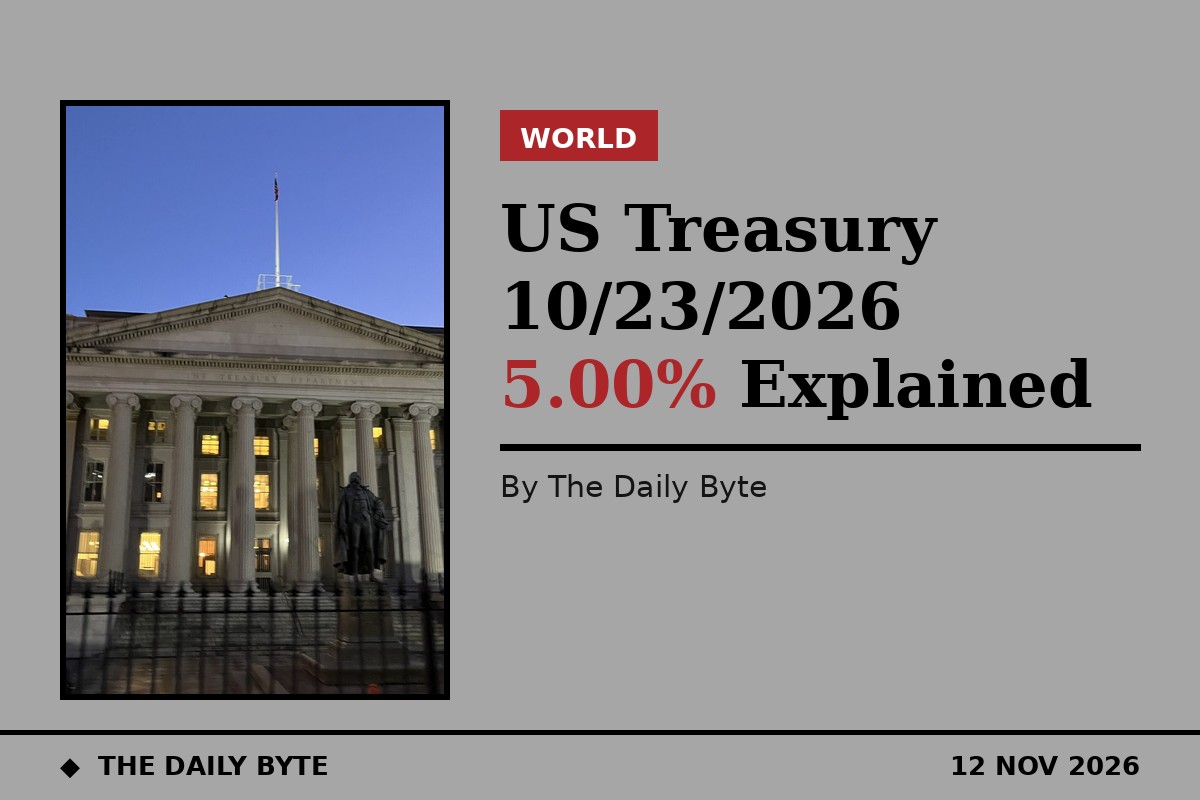
If you typed "US Treasury 10/23/2026 5.00" into a search engine, you were almost certainly looking at one line of one official table — and trying to work out what it meant. The short answer is that on Friday, 23 October 2026, the yield on the benchmark 10-year US Treasury note stood at exactly 5.00%, according to the US Department of the Treasury's own daily rates. This explainer unpacks each part of that search.
What does "US Treasury 10/23/2026 5.00" actually mean?
Read from left to right, the search breaks down into three parts. "US Treasury" is the issuer — the United States Department of the Treasury, which borrows money on behalf of the federal government by selling debt securities. "10/23/2026" is a date written in the American month-day-year format: 23 October 2026. And "5.00" is a yield of 5.00% — specifically, the 10-year yield in the Treasury's Daily Treasury Par Yield Curve Rates table for that day.
The Treasury publishes this table every business day, and the row for 23 October 2026 reads as follows across the curve: 1 month 4.11%, 3 months 4.22%, 6 months 4.30%, 1 year 4.44%, 2 years 4.69%, 3 years 4.75%, 5 years 4.82%, 7 years 4.89%, 10 years 5.00%, 20 years 5.37% and 30 years 5.33%. The "5.00" is the 10-year figure — the one markets, journalists and borrowers watch most closely. The same reading also appeared on 13, 14 and 26 October 2026, while the day before, 22 October, it stood at 4.96%.
What is a US Treasury security?
A US Treasury security is a debt instrument. As TreasuryDirect, the Treasury's own investor portal, explains, the Department of the Treasury issues securities to raise the money needed to operate the federal government, and the full faith and credit of the US government guarantees that interest and principal payments will be paid on time. That guarantee is why Treasury securities are treated as one of the safest investments in the world — and why their yields are used as a benchmark for almost everything else.
There are three main types of marketable Treasury security. Treasury bills mature in one year or less and are sold at a discount rather than paying regular interest. Treasury notes mature in 2, 3, 5, 7 or 10 years and pay a fixed rate of interest every six months. Treasury bonds mature in 20 or 30 years and also pay interest every six months. The 10-year note sits in the middle of that range, and its yield is the market signal watched most closely.
What is the 10-year Treasury yield — and what is a "par yield"?
The yield is the annual return an investor effectively earns from holding the security, taking its market price into account. When a Treasury note's price falls, its yield rises, and vice versa — the two always move in opposite directions. So when headlines say the 10-year yield "hit 5.00%", they mean the market price of 10-year notes had fallen to the point where a buyer would earn 5.00% a year.
The Treasury's daily figure is a "par yield", which needs a little more explanation. The Treasury's official yield curve is derived from indicative bid-side market price quotations for the most recently auctioned securities, collected by the Federal Reserve Bank of New York at or near 3:30 PM each trading day, as the Treasury's yield curve methodology page sets out. The par yield is the yield a hypothetical newly issued security would need to pay to sell exactly at its face value — its "par" — given the prices of the securities actually trading that day. It is a standardised reading, not the yield of one single named bond, so it can be compared cleanly from one day to the next. The rates are usually published by 6:00 PM Eastern Time each trading day.
How to read the Treasury's table for 23 October 2026
The most useful thing about the 23 October row is its shape. Yields rose steadily with maturity: 4.11% at one month, 4.69% at two years, 4.82% at five years, 5.00% at ten years and 5.33% at thirty years. That upward slope is the normal shape of a yield curve. The gap between the 2-year yield (4.69%) and the 10-year yield (5.00%) was 31 basis points, a modest but positive spread.
The date also matters. Yields had been volatile that month: the ten-year yield had stood as high as 5.31% on 5 October 2026 before some of that increase reversed, so the 5.00% reading on 23 October came after a pullback from the month's highs rather than at the peak. The Federal Reserve had raised its target interest rate range by 25 basis points to 3.75%–4.00% in September 2026, part of the backdrop to yields sitting near 4% to 5% at all.
Why does 5.00% matter so much?
Partly, it is psychology: 5.00% is a round number, and round numbers act as markers that traders, journalists and savers all notice. Crossing or touching 5% on the 10-year yield tends to generate headlines in a way that 4.96% or 5.03% does not, even though the economic difference between those figures is small. Partly, it is practical: the 10-year yield is the benchmark that feeds into mortgage rates, corporate borrowing costs and the valuation of shares and bonds around the world. When it rises, borrowing tends to become more expensive for households and businesses; when it falls, that pressure eases.
That is also why so many people search for the figure with a specific date attached. Investors checking a portfolio, homeowners watching mortgage rates and readers who saw "5.00%" in a headline all want the same thing: the official number for that exact day, rather than a rounded or remembered version of it. The Treasury's daily table is the authoritative place to find it, because it is the source every other provider ultimately draws on.
Frequently asked questions
What was the US 10-year Treasury yield on 23 October 2026?
Exactly 5.00%, according to the US Department of the Treasury's Daily Treasury Par Yield Curve Rates for that date. The 2-year yield was 4.69% and the 30-year yield was 5.33% on the same day.
Is 5.00% the interest rate on a specific Treasury bond?
No. It is the 10-year par yield — a standardised rate derived from the market prices of recently auctioned 10-year notes, not the fixed coupon printed on any single security.
Why is the 10-year yield watched more than other maturities?
Because it is the global benchmark for long-term borrowing costs: mortgage rates, corporate bond yields and many other rates are priced with reference to it.
Where can I check the figure myself?
On the US Department of the Treasury's Daily Treasury Rates page, which publishes the par yield curve for every business day — the row for 23 October 2026 shows the 10-year column at 5.00.
This article is an explainer, not investment advice. Figures are taken from the US Department of the Treasury's Daily Treasury Par Yield Curve Rates and its published yield curve methodology, with background on the types of Treasury security from TreasuryDirect.
Sources: U.S. Department of the Treasury, Daily Treasury Par Yield Curve Rates, October 2026.