Venezuela quake towers hid rebar flaws, CNN finds
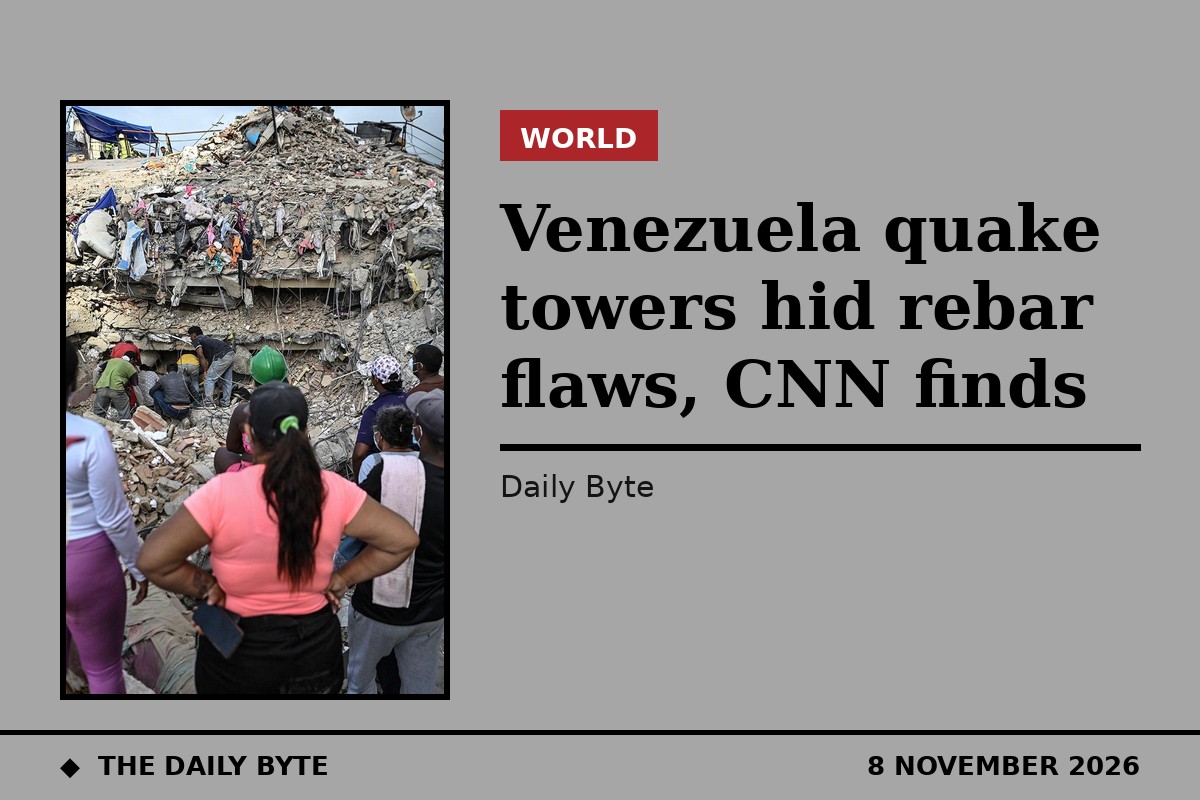
A CNN investigation published on 8 November has found signs of serious construction flaws in the Venezuelan public housing towers that collapsed during the twin earthquakes of 24 June 2026, raising fresh questions about why so many state-built homes fell while nearby buildings survived.
Fifteen towers in the coastal town of Caraballeda, each more than eight storeys high and containing at least 240 apartments, collapsed in the magnitude 7.2 and 7.5 quakes. The Venezuelan government has yet to publish a comprehensive list of those killed, but CNN reports that thousands of public housing residents likely died. The official death toll stands at 6,509 and has not been updated since 24 August, while independent estimates put the true figure at between 10,000 and 20,000.
CNN analysed videos and photographs of the buildings taken during construction and after their collapse. The evidence appears to show improperly assembled steel reinforcement, known as rebar stirrups, at five government-built complexes where the 15 towers stood, in apparent breach of Venezuela's building code. Images from three of the complexes also show deep-seated rust in the metal supports, which experts said could point to poor-quality concrete.
Venezuela's 2006 building code, which was in force when the towers were built, required stirrups to be bent to 135 degrees in every high-rise in La Guaira state, so that the ties reinforcing beams and columns hold firm during shaking. But photographs from the construction period show some stirrups bent to only 90 degrees. Structural engineers Jeffrey Dowgala and Terrence Paret, of the firm Wiss, Janney, Elstner Associates, told CNN that just a few badly assembled stirrups could compromise the integrity of a beam or column.
Structural engineer Kit Miyamoto, who has led post-earthquake damage assessments around the world and has been working on the ground in Venezuela, said the defect was widespread in the rubble he examined in La Guaira. "This is how a concrete structure fails if it's not done right," he told CNN.
A photograph taken during an inspection of the complex known as OPPPE 27 in March 2012 appears to show several defective stirrups at the foundation of one tower. All four towers at that site collapsed in the June earthquakes. Of more than 40 photographs and videos verified by CNN that specifically showed the stirrups, only a small minority were clearly bent correctly, the investigation found.
The towers were commissioned in 2011 by then-president Hugo Chavez as part of a drive to house families displaced by flooding and landslides in 2010. Construction was handled by the Presidential Office of Special Plans and Projects, known as OPPPE, which Chavez had created two years earlier as part of an ambition to build three million homes in nine years. The developments were built in barely a year, with construction teams working two to three shifts a day, and the office's then director wrote that the president had demanded 200,000 homes in 2012 alone.
A former OPPPE principal, Lucas Pou, told CNN it was standard practice for the office to award no-bid contracts under an emergency directive to speed up building, although he said he had not worked on the Caraballeda projects. Interim President Delcy Rodriguez ordered the suspension of OPPPE in February, a few months before the earthquakes.
The findings echo an Associated Press investigation published in October, which found that government officials pressed ahead with housing construction along the coast despite warnings from scientists and engineers about the area's seismic risks. Satellite imagery cited by CNN shows that 63 percent of all high-rise towers built by the special public housing authority in Caraballeda collapsed.
Not every tower built by the office fell. At the OPPPE 25 complex, five of seven towers survived the quakes, but residents have been evacuated and are camping in tents outside, and it is unclear whether the buildings will ever be used again. A 2012 photograph of that complex also shows stirrups assembled with the same 90-degree bends.
A government commission set up immediately after the earthquakes is analysing nearly 100 buildings using material samples and measurements, its president, Francisco Garces, told CNN. Venezuela's Communications Ministry did not respond to CNN's request for comment. The office's former director, Francisco Sesto, did not respond to CNN, but told The New York Times it was not "journalistically sound" to focus on a handful of public housing buildings when hundreds of private buildings also fell.
Experts cautioned that it is difficult to prove a direct cause after such powerful tremors, and that the flaws may not have been present in every tower that fell. But they said the defects could have made the buildings more likely to collapse — a partial answer for families still searching the rubble for missing relatives more than four months on.