Viasat Loses 83% of US Subscribers to Starlink
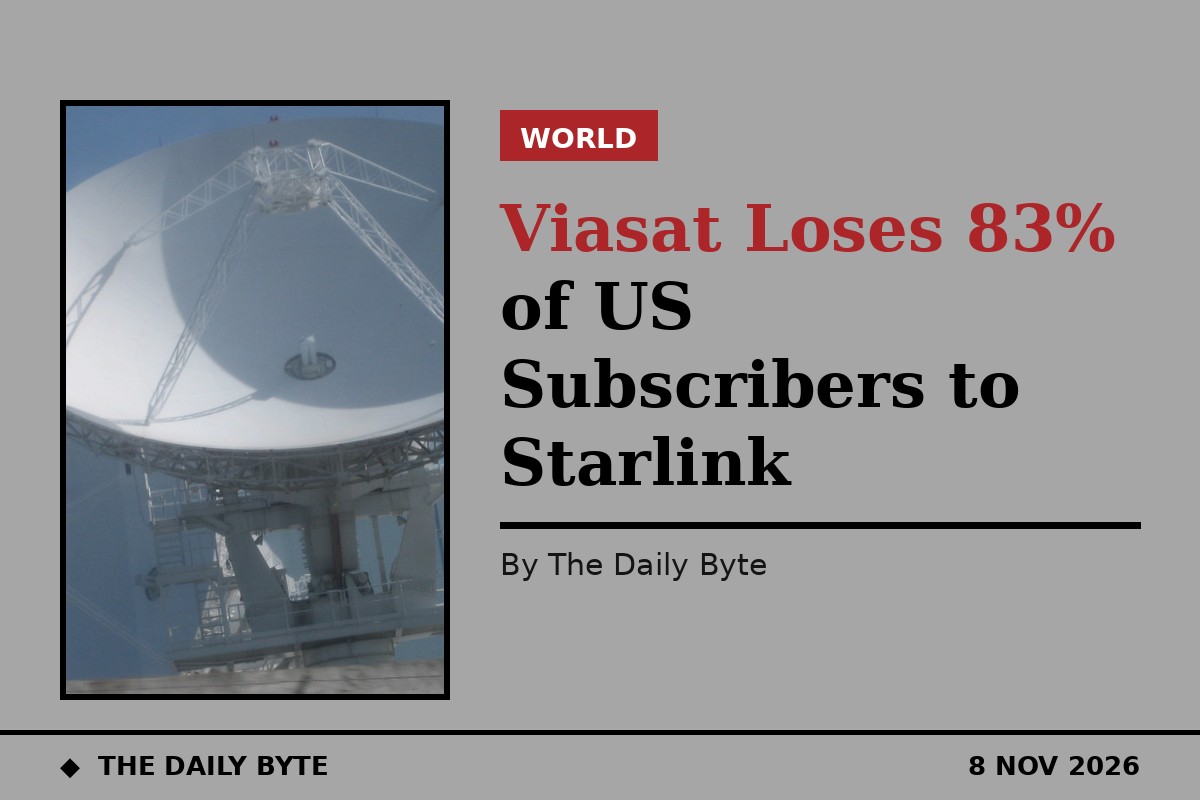
Viasat has lost more than four-fifths of its United States fixed broadband subscribers since Starlink arrived, according to the company's latest quarterly earnings, in a stark measure of how SpaceX's low-earth-orbit network has reshaped the satellite internet market.
The company ended its latest quarter with about 100,000 US fixed broadband subscribers, down from 603,000 in the third quarter of 2020, a fall of roughly 83%. Starlink's public beta began in late 2020, and Viasat's customer base has shrunk almost continuously since. The company blamed seasonally high summer churn for the latest drop.
The contrast with its rival is sharp. Deutsche Bank has estimated that Starlink now has about 4.1 million subscribers in the United States. Where Viasat relies on a small number of geostationary satellites orbiting about 35,700 kilometres above the Earth, Starlink uses thousands of satellites in low orbit, delivering faster speeds and far lower latency.
Viasat's answer is new hardware. Its ViaSat-3 Flight 2 satellite entered service over the Americas in early October and is designed to deliver download speeds above 100Mbps. The company is using it to power a new Unleashed Max plan, which promises unlimited data, top network priority, baseline speeds of 80Mbps and bursts of up to 200Mbps.
The plan costs $109.99 a month for the first year, rising to $179.99 after that, against about $130 for Starlink's Residential Max 2 plan. Starlink has also been offering discounts of 30% to 50% in selected areas. Viasat's chief financial officer said the plan is to use the improved performance to stabilise the business over the next few quarters.
Obstacles remain. Moving to the new service needs new equipment and a professional installation, and latency on Unleashed Max is still around 645 milliseconds, compared with about 45 milliseconds for Starlink. For households that stream video, play games online or make video calls, that gap is hard to ignore.
Viasat is not the only legacy provider under pressure. HughesNet, another geostationary operator, has also lost hundreds of thousands of customers to Starlink, and the wider industry has shifted its focus. Viasat itself has increasingly leaned on aviation, maritime and government contracts since acquiring the British satellite operator Inmarsat in 2023.
The subscriber slide shows how quickly a technology shift can redraw a market. Viasat once dominated residential satellite broadband in the United States. Six years after Starlink's beta launch, its consumer business is a fraction of its former size, and its recovery depends on whether the new satellite and the new plan can win back customers who have already moved on.


