Vitalik: ETH Is a Store of Value, Not a Fee Token
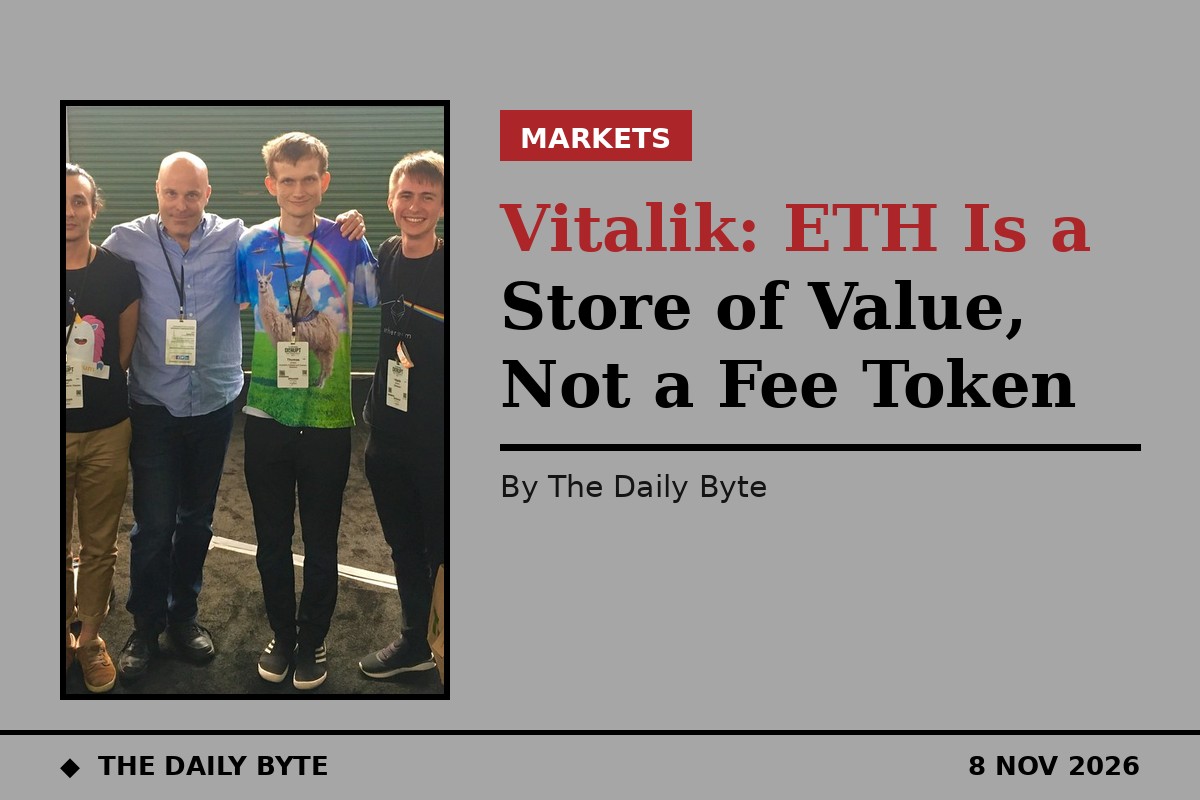
Ethereum co-founder Vitalik Buterin has argued that ETH should be valued as a store of value rather than as a token whose worth depends on how much of it is burned in transaction fees.
In a post on X on Sunday, 8 November, Buterin set out three reasons for his view, saying that focusing on "ETH as store of value" made "much more sense" than focusing on "ETH as fee-burning token".
His first argument was that the fee-burning case "never was as strong as it seemed". He pointed to the large amounts of ETH burned through transaction fees in 2021 to 2023, when demand for NFT trading and decentralised finance was intense. Much of that activity, he argued, depended on wealth already circulating inside crypto markets, so the fees it generated would shrink when the price of ETH fell. A valuation floor built on burned fees would therefore weaken at exactly the moment holders would need it most.
Buterin illustrated the point with a calculation: even $1 billion of token burns a year, discounted at 4%, could theoretically justify only a $25 billion valuation. He also noted that tokenised real-world assets now bring Ethereum activity linked to conventional markets, but said he did not expect mature financial products to reproduce the extreme fees of the speculative NFT boom.
His second argument concerned what Ethereum would have to become if fee generation were its main goal. To justify a market value of about $270 billion through fee revenue, he said, Ethereum would need to behave like a corporation of similar size. Using the French cosmetics group L'Oréal as his example, he estimated that Ethereum would need about 700,000 ETH a year in protocol research and development funding, which he said would cut validator income by roughly two-thirds. Such a model would demand constant investment and interventionist governance, he argued, which would be hard to reconcile with decentralisation and resistance to capture. Maximising fees could also mean pushing gas prices higher, shutting out users who need affordable, private transactions.
The positive case, his third argument, rests on what he called decentralisation and CROPS: censorship resistance, open source, privacy and security. "The core idea: the big thing that people appreciate about Ethereum is decentralization and CROPS," he wrote. "The main pragmatic benefit that these things translate into is stability." He argued that in an era of disruption from artificial intelligence, stability would be highly valued by people and institutions holding assets on the network.
Buterin was clear that he was not calling for the fee-burn mechanism to be scrapped. "EIP-1559 (including its burn) is fine and good, we should keep them," he wrote, adding that nobody should be sad if fee burning stayed below 10% of the level needed to offset new issuance indefinitely. Under EIP-1559, introduced in August 2021, the base part of each transaction fee is destroyed while new ETH is still issued to validators, so supply rises or falls with the balance between the two.
The debate matters because Ethereum's fee income has fallen since the Dencun upgrade in March 2024 cut the cost of using layer-2 systems, moving activity off the main network. ETH supply has since gone through periods of net inflation, with more tokens issued than burned. At the time of Buterin's post, ETH was trading at about $2,237, with a market capitalisation of around $273.4 billion, according to CoinGecko.
Solana co-founder Anatoly Yakovenko backed Buterin's argument in a reply on X, writing: "Vitalik is absolutely right that you can't focus on fees as the product. That'[STRING_PLACEHOLDER_1]'s own priorities this year, set out in the Ethereum Foundation's mandate in March.
Buterin's comments are an opinion, not a protocol proposal, and they change nothing in Ethereum's code. The open question is whether investors who have long tracked ETH's burn rate and supply figures will accept decentralisation and stability as a basis for valuing the asset instead.