VIX Jumps 70% to Eight-Month High in Tech Rout
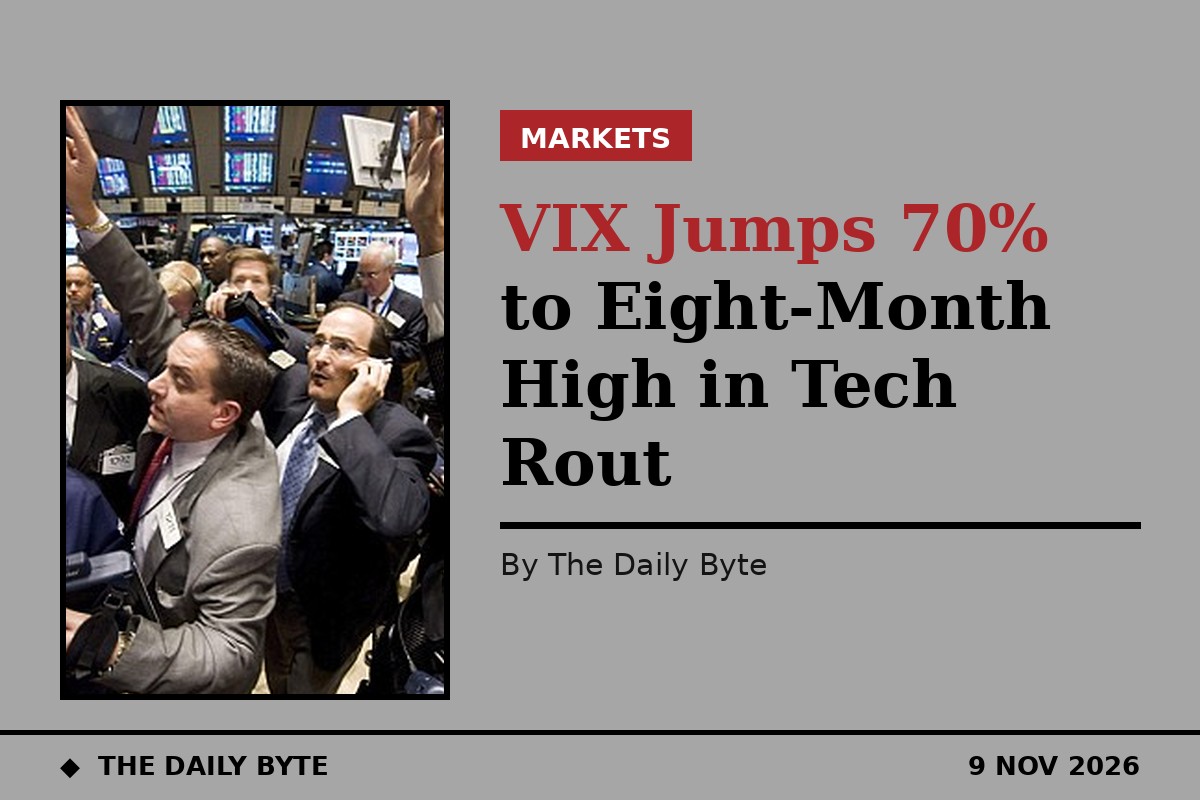
Wall Street's fear gauge surged by the most in more than a year last week, as a brutal sell-off in chip and data-centre stocks dragged the Nasdaq into correction territory and rattled markets on both sides of the Atlantic.
The Cboe Volatility Index, known as the VIX, closed on Thursday 5 November up 69.7% at 28.17. It was the index's biggest one-day percentage gain since December 2024 and the second largest since the February 2018 episode traders call Volmageddon. The close was the highest since 30 March, and the 11.6-point jump was the biggest since April 2025.
The move came fast. About 90 minutes after the opening bell on Thursday, the VIX had already jumped as much as 5.7 points to above 28. From its intraday low to its high, the index moved more than 11 points, its biggest one-day swing since 9 April. By midday, nearly 800,000 VIX call options had traded, about three and a half times the 30-day average, according to Cboe data.
The VIX is an options-based gauge of how much volatility traders expect in the S&P 500 over the next 30 days. It rises when investors rush to buy protection against further falls, which is why it is often called Wall Street's fear gauge. A reading around 16 has historically equated to roughly a 1% daily move in the index, so a level above 28 implies traders expect much larger swings.
The trigger was a reassessment of artificial intelligence investments. The Democrats' sweeping victory in the US midterm elections, taking control of both houses of Congress, raised fears of tighter rules on the AI industry and on data-centre construction. The concern hit the market's most crowded trade hardest: the S&P 500 fell 3% on Thursday and was headed for its worst decline since April 2025, while the Nasdaq slid more than 10% below its record close and into correction territory. The Philadelphia Semiconductor Index fell more than 12% in a single session, its steepest drop since the pandemic.
The stress spread beyond the VIX itself. The Cboe VVIX, which tracks how much traders expect the VIX to swing over the next 30 days, jumped 49.3% to 134.99, its biggest one-day percentage gain since February 2007 and its highest close since 6 March. A move like that suggests traders were rushing to buy protection against further spikes in volatility, not just against a drop in stocks.
History offers some comfort, but only up to a point. Before Thursday, the VIX had risen by 60% or more in a single day only five times since Cboe's data began in 1990, and the S&P 500 was higher a month later in all five. In the 24 cases of a jump of 40% or more, the index was higher a month later in 18 and a year later in 22, by an average of almost 19%. The caveat is that the worst outcomes came when the spike marked the start of a bigger shock, as in February 2020, when the S&P 500 was down 24% a month later as the pandemic took hold.
Traders were divided on what the spike meant. Noel Smith, a trader, said his data pointed to de-risking, but described the session as a liquidation rather than a reaction to oil or interest rates, which he said were relatively unchanged. Others argued the market was pricing risk rather than crisis, and that volatility had not yet reached the extremes that have marked market bottoms.
The gauge eased on Friday, and the one-day VIX, which captures expected moves over a single session, tripled to 36.80, implying a move of about 2.3% in the S&P 500. Traders in London and across Europe will be watching the gauge closely when markets open on Monday, with the tech rout, the midterm fallout and Tuesday's US inflation data all still in play.