Von der Leyen Plans Black Sea Security Talks in Romania
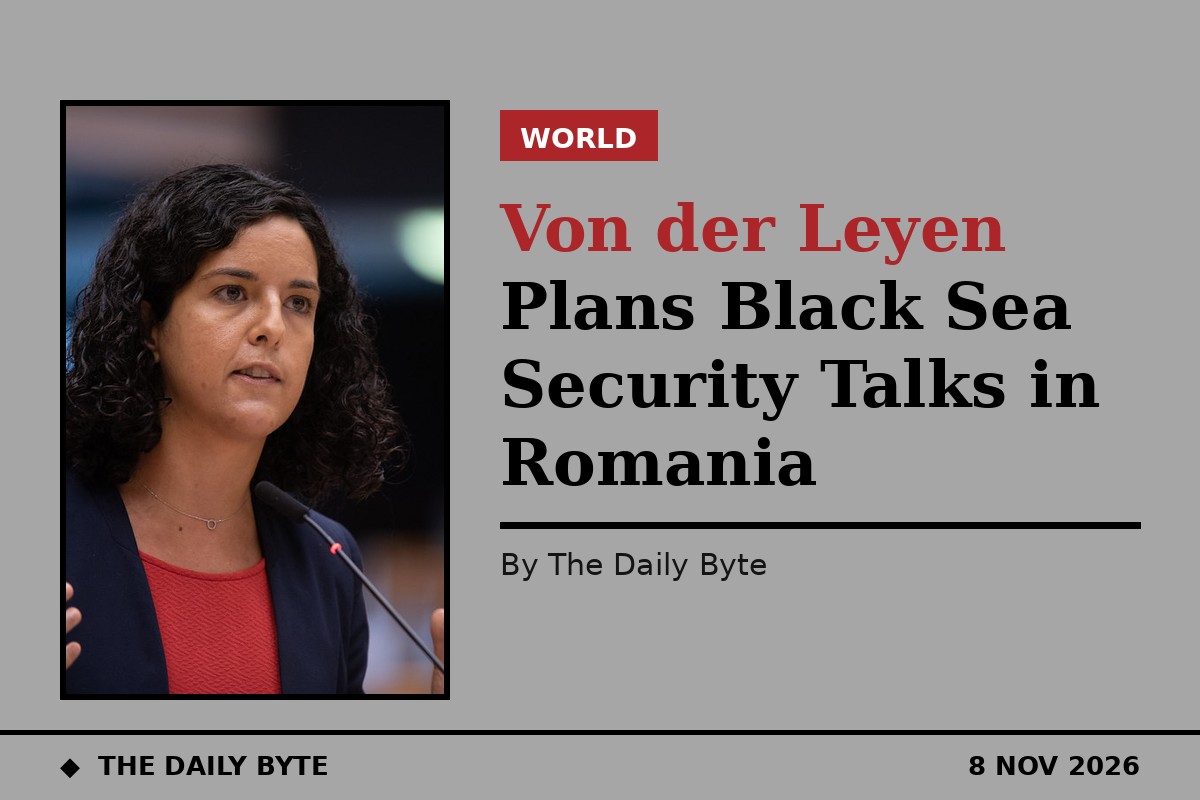
European Commission President Ursula von der Leyen will visit Romania and Bulgaria on 9 and 10 November for talks centred on Black Sea security, as Brussels seeks a greater role in protecting the region's shipping, energy infrastructure and trade routes.
The visit begins in Bucharest on Monday, 9 November, where von der Leyen is scheduled to meet Romanian President Nicușor Dan and Prime Minister Luca Niculescu. She will then travel to Bulgaria on Tuesday, 10 November, for talks with Prime Minister Rumen Radev in Varna and a visit to the Nikola Vaptsarov Naval Academy.
According to the European Commission's official announcement, the discussions will cover European security and defence, competitiveness, energy supplies, EU enlargement and negotiations over the Union's next seven-year budget, for 2028 to 2034.
One of the principal issues under discussion is the proposed Black Sea Maritime Security Hub. The initiative forms part of the Commission's Black Sea strategy, published in May 2025, and aims to improve maritime surveillance, exchange security information, protect critical infrastructure and strengthen cooperation against threats to shipping.
On 6 November, Romanian Defence Minister Ștefan-Radu Oprea discussed the hub's gradual development with European Commission Executive Vice-President Roxana Mînzatu. The Romanian Defence Ministry confirmed that the proposed mechanism would remain civilian, with military expertise contributing through cooperation between national institutions, and that it is intended to complement existing NATO activities rather than establish a separate EU naval operation.
That distinction matters because the Black Sea is already covered by military arrangements involving Romania, Bulgaria and Turkey. The three NATO members established a joint mine-countermeasures task group in 2024 to address the danger posed by drifting naval mines, and in July 2026 they agreed to expand cooperation towards protecting critical infrastructure, including energy installations and underwater communications cables.
Russia's war against Ukraine has fundamentally altered the security environment around the Black Sea. Attacks on Ukrainian ports, drone operations against commercial vessels and the continuing danger of naval mines have created risks extending beyond Ukraine's territorial waters, while disruption to commercial shipping can increase insurance costs, delay cargo movements and complicate essential transport corridors.
The Black Sea remains an important route for Ukrainian agricultural exports, international trade and regional energy supplies. The expansion of offshore energy infrastructure adds another consideration: Romania's Neptun Deep gas project, expected to begin production in 2027, is set to increase the country's importance as an energy supplier within the European Union, making the protection of offshore installations and associated pipelines a matter of wider European energy security.
The Bucharest discussions will also address Moldova's progress towards European Union membership. Romania has been one of Moldova's principal political supporters within the EU, and the Commission's enlargement assessment published on 4 November states that Moldova has continued making progress in accession negotiations. Brussels considers the country's objective of completing negotiations by early 2028 achievable, provided the government maintains its current reform programme, although that timetable is conditional and does not constitute a guaranteed date for membership.
Funding will also be on the agenda. Romania wants the next EU budget to reflect the security requirements of member states situated on the Union's eastern flank, and Oprea raised European defence projects and the EU's Security Action for Europe financing instrument during his meeting with Mînzatu. However, discussions concerning the maritime hub and future defence investment have not yet established a final financing arrangement.
For Brussels, the challenge will be translating regional security objectives into operational mechanisms without duplicating NATO responsibilities. The Bucharest and Varna meetings will provide an opportunity to clarify how the European Commission intends to support maritime surveillance, infrastructure protection and cooperation with countries bordering the Black Sea.


