What Are AI Chips? US Export Rules Explained
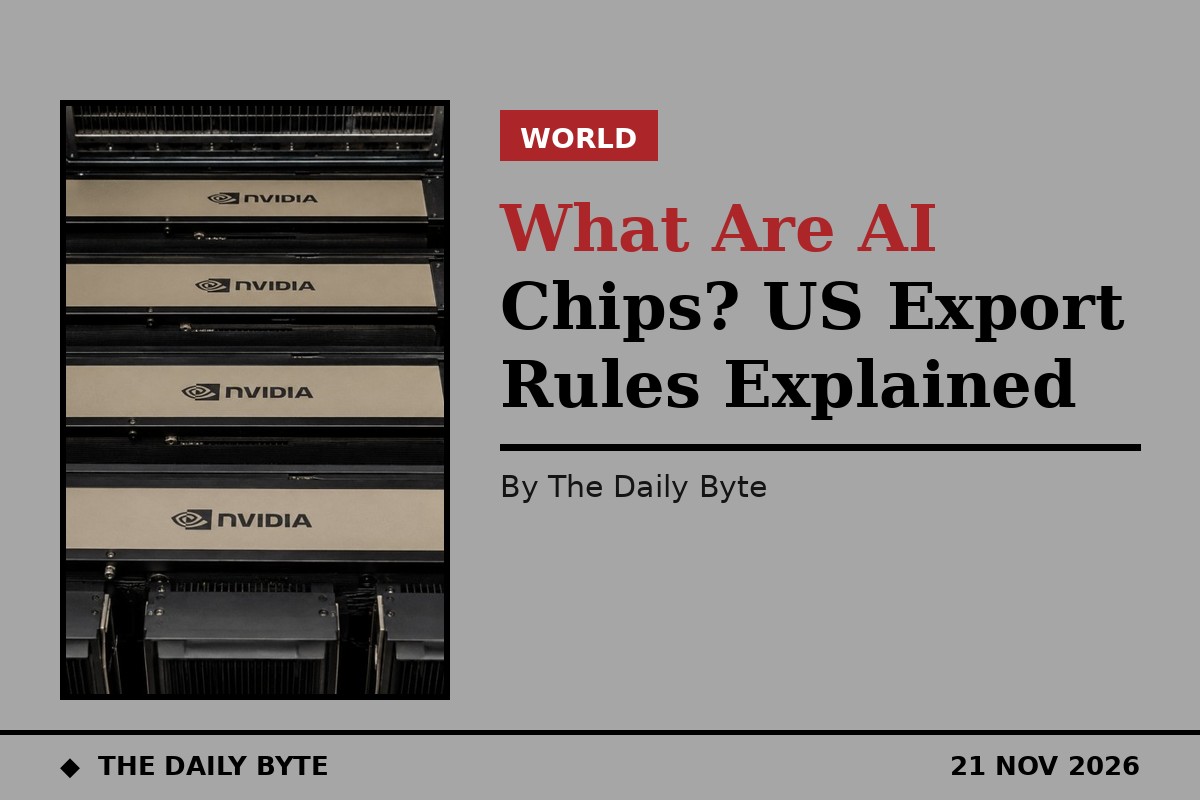
An AI chip is a specialised computer processor built to carry out the huge number of calculations that artificial intelligence needs. The term usually means a graphics processing unit, or GPU, designed for data centres rather than for a laptop or a games console. On 19 November 2026, the subject moved from the technology pages to the front of a political row in Washington, when the chairman of the House Foreign Affairs Committee published licensing records showing that the United States had approved the sale of more than 879,000 advanced AI chips to Chinese companies. This explainer sets out what an AI chip is, how the American export rules work, and what that disclosure actually means.
What is an AI chip?
Training a modern AI model means performing the same mathematical operations billions of times over. A normal computer processor, a CPU, handles a small number of complicated tasks one after another. A GPU takes the opposite approach: it carries out thousands of simpler calculations at the same time. That parallel design was first developed to draw graphics on screens, where millions of pixels must be updated at once, but it turns out to suit AI training almost exactly.
The chips at the centre of the current dispute are data-centre accelerators. Nvidia's H200, from its Hopper generation of processors, and AMD's MI325X are the two models named in the licensing records released by the House committee. They are not sold in shops. They are installed by the hundred or the thousand in data centres, where they are linked together to train large language models, run image and video systems, and power cloud services that customers rent by the hour.
There are two main jobs an AI chip does. The first is training: building a model by feeding it enormous amounts of data until it can recognise patterns and produce answers. The second is inference: running a finished model to answer a question, write a paragraph, or identify an object in a photograph. Training needs the most powerful hardware and the most chips working together. Inference can run on smaller, cheaper chips, which is one reason export controls focus on the most advanced hardware.
The same hardware is also dual-use. The computing power that trains a chatbot can also be used for scientific simulation, weather modelling, drug discovery, and financial analysis. That is why governments treat the most powerful chips as strategic goods rather than ordinary electronics.
Why does the United States control AI chip exports?
The United States has restricted exports of advanced computing chips to China since October 2022, when the Commerce Department imposed sweeping controls, and it has tightened those rules several times since. The stated reason is national security. Advanced chips are essential for designing nuclear weapons, stealthy submarines, and advanced aircraft, and Washington wants to slow the ability of the People's Liberation Army to develop advanced weapons systems.
The controls work through licences. A company that wants to sell a controlled chip to a customer in China must apply to the Bureau of Industry and Security, known as BIS, which sits inside the Commerce Department. BIS can approve the sale, refuse it, or approve it with conditions. The system is not a blanket ban: some sales are allowed, and the question of which ones has become one of the most contested issues in American trade policy.
Part of the argument turns on who the buyers are. The US Department of War, as the Pentagon is now styled, keeps a list of Chinese military companies: firms it regards as contributors to China's defence industrial base through what it calls military-civil fusion. Alibaba and Tencent, two of China's largest technology companies, are on that list. Critics of the licensing decisions argue that selling advanced chips to companies on that list undermines the purpose of the controls. Supporters of a more permissive approach argue that American chipmakers should be allowed to compete commercially, and that Chinese companies will obtain computing power one way or another.
What did the new disclosure reveal?
On Thursday 19 November 2026, Brian Mast, the Republican chairman of the House Foreign Affairs Committee, used powers under the Export Control Reform Act to publish licensing information that the Commerce Department had previously withheld. His committee said it was the most detailed public disclosure in the history of that law.
The records cover applications made between December 2025 and 11 May 2026. In that period, Nvidia and AMD applied to sell about 3.4 million AI chips to China. BIS approved more than 879,000 of them, 879,868 across 21 applications, according to the committee's figures. That is roughly a quarter of the chips requested.
The approvals were broken down by buyer. Alibaba was cleared for 75,000 chips. Tencent and its subsidiaries were cleared for 150,000. Baidu was cleared for 43,000, and the electric vehicle maker BYD for 4,000. All four are on the Department of War's list of Chinese military companies, the committee noted.
Not every request was granted. BIS refused some very large applications, including Nvidia's request to sell 610,000 chips to Alibaba and 508,000 to ByteDance, the owner of TikTok. The committee also alleged that some of Nvidia's applications involved possible chip-smuggling fronts, an allegation reported by the New York Times, which linked some of the entities named to Megaspeed, a company accused of diverting chips. Those allegations have not been established as fact, and Nvidia and AMD have both said they comply with US export control regulations.
One detail in the released documents drew particular attention. Every application submitted by Nvidia and AMD stated that the proposed transfer posed a low risk of diversion, meaning the companies assessed that the chips were unlikely to end up with an unauthorised user. The committee's point is that the regulator accepted those assessments while approving sales to companies the Pentagon regards as military-linked.
Approval is not the same as delivery
The most important caveat in the whole story is that a licence is permission, not a shipment. The records list only what BIS approved. They do not show how many of the approved chips were actually sent to China, and reporting suggests many were not. The Register noted that many of the approved orders never resulted in shipments, and Reuters found no deliveries of H200 chips at all when it checked in May 2026.
There is a practical reason for that gap. China also controls what enters the country, and Beijing's permission is needed before the chips can be imported. Nvidia has since stopped shipping H200 chips to China, according to the company, and Chinese buyers have increasingly turned to domestic suppliers while their own chipmakers develop competing products.
That does not make the approvals meaningless. They show how the licensing system operated in practice over six months, and they give lawmakers a concrete set of numbers to argue over. But anyone reading the headline figure should understand that 879,000 is a ceiling on permission, not a count of chips that crossed the Pacific.
The new remote-access rule
The disclosure landed in the same week as a further tightening of the rules. On 19 November 2026, a BIS interim final rule titled Addressing Remote Access to Advanced Semiconductors took effect. Its target is a workaround: instead of buying a restricted chip and shipping it to China, a Chinese company could rent computing power from a data centre abroad that holds the chips. The new rule requires a licence when advanced GPUs are supplied to a data centre that provides large amounts of computing power to companies headquartered in China or other restricted countries.
The effect was immediate. Tencent said on Wednesday that the new rule would reduce the quantity of advanced computing capacity available to the company and slow its efforts to train models. Alibaba's chief executive, Eddie Wu, said on the company's earnings call that the policy would definitely affect the long-term construction of Alibaba Cloud's data centres at home and abroad, and that its long-term target of 20 gigawatts of capacity may be lowered, with capital spending cut accordingly.
Both companies, however, said they did not see the rule as a long-term problem, because they expect Chinese chipmakers to be making advanced AI hardware at scale in 2027 or 2028. Alibaba's Wu said the company would go through a phase of its largest investment in AI infrastructure once domestic chipmakers catch up. If that happens, the export control debate may matter less, because Chinese firms would no longer need American chips at all.
What happens next?
The committee's release has set up a political fight rather than settled one. Lawmakers who want tighter controls now have a detailed record to point to, and the committee plans hearings with Commerce Department officials. The Commerce Department has defended its approach, saying its licensing of the H200 is based on a rule published in the Federal Register in January 2026 that imposes significant additional national security requirements on applicants.
For readers, the story matters for three reasons. First, it shows that export controls are not a simple on-off switch: they are a licensing system in which most requests are refused but a substantial minority are approved. Second, it shows how quickly the rules are changing, with a new remote-access rule taking effect on the same day the old approvals were published. And third, it is a reminder that the AI race is fought as much through supply chains and licences as through research. The chips themselves are the prize, and who is allowed to buy them is now one of the central questions in the contest between the United States and China.