What Are Special Votes in New Zealand Elections?
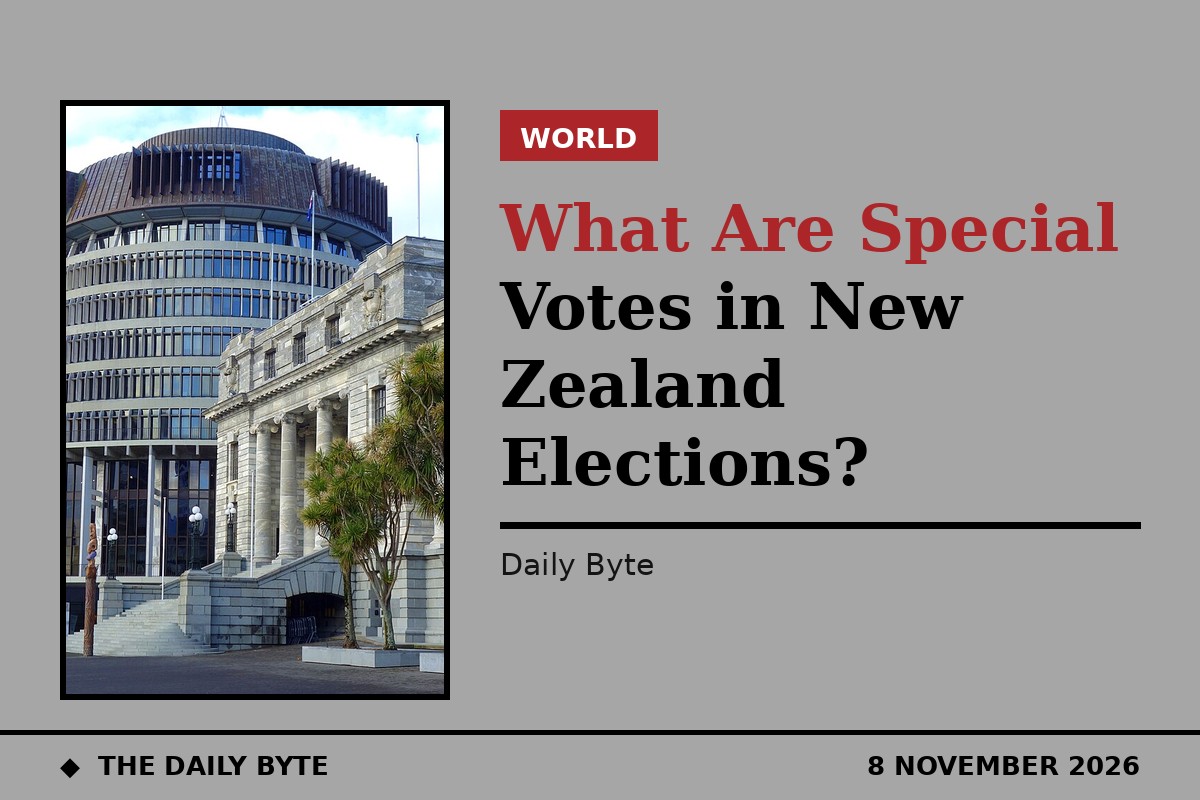
New Zealand voted on Saturday 7 November 2026 and woke up without a government. The preliminary count gave no party a clear win: Prime Minister Christopher Luxon's National Party finished with 42 seats, and with its partners ACT on 13 and New Zealand First on 12 it holds 67 seats between them, one more than the 66 needed for a majority in a House of about 131. Yet Labour won more party votes than National, by 3,650 votes, and the newcomer Opportunity Party entered Parliament for the first time. Nothing is settled, because nearly 400,000 votes have still not been counted. They are special votes, and in an election this close they will decide who governs. This guide explains what special votes are, who casts one, why there are so many this time, and when New Zealand will finally know the result.
What is a special vote?
A special vote is any vote that cannot go straight into the ballot-box count on election night, because the voter's details need checking first. That is the whole idea in one sentence. An ordinary vote is cast by someone whose name is on the printed electoral roll at the voting place they attend, so it can be counted immediately. A special vote goes into an envelope with a signed declaration, and the Electoral Commission checks that the person is enrolled, is eligible to vote, and has not already voted somewhere else before the vote is counted. Only after those checks does the vote join the official result. Special votes are not second-class votes. They count exactly the same as ordinary votes once they pass the checks. The difference is timing: they are not in the election-night result at all, and they are only added when the official result is declared. That is why an election-night result in New Zealand is always described as preliminary, and why a close election can look finished on Saturday night and still change weeks later.
Who casts a special vote?
You cast a special vote if any of several situations applies. The most common is voting outside your own electorate, for example while travelling, on holiday, or at a busy advance voting place in a city centre that serves voters from many electorates. People voting from overseas cast special votes too, by downloading and uploading their voting papers. You also cast one if you enrolled after writ day, which was 4 October 2026, with enrolment closing at midnight on 25 October. Other cases include being on the unpublished roll, which is used mainly for safety reasons; having your name not found on the roll at the voting place, or being on the dormant roll; voting by dictation over the phone, a service for people who are blind, have low vision or cannot mark a paper; and voting from a hospital, a rest home or another place where staff bring the ballot to you. Voting early does not by itself make your vote special. Advance votes cast in your own electorate are ordinary votes and are counted on election night. Advance votes cast outside your electorate are special votes. The categories are set out in the Electoral Act 1993, and the Electoral Commission applies the same checks to every declaration.
Why are there so many special votes in 2026?
After election night the Electoral Commission estimated 399,365 special votes in 2026, including 96,947 from overseas and by dictation. That is a large number, but it is smaller than the 603,257 special votes cast in 2023, when they made up 20.9 per cent of all votes. In 2020 there were 504,621, and in 2017 there were 446,287. Several things push the number up this time. The biggest change is the law. The Electoral Amendment Act 2025 ended election-day enrolment, so anyone who enrolled after writ day casts a special vote instead of enrolling and voting on the spot. Boundary changes also play a part: several electorates were redrawn for 2026, and people voting outside their new electorate cast special votes. On top of that, voting outside your electorate is simply common, especially at busy advance voting places, and tens of thousands of New Zealanders abroad vote at every election. Even at roughly 399,000, special votes are about 14 per cent of the total vote, easily enough to move seats in a Parliament decided by a few thousand votes.
How special votes change the result
Special votes are counted for the party vote and, where the voter is enrolled in an electorate, for that electorate's candidates. Because the people casting them tend to be younger, more mobile and more often overseas, they do not split the same way as ordinary votes, and the seat count often shifts when they are added. The pattern at recent elections is a shift of one or two seats, and that is often enough to matter. In 2023 National fell from 50 seats on election night to 48 in the official result, while the Greens rose from 14 to 15 and Te Pati Maori from four to six. In 2020 Labour rose from 64 to 65, National fell from 35 to 33, and the Maori Party doubled from one seat to two. In 2017 National fell from 58 to 56, Labour rose from 45 to 46 and the Greens from seven to eight. In 2023 the shift changed the arithmetic of forming a government, because National needed both ACT and New Zealand First after losing those two seats. The 2026 arithmetic is even tighter. Labour leads National by only 3,650 party votes, 710,330 to 706,680, or 29.36 per cent against 29.21 per cent, and the centre-right bloc's projected majority is a single seat. A swing of one or two seats in the official count could erase it, flip marginal electorates, or change which parties hold the balance of power. Historically special votes have tended to help Labour, the Greens and smaller left-leaning parties, and in 2023 they handed three extra seats to Te Pati Maori and the Greens between them, but the pattern is not fixed, and the new enrolment rules this year could change it.
New Zealand's MMP system and the overhang, in plain English
To understand why the count is so complicated, it helps to understand the voting system. New Zealand uses mixed-member proportional representation, known as MMP, adopted after a referendum and in place since the 1996 election. Every voter casts two votes: one for a local electorate MP, and one for a party. Parliament is meant to reflect each party's share of the nationwide party vote. A party enters Parliament if it wins at least 5 per cent of the party vote or wins an electorate seat, and list seats are then filled from party lists until each party's total is proportional to its vote. The wrinkle is the overhang. If a party wins more electorate seats than its party vote entitles it to, it keeps the extra seats and Parliament grows to fit them. That is what happened in 2026. National won 42 electorate seats, far more than its roughly 29 per cent party-vote share would entitle it to, and Te Pati Maori also won more electorates than its vote share allows, so the next Parliament is set to be the largest under MMP, at 131 seats, with 66 needed to govern. The Greens hold a projected 16 seats, Te Pati Maori five, and the centrist newcomer Opportunity Party seven after clearing the 5 per cent threshold, something no brand-new party had managed since MMP began. Special votes feed into this arithmetic twice over: they can change the party-vote shares that set each party's entitlement, and they can flip close electorate races, which changes the overhang. That is why the final shape of the House cannot be known until the official count.
When will we know the result?
The wait is built into the system, and the Electoral Commission has said it cannot deliver official results in under 20 days, because each special vote has to be checked by hand before it is counted. The timeline for 2026 runs like this. Election day and the preliminary count took place on Saturday 7 November. Special votes from overseas can still arrive for up to 10 days after election day. Through November, officials check every special vote declaration and carry out the official count, during which staff also recheck every voting place's ballot papers against the election-night figures and correct any errors. The official results are due on Friday 27 November, and the writ is returned on Thursday 3 December. After the official result, a candidate can apply to a District Court judge for a recount in an electorate within three working days. A recount of the party vote nationally is rare, and recounts usually change only a handful of votes, but they matter when a seat is won by fewer than a few hundred votes, and several electorates were won by very slim margins on election night. Until 27 November, every seat total and every coalition claim is provisional.
What happens while New Zealand waits?
Until the final results are confirmed, the country runs under caretaker government conventions, meaning routine government business continues but no major new decisions are made. Luxon has said he will run a caretaker government until the final votes are announced, and that meaningful negotiations can only begin once the final results are known. He told supporters on election night that the result was too close to call and that the special votes would need to be counted first. Neither Luxon nor Labour leader Chris Hipkins claimed victory. Coalition negotiations are expected to run in parallel with the slow count rather than after it, and the Opportunity Party's seven seats could make it a kingmaker if neither the centre-right bloc nor the left bloc can command a majority on the final numbers. The lesson of the last three elections is that the Saturday-night picture is a draft, not a verdict. In 2017, 2020 and 2023 alike, special votes moved seats. In 2026, with the two big parties separated by 3,650 votes out of more than 2.4 million party votes cast, and a projected majority of one seat, those 399,365 special votes are not a footnote to the election. They are the election, and New Zealand will not know what it decided until 27 November.
Source: figures and process from the Electoral Commission as reported by AAP and the New Zealand election explainer nzelection.co.nz, and the preliminary results reported by AAP.