What Are the UK's Samurai Sword Laws? Explained
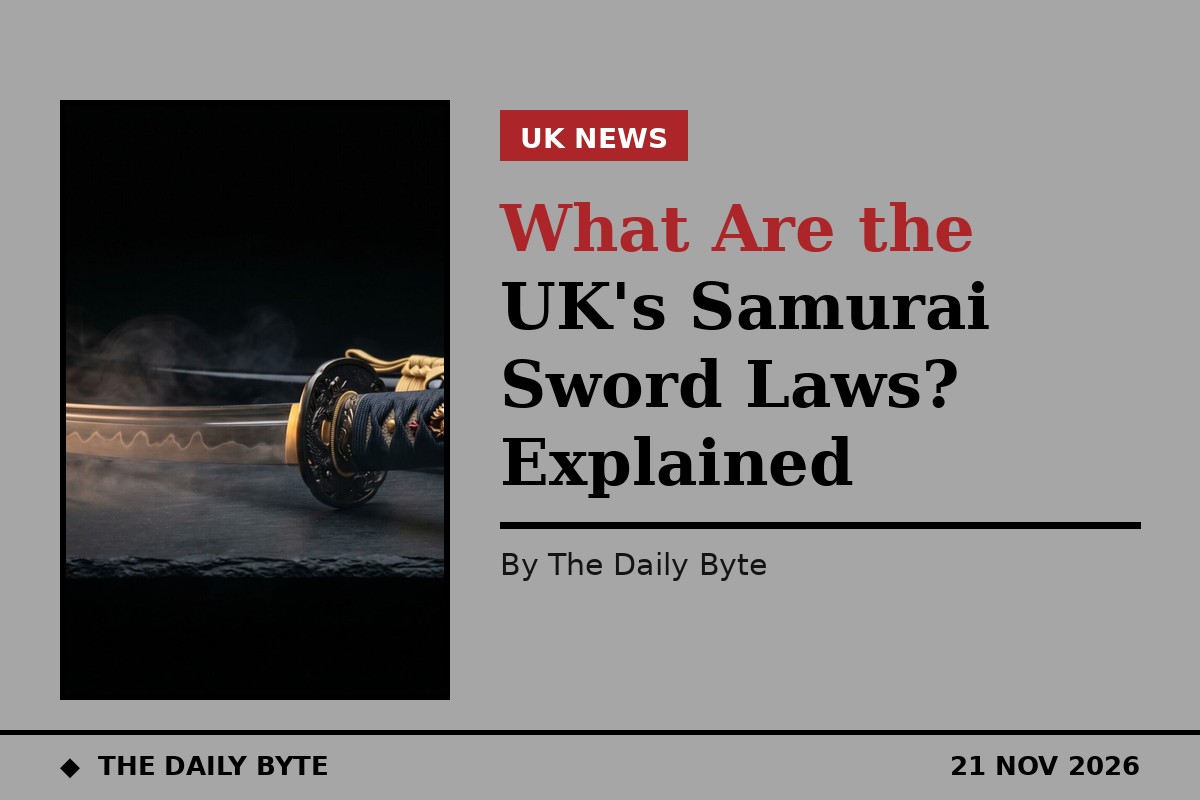
Samurai swords occupy a strange place in British law. They are not banned outright, but buying, selling, importing or making most of them is a criminal offence. The question came back into the news in November 2026, when three men were jailed at Truro Crown Court for a samurai sword robbery at a home in Bude, Cornwall. This explainer sets out what the law actually says, who it applies to, and what the exemptions are.
What happened in Bude?
On the night of 14 July 2024, three men went to a property in Puffin Close, Bude, believing there was money inside. Two of them, Ben Burnage and Ashley Stewart, approached the front door armed with a samurai sword, tried the handle, and banged on the door. They left, were driven away, and then returned demanding more money before leaving the scene.
All three were sentenced at Truro Crown Court on 11 November 2026. Burnage, 24, of Polruan, was jailed for five years after pleading guilty to robbery. Stewart, 19, from Bude, who was 17 at the time of the offence, was sentenced to two years and six months in a young offenders' institution. Chaz Baker, 35, of no fixed abode in Plymouth, who drove them to the property, was sentenced to 15 months after pleading guilty to assisting an offender.
The officer in the case, Detective Constable Harry Mills, said: "Ben Burnage and Ashley Stewart took the decision to arm themselves with a potentially deadly weapon and attend a property knowing there would be people inside, and intending to rob them." The case was a robbery prosecution, not a prosecution for owning the sword, but it is a reminder of why the law treats these weapons as it does.
What does the law actually ban?
The key point is that British law does not ban the words "samurai sword". It bans a shape. Under section 141 of the Criminal Justice Act 1988, the Home Office can list weapons by order, and it is an offence to manufacture, sell or hire out any weapon on that list. Importing a listed weapon is also prohibited.
In April 2008, the list was extended to cover swords with a curved blade of 50 centimetres or over. The change came into force on 6 April 2008 through the Criminal Justice Act 1988 (Offensive Weapons) (Amendment) Order 2008. GOV.UK's current guidance lists the weapon simply as "Sword: a curved blade of 50 centimetres or over, based on the straight-line distance from the top of the handle to the tip of the blade."
For any weapon on the banned list, GOV.UK states that it is illegal to possess it, bring it into the UK, sell or hire it out, or lend or give it to someone, unless a legal exemption applies. The ban therefore covers the supply chain, not just the moment of use: a shop cannot sell a cheap replica katana, an importer cannot bring one in, and a private seller cannot pass one on.
It is also illegal to carry most knives or any weapons in public without a good reason, and illegal to use any knife or weapon in a threatening way. A folding pocketknife with a cutting edge no longer than three inches, which is not a lock knife, is the main exception to the carrying rule.
Why 50 centimetres?
The ban followed a government consultation published in March 2007 on whether to ban the sale, hire and import of samurai swords and other weapons. The government announced in December 2007 that it intended to proceed, and the order was debated in Parliament in March 2008.
Ministers told Parliament that they were concerned about reports of weapons described as samurai swords being used in violent crime, including murder. In the debate on 17 March 2008, the Home Office minister said that samurai swords had been used in about 80 incidents during the previous four years, including at least 10 murders. Police advice was that the availability of cheap imitation swords made them the weapon of choice for growing numbers of young men with criminal intentions, and the Association of Chief Police Officers supported the ban.
The 50-centimetre curved-blade definition was chosen deliberately. It was designed to catch the cheap imitation swords the government was most concerned about, while allowing legitimate uses of samurai swords by martial arts groups, historical re-enactors and collectors. The government said it had framed the definition to be enforceable without requiring police officers to make subjective judgments about whether a particular blade was or was not a samurai sword.
What is still legal?
The ban has always had exemptions, and they matter a great deal to collectors, martial artists and re-enactors. A curved sword is not covered by the ban if it was made before 1954, or if it was made by traditional methods of making swords by hand. The original defence applied only to swords made in Japan, but it was widened later in 2008 to cover genuine curved swords made anywhere in the world, after collectors pointed out that swords of cultural and historical significance were made elsewhere, including military swords from the First and Second World Wars.
There are further defences for swords used in religious ceremonies, for martial arts, and for historical re-enactment or sporting activity, where public liability insurance is held. GOV.UK also notes that knives and weapons more than 100 years old are generally exempt from the banned list, except for flick knives and gravity knives. Anyone relying on an exemption should be able to show evidence for it, and the Home Office advises people to contact their local police or seek legal advice if they are unsure.
The practical result is that a genuine antique katana, or a traditionally hand-forged blade used by a martial arts club, can be owned and traded lawfully, while a factory-made replica with a curved blade of 50 centimetres or more cannot be sold, hired or imported. Buying a sword online from overseas is particularly risky: customs officers apply the same rules at the border, and a prohibited sword can be seized.
Carrying a sword in public
Owning a lawful sword and carrying it in public are different things. It is illegal to carry most knives or weapons in public without a good reason, and a court decides whether the reason is good enough if a person is charged. Examples of good reasons given by GOV.UK include using the item for work, for religious reasons, such as the kirpan some Sikhs carry, or as part of a national costume. Travelling directly to or from martial arts training or an appraisal, with the sword securely wrapped, is the kind of reason that can count. Stopping off to display it, or carrying it without any purpose, is not.
The penalties are serious. GOV.UK states that the maximum penalty for an adult carrying a knife or weapon illegally is four years in prison, an unlimited fine, or both. A person convicted of carrying a knife or weapon illegally more than once will receive a prison sentence. Using a weapon to threaten someone, or in a robbery as in the Bude case, is dealt with as a separate and much more serious offence, and the sentences reflect that.
Other banned blades
Samurai swords are only one entry on a long list. GOV.UK's banned knives and weapons table also includes flick knives, gravity knives, butterfly knives, disguised knives, stealth knives, swordsticks, push daggers, and shuriken, also known as throwing stars. Two more recent additions are aimed at weapons associated with street violence: the ninja sword, defined as a sword with a straight blade 14 to 24 inches long, and zombie-style knives or machetes, defined as a knife or machete over eight inches long with a pointed end and a plain cutting edge, plus features such as serrations, spikes, or more than two sharp points.
The pattern is consistent: the law targets weapons designed to kill or cause serious injury that have no legitimate everyday use, and it defines them by measurable features, such as blade length and shape, so that the rules can be applied at a shop counter or a border post.
What this means in practice
For most people, the rules are straightforward. Do not buy a cheap curved sword online and expect it to arrive. Do not carry any blade in public without a clear, lawful reason. If you collect or practise martial arts, keep the paperwork that shows your sword qualifies for an exemption, store it securely at home, and transport it wrapped and out of sight.
For sellers, the rules are stricter still. It is illegal to sell most knives or any weapons to anyone under the age of 18, and selling a banned sword at all is an offence. Ignorance of the law is not a defence, and the Bude case shows the other side of the same coin: a sword used to frighten people during a robbery will be treated by the courts as what it is, a potentially deadly weapon, and sentenced accordingly.
This article is general information about the law, not legal advice. Anyone who owns, collects or sells swords and is unsure of their position should check the GOV.UK guidance or speak to a solicitor, because the exemptions are narrow and the penalties for getting it wrong are severe.