What Happened to Russian Warship Naro-Fominsk?
Ukraine says its security service struck the Russian missile corvette Naro-Fominsk with drones in the Gulf of Finland on the night of 10–11 November 2026, in what is thought to be the first Ukrainian drone attack on a Russian warship in Baltic waters used by civilian shipping. Finland has confirmed that it detected a strike on a Russian warship in the gulf, and Estonia has confirmed an explosion on a Russian Baltic Fleet vessel — but neither country has named the ship or the attacker, and Russia has not confirmed that the Naro-Fominsk was hit. The extent of any damage, and whether anyone was hurt, remains unknown.
That careful split — a clear Ukrainian claim on one side, and partial confirmation from two NATO neighbours on the other — is the heart of this story. This explainer sets out what each side has actually said, what the ship is, why the location matters, and what is still not known.
What happened in the Gulf of Finland?
Ukraine’s Security Service, the SBU, said it “planned and carried out” a drone strike on the Naro-Fominsk on the night of 10–11 November, as part of a wider drone operation against the Russian oil export port of Ust-Luga on the Baltic coast. The SBU described the vessel as a Buyan-M-class small missile corvette of Russia’s Baltic Fleet carrying Kalibr and Oniks cruise missiles. It did not say what weapon was used, give a position or a time for the hit, or publish any photograph or video evidence of damage to the ship.
The Ust-Luga half of the same overnight operation is better documented. Ukraine’s general staff said five oil storage tanks were damaged at the port, and the governor of the Leningrad region, Alexander Drozdenko, confirmed a fire in the Ust-Luga port area after a drone attack, three injured workers, and about 150 drones shot down over the region that night. Russia has not confirmed a hit on the Naro-Fominsk by name.
Estonia’s defence minister, Martin Herem, told the public broadcaster ERR that an explosion occurred on a Russian Baltic Fleet vessel in the Gulf of Finland at about 5.30am local time on Wednesday 11 November, that smoke was seen coming from the ship afterwards, and that the ship then headed back towards St Petersburg. Herem was careful about the cause, saying Estonia could not confirm whether Ukrainians were behind the explosion or whether some accident had happened. He did not name the ship.
Finland’s account matches that timing and place. A senior Finnish official told the public broadcaster Yle that Finland had detected a strike near Gogland, the Russian-held island in the eastern Gulf of Finland that Finns call Suursaari, about 40 kilometres off the Finnish coast near Kotka. Brigadier General Markku Viitasaari, director of national defence at Finland’s defence ministry, told the newspaper Helsingin Sanomat that Finnish sensors had recorded flashes and smoke from the ship in international waters near Gogland. Finland’s Defence Forces said they had detected a strike on a Russian warship in the Gulf of Finland and had monitored the situation since, but would not say where, when or how it was detected.
What have Finland and Estonia confirmed — and what have they not?
It helps to keep three separate confirmations apart, because they are not the same thing. Ukraine names the ship, claims responsibility, and links the strike to the Ust-Luga operation, but offers no visual evidence and no detail on damage. Finland confirms that a strike on a Russian warship was detected in the Gulf of Finland, and its officials place the incident near Gogland, but Finland has not said who carried it out, with what, or which ship it was. Estonia confirms an explosion on a Russian Baltic Fleet vessel at about 5.30am on 11 November and says the ship returned towards St Petersburg, but its defence minister explicitly declined to confirm an attacker or rule out an accident.
Finland’s foreign minister, Elina Valtonen, said the security situation in the Baltic Sea remained stable and safe and that there was no threat of any kind to marine traffic. Finnish authorities also restricted sea and air traffic in the eastern end of the gulf for a time as a precaution, and reports said a drone briefly entered Finnish airspace that night. None of that amounts to a Finnish confirmation that the ship Finland and Estonia observed was the Naro-Fominsk — that link is, for now, a reasonable inference from matching times and places, not an officially established fact.
That distinction matters because some write-ups of the incident have gone further than the SBU itself, describing the corvette as destroyed. The SBU’s own wording describes a hit, not a sinking, and it says nothing about the ship’s condition afterwards. Until photographs, satellite imagery or an official statement on the vessel’s state appear, the honest position is that a strike is claimed and partly corroborated, while the damage is unknown.
What is the Naro-Fominsk?
The Naro-Fominsk is a Project 21631 small missile ship, known by its class name Buyan-M. It was commissioned into Russia’s Baltic Fleet on 23 December 2023, is 74.1 metres long, and displaces 949 tonnes, according to defence reporting on the class. Buyan-M corvettes are small warships designed for coastal waters, inland seas and navigable rivers, but they carry outsized firepower for their size: a single eight-cell vertical launch system that can fire Kalibr land-attack cruise missiles or Oniks anti-ship missiles, along with a 100mm naval gun and self-defence weapons.
That missile load is why the ship matters beyond its size. Kalibr missiles have been used extensively by Russia to strike targets on land in Ukraine, and Oniks missiles are designed to attack ships. A Buyan-M operating in the Baltic can therefore threaten targets far beyond the gulf itself, even though the vessel is far smaller than a frigate or destroyer. The SBU described the Naro-Fominsk in exactly those terms — a Kalibr and Oniks carrier — and the ship’s missile load at the time of the strike is not known.
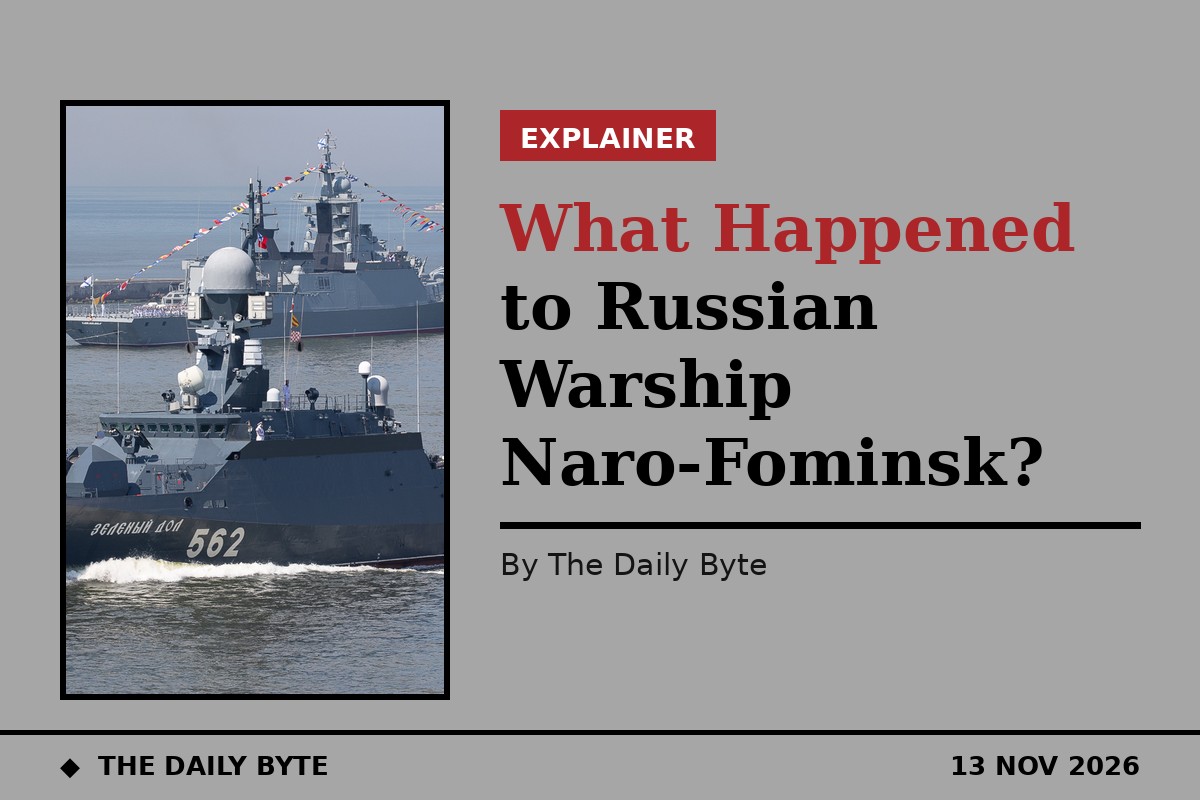
The photograph used with this article shows a Buyan-M-class corvette of the same class, the Zelenyy Dol, rather than the Naro-Fominsk itself. No verified photograph of the Naro-Fominsk after the reported strike has been published.
Why does the location matter?
The Gulf of Finland is a narrow arm of the Baltic Sea between Finland to the north, Estonia to the south and Russia to the east, leading to the port of St Petersburg. It is a busy civilian waterway used by oil tankers and commercial shipping, and it is also home to subsea data and power cables. Finland and Estonia are both NATO members, and Finland shares a long land border with Russia, so any military incident in the gulf is watched closely in Helsinki and Tallinn as well as in Moscow and Kyiv.
That is why the “first” in this story carries weight. The BBC reported that the attack was thought to be the first time Ukrainian drones had attacked a Russian ship in an area of the Baltic Sea open to civilian maritime traffic, and defence analysts have described it as the first Ukrainian attack on an operational Russian warship at sea in the Baltic region since Russia’s full-scale invasion began in February 2022. Ukraine has previously used naval drones against Russian warships in the Black Sea, but the Baltic is a different theatre — shallower, narrower, crowded with neutral and NATO shipping, and much further from Ukraine.
Finland’s defence officials had warned Kyiv that the gulf is a narrow waterway used by commercial ships and oil tankers and crossed by subsea cables, according to the BBC’s reporting, which underlines the risk that a strike in these waters could affect shipping that has nothing to do with the war. So far, Finland’s foreign minister has said there is no threat to marine traffic, and no civilian vessel has been reported damaged.
What is not known — and what has not been claimed
Several basic questions remain unanswered. The extent of the damage to the Naro-Fominsk is unknown, and it is not known whether any crew members were killed or injured. It is not known what weapon was used, whether one drone or several were involved, or how a Ukrainian drone reached a target in the eastern Gulf of Finland. It is not officially established that the ship observed by Finland and Estonia was the Naro-Fominsk, even though the times and the location line up with the SBU’s claim. And Russia has said nothing about the ship itself, which follows its established pattern of withholding confirmation of naval losses.
Readers should also beware of claims that go beyond the evidence. The SBU did not say the ship was sunk or destroyed, did not publish damage photographs, and did not say the vessel could no longer sail or fight. Any report stating those things as fact is adding detail that the source material does not contain. Equally, the absence of a Russian denial about the ship is not proof that the strike succeeded — Moscow rarely comments on such incidents at all.
Does this change the war at sea?
It is too early to say, but the direction of travel is clear. Ukraine has steadily extended the reach of its long-range drone operations, from the Black Sea to Russian oil refineries and ports, and now — if the SBU’s claim is correct — to a Russian warship under way in the Baltic. That would show that no Russian naval vessel in home waters can be assumed safe, and it would force Russia to devote more air defence and escort resources to the Baltic Fleet, which has historically operated in relatively sheltered waters close to St Petersburg.
For NATO’s Baltic members, the incident is a reminder of how quickly the war can touch their neighbourhood. Estonia and Finland both detected the incident with their own sensors and spoke about it publicly within a day, which is itself a signal: both countries wanted it known that they were watching. But neither country has treated the incident as a threat to its own security, and Finland has stressed that the situation remains stable. The gulf is not a NATO–Russia flashpoint today; it is a place where a Ukrainian operation happened to take place within sight of two NATO states.
What happens next?
The next evidence is likely to come from outside official statements. Satellite imagery of the Baltic Fleet’s base areas, shipping movements in the gulf, and any photographs of the Naro-Fominsk in port would each help establish whether the ship was damaged and how badly. Ukraine may release further detail if it chooses to, and Finland or Estonia may say more about what their sensors recorded. Russia is unlikely to confirm anything unless the damage becomes impossible to hide.
The strike also came at a diplomatically busy moment. Russia and Ukraine held talks in Abu Dhabi on 10–11 November, and US envoys Steve Witkoff and Jared Kushner then visited Moscow and met President Volodymyr Zelenskyy in Dublin, where it was agreed that European partners would join the next round of negotiations. No source links the Gulf of Finland strike to those talks, and this article draws no such connection — the timing is a coincidence of the calendar, not evidence of a message being sent.
For now, the verified position is this: Ukraine says it hit the Naro-Fominsk in the Gulf of Finland; Finland and Estonia confirm that something exploded on a Russian warship there on the morning of 11 November; and nobody outside Ukraine has confirmed the ship’s name, the weapon, the damage or any casualties. That is a significant claim, partly corroborated — and still incomplete.
Frequently asked questions
Did Ukraine sink the Russian warship Naro-Fominsk? No such claim has been verified. The SBU said it hit the corvette; it did not say the ship sank or was destroyed, and the extent of any damage is unknown.
Where is the Gulf of Finland? It is the eastern arm of the Baltic Sea, between Finland, Estonia and Russia, leading to St Petersburg. It is used by civilian shipping and oil tankers and crossed by subsea cables.
What missiles does the Naro-Fominsk carry? According to the SBU and defence reporting, the Buyan-M-class corvette carries Kalibr land-attack cruise missiles and Oniks anti-ship missiles in an eight-cell vertical launch system.
Has Russia confirmed the strike? No. Russia has not confirmed a hit on the Naro-Fominsk by name, although the Leningrad region governor confirmed a fire at the Ust-Luga port in the same overnight operation.
Sources: BBC News, reported via Europesays: Ukrainian drone strikes Russian warship in Gulf of Finland; Global Defense Corp: Ukraine’s long-range kamikaze drones destroyed Russia’s missile corvette in the Gulf of Finland; The Insight International: Ukraine strikes Russian warship in the Gulf of Finland, Finnish military confirms; EA WorldView: Ukraine war, day 1,723 — no advance but Europe to join talks with Russia.