What Is a Court-Martial? US Military Justice Explained
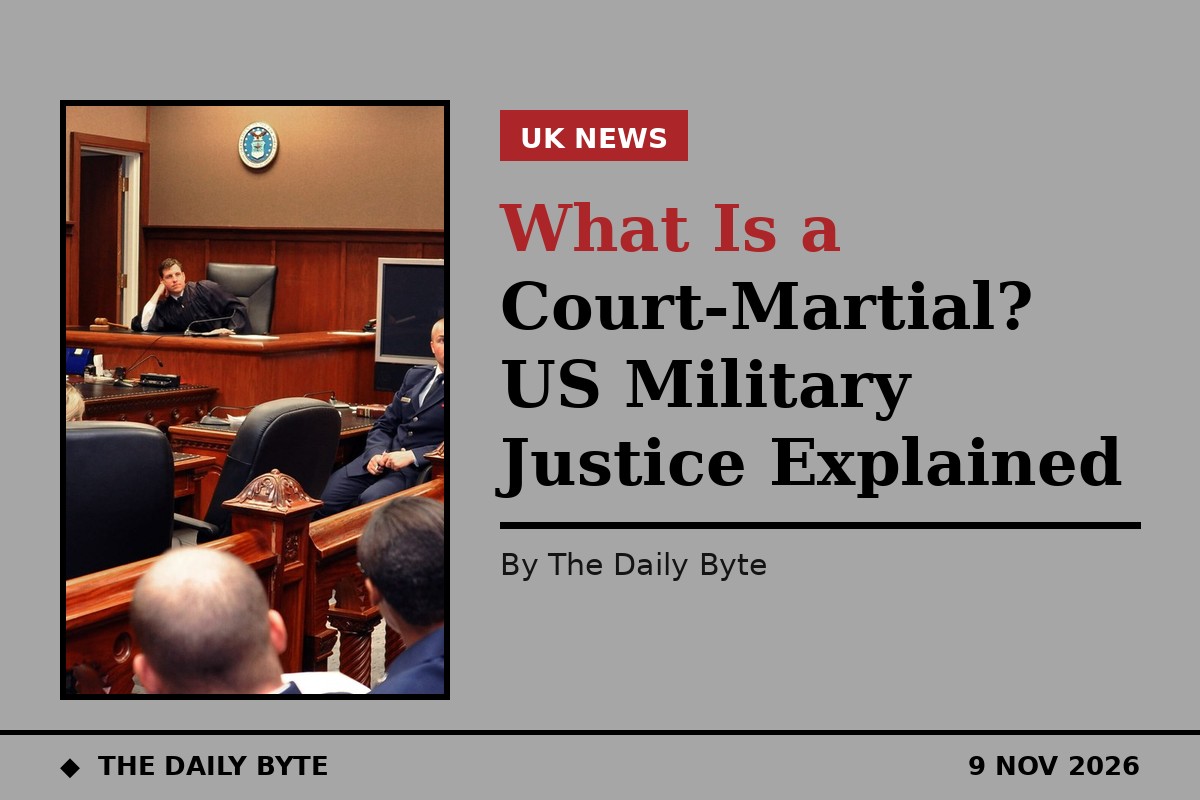
A court-martial is a military criminal trial. It is the system the United States armed forces use to try service members accused of breaking military law. It is not a civilian court: it is established under Congress's constitutional authority to regulate the armed forces, and it runs under its own code, the Uniform Code of Military Justice (UCMJ).
The Uniform Code of Military Justice
Congress enacted the UCMJ, codified in Title 10 of the United States Code, sections 801 to 941, as the criminal code for every member of the armed forces, wherever they serve in the world. The president implements the code through the Manual for Courts-Martial, which sets out the rules for trial procedure and evidence. Each service then adds its own regulations, such as Air Force instructions for the Air Force.
The UCMJ covers offences ranging from absence without leave to serious crimes. Its punitive articles run from Article 77 to Article 134 and include offences that have no civilian equivalent, such as conduct unbecoming an officer and a gentleman.
The three levels of court-martial
There are three levels of trial, each with different powers. A summary court-martial is the least formal: a single commissioned officer acts as judge and jury, it can try only enlisted members, and it handles only non-capital offences. A special court-martial is the intermediate level, used for mid-range offences, with a maximum of twelve months' confinement. A general court-martial is the highest trial level, used for the most serious offences. It is made up of a military judge sitting alone, or five members and a military judge.
How a case gets to trial
When an offence is reported, the accused's commander conducts an inquiry. If the case is serious enough, formal charges are preferred, which means they are formally brought against the accused. Preferred charges are allegations only: the accused is presumed innocent unless and until proven guilty.
Before charges can be referred to a general court-martial, an Article 32 preliminary hearing must normally be held, unless the accused waives it in writing. A hearing officer, usually a certified judge advocate, examines whether the charge describes an offence under the UCMJ, whether there is probable cause to believe the accused committed it, whether the convening authority has jurisdiction, and what should happen to the case. The hearing officer's recommendation is not binding, and the convening authority then decides whether to refer the case to trial.
Rights of the accused and appeals
The accused has the right to counsel, may cross-examine witnesses and may present evidence at the hearing and at trial. A conviction at a general court-martial can be appealed through the military appeals system, which includes the service courts of criminal appeals and the Court of Appeals for the Armed Forces.
Why it is in the news
The system is in the headlines because the US Air Force has preferred charges against Lieutenant Colonel Michael Morris, a former assistant military attache at the US embassy in London. The charges, which are allegations and have not been proven, include possession and distribution of child sexual abuse material, obstruction of justice and conduct unbecoming an officer. Morris left the United Kingdom in August 2026 before British police could question him, and the Metropolitan Police said US authorities informed them of the investigation on 25 August. A military hearing is due in November at Joint Base Andrews, near Washington DC, and Morris will enter a plea only if the case is referred to a court-martial. His brother, Benjamin Morris, faces separate trial in Illinois on related charges, which he denies.