What Is a Data Centre? How They Work
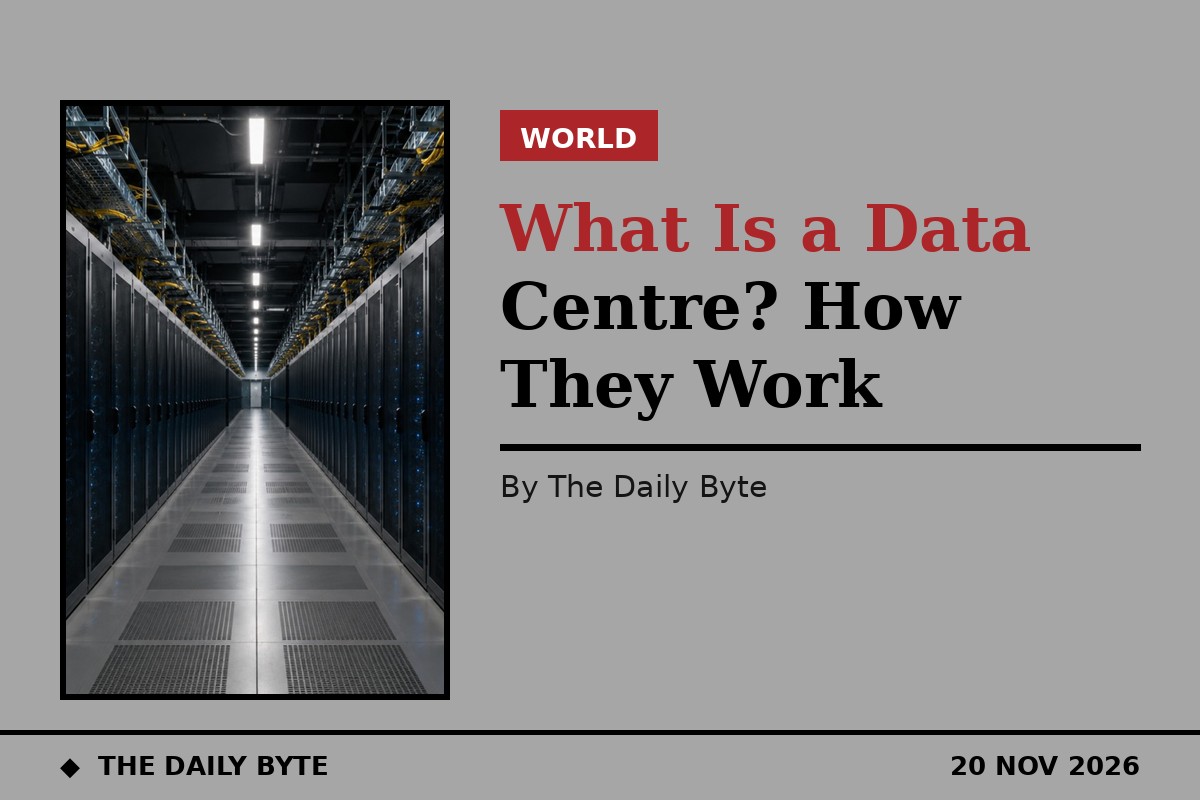
A data centre is a purpose-built building that houses the computers, storage and networking equipment that the digital world runs on, and supplies them with the power, cooling and security they need to keep working around the clock. Every time you send a message, watch a video, check a bank balance or ask a chatbot a question, the work is almost certainly done in a data centre, often hundreds or thousands of kilometres away. The building itself is usually plain and windowless, but inside it is one of the most important pieces of infrastructure in modern life — as essential, in its way, as a power station or a waterworks.
Data centres are in the news in November 2026 because they have become a political argument as well as a piece of infrastructure. On 20 November, US President Donald Trump said the United States would penalise American companies that build data centres overseas, telling reporters at the White House that he would impose a "tremendous tax" on firms that build them abroad, after returning from a trip to Asia. He gave no details of the plan and said he had not yet told his own officials about it. The same week, his administration tightened the rules on the advanced computer chips that go into data centres in South East Asia, in an effort to stop Chinese companies from renting computing power abroad to get around US export controls. The argument is about artificial intelligence, energy and national power, but it only makes sense if you understand what a data centre actually is.
What is inside a data centre?
The basic unit of a data centre is the server, a powerful computer that stores information or carries out calculations. Servers are stacked in tall metal cabinets called racks, which stand in long rows inside large halls. A single rack can hold dozens of servers, and a large hall can hold thousands of racks. The servers are connected by cables to each other and to the outside world through fibre-optic links, so that data can move in and out of the building at enormous speed.
Around the servers sits a second layer of equipment. Storage systems hold the data that servers need, from photographs and emails to the vast datasets used to train artificial intelligence models. Network switches direct traffic between servers and to the internet. Then there is the infrastructure that keeps everything running: transformers and switchgear that bring electricity in from the grid, batteries and generators that take over if the power fails, air conditioning and cooling systems that remove the heat the servers produce, and security systems that control who can enter the building and which parts of it they can reach.
To a visitor, a data centre hall looks oddly empty. The racks hum, small lights blink, and cold air blows up through vents in the floor, but there are very few people. That is deliberate. The machines are designed to be managed remotely, and staff mostly work in control rooms, or walk the halls to replace failed parts. A large data centre may employ only a few dozen people directly, which is one reason local communities sometimes ask what they get in return for hosting one.
Why do data centres use so much electricity?
Servers turn almost all the electricity they consume into heat. That is the fundamental problem of a data centre: it is a building full of machines that produce heat, and the heat has to be removed continuously or the machines will fail. A modern rack of servers can give off tens of kilowatts of heat, and racks built for artificial intelligence can give off more than 100 kilowatts each, which is why the newest data centres are so much more power-hungry than the ones built ten years ago.
Power arrives at a data centre in a chain. Electricity from the grid enters at medium voltage, passes through transformers and switchgear, then through uninterruptible power supplies, known as UPS systems, which use batteries to keep the servers running for a few minutes if the grid fails, and finally reaches the servers themselves. Every step in that chain loses a little energy as heat, and the losses add up.
The industry measures this with a figure called power usage effectiveness, or PUE, which is the total power used by the whole building divided by the power used by the computing equipment alone. A PUE of 1.2 means that for every 100 units of power the servers use, another 20 units are spent on cooling, lighting and the rest of the building. A perfect score would be 1.0, and no real data centre achieves it, although the best modern buildings come close. According to the UK's National Energy System Operator, data centres used about 2 percent of all electricity in the United Kingdom in July 2025, with around a third of that energy going to cooling.
That share is rising as demand for artificial intelligence grows, and it is the reason data centres are now argued about in the same breath as power stations. A single large data centre campus can draw 100 megawatts or more, comparable to a small city, and some planned artificial intelligence campuses aim for a gigawatt, which is the output of a large power station. Where that power comes from, and whether the grid can supply it without raising prices or emissions for everyone else, has become one of the most contested questions in energy policy.
How do data centres stay cool, and why does water matter?
Cooling is the second great system in a data centre, after power, and it is the one that most often brings the building into conflict with its neighbours. The simplest method is air cooling: cold air is blown through the halls, picks up heat from the servers, and is then cooled and blown around again. It works, but it uses a great deal of electricity to move and chill the air.
The cheapest way to remove large amounts of heat is to evaporate water. In evaporative cooling, outside air passes over wet surfaces or through a cooling tower, and the water that evaporates carries the heat away with it. It uses less electricity than air cooling, but it consumes water, and the water that evaporates is gone for good — it does not return to the local supply. Industry estimates suggest that a medium-sized data centre can use roughly 300,000 gallons of water a day, while a large hyperscale facility in a hot climate can use between one and five million gallons a day. One of Google's largest sites in the United States, at Council Bluffs in Iowa, has withdrawn on the order of 3.9 million gallons a day, according to Google's own environmental reporting.
Newer cooling methods try to escape this trade-off. Direct-to-chip liquid cooling pipes water or another fluid directly to the hottest parts of the server, removing heat far more efficiently and using much less water. Immersion cooling goes further, submerging whole servers in a special liquid that does not conduct electricity. Closed-loop systems recycle their cooling fluid instead of evaporating it. Each of these methods costs more to build, which is why older and cheaper buildings still use evaporative cooling, and why the water question is different for every site. There is no single figure for how much water a data centre uses, because the answer depends on its size, its cooling design and its local climate — and that is exactly what local residents and planners argue about when a new one is proposed.
What are the different types of data centre?
Not all data centres are the same size or serve the same purpose. An enterprise data centre is built by a single company for its own use — a bank, a hospital or a government department, for example. In the United Kingdom, the Cyber Security and Resilience Bill 2025 defines enterprise data centres as having an IT load of more than 10 megawatts, which gives a sense of how large even a single company's facility can be.
A colocation data centre is a shared building. Many different customers rent space, power and cooling inside it, and install their own servers in their own racks. Colocation suits companies that need a secure, well-connected home for their equipment but do not want to build a whole facility themselves.
A hyperscale data centre is the largest kind, built by the giant cloud companies to provide computing as a service to millions of customers. The word hyperscale describes both the size of the building and its ability to add capacity quickly as demand grows. The companies that build them are known as hyperscalers, and the largest include Microsoft Azure, Google Cloud and Meta. A hyperscale campus is often a cluster of many huge buildings on one site, with its own substations and sometimes its own water supply arrangements.
Finally there is the edge data centre, a small facility built close to the people who use it, for services that need very fast responses, such as mobile networks, self-driving vehicles or local video processing. Edge centres are small but numerous, and they are expected to grow as more devices need computing power nearby rather than in a distant giant hall.
How do data centres keep working when things go wrong?
A data centre's whole purpose is to keep working, and its design reflects that. Power comes in through more than one route, so that a failure in one supply does not stop the building. Batteries take over instantly if the grid fails, and diesel generators start up within seconds to keep the building running for hours or days. Cooling systems have spares. Network links arrive by different physical paths, so that a digger cutting one cable does not disconnect the building.
The industry grades this redundancy in tiers, from basic buildings with a single path for power and cooling to the most resilient buildings, where every system has a duplicate that can take over without interruption. The higher the tier, the more expensive the building, and the more a customer can rely on it. Cloud companies spread their services across several data centres in different places, so that even if one whole building fails, the service keeps running from another.
Security is part of the same picture. Data centres hold other people's most sensitive information, so they are protected by fences, gates, guards, cameras and biometric checks, and by strict rules about who can enter a hall and touch a server. The UK Parliament's POSTnote on data centres, published in March 2026, describes them as buildings that underpin most aspects of modern life, including economic activity, public services and how people interact with one another — which is why governments are increasingly treating them as critical infrastructure, and why attacks on them, whether physical or digital, are taken seriously.
Why are data centres controversial?
For the companies that build them, data centres are simple: the world wants more computing, and computing needs buildings. For the communities that host them, the calculation is more complicated. A data centre uses a great deal of electricity and sometimes a great deal of water, it takes up land, and it creates relatively few permanent jobs for its size. Residents near proposed sites have raised concerns about power prices, water supplies, noise from cooling equipment and the loss of farmland, and protests have been held in several European cities, including Dublin, Helsinki and Amsterdam. In Norway, the government has paused new grid connections for data centres while it reviews the policy.
Developers and governments answer that data centres bring investment, construction jobs, tax revenue and the digital services that everyone uses, and that they can be built with cleaner power and better cooling than the older ones. Some offer to pay for local infrastructure, fund community projects, or supply waste heat to nearby homes and greenhouses. The argument is far from settled, and it is now playing out in planning inquiries and in national politics in many countries at once.
The international argument is newer. Under a rule issued by the US Commerce Department on 16 November 2026, advanced American chips sent to data centres in Singapore, Malaysia, Indonesia, Thailand and Brazil now need licences, and operators that rent large amounts of computing power to customers in China and other restricted countries must obtain permission to continue, with a 90-day transition period. Washington's aim is to stop Chinese firms from renting computing power abroad to get around the ban on buying the chips themselves. The rule has alarmed banks and developers who have lent billions to data centre projects in South East Asia, because it makes those projects more expensive and less certain. President Trump's statement on 20 November, threatening a tax on American firms that build data centres abroad, points in the same direction: data centres are no longer just buildings, they are part of a contest over who controls artificial intelligence.
Frequently asked questions
What is the difference between a data centre and the cloud? A data centre is a physical building full of servers. The cloud is a service that runs on data centres: instead of buying your own servers, you rent computing power from a company that owns the buildings.
What is the difference between a data centre and a server room? A server room is a small room inside an office building with a few racks of servers. A data centre is a dedicated building, designed from the ground up for power, cooling, security and round-the-clock operation, and it is usually far larger.
How much electricity does a data centre use? It varies enormously. A small one might use less than a megawatt, while a large hyperscale campus can draw 100 megawatts or more. In the UK, data centres as a whole used about 2 percent of the country's electricity in 2025, according to the National Energy System Operator.
Do data centres use drinking water? It depends on the site. Evaporative cooling can consume large amounts of water, much of it lost to the air, while air-cooled and closed-loop liquid-cooled buildings use far less on site, although they may use more electricity instead. Developers are increasingly asked to disclose exactly how much water a proposed site will use and where it will come from.
Why are data centres built in particular places? Builders look for cheap and reliable electricity, good fibre-optic connections, land at a workable price, a climate that helps with cooling, and a planning system that will approve the project. That is why some regions have many data centres and others have almost none, and why governments are now competing to attract them.
Sources: UK Parliament — POSTnote 762: What are data centres and how sustainable are they? and Reuters — Trump says US to penalize firms building data centers abroad.