What Is a General Strike and How Does It Work?
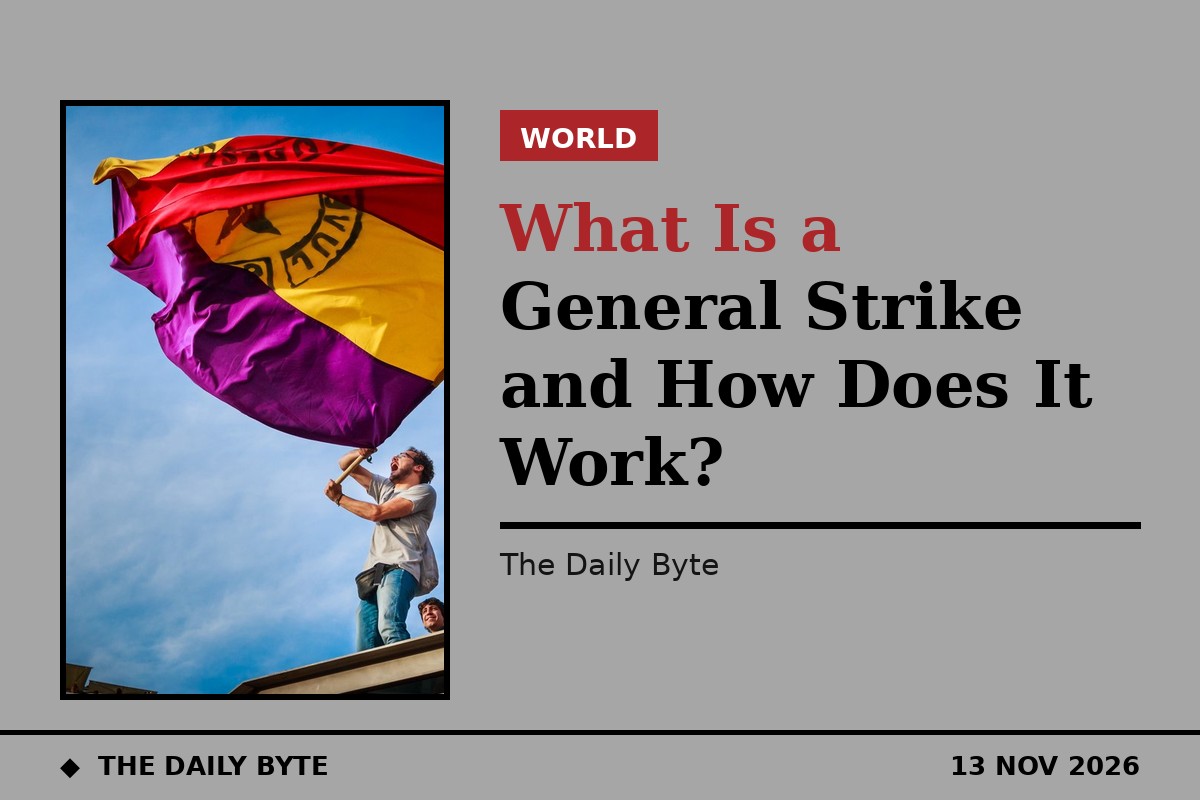
A general strike is a mass work stoppage in which a substantial proportion of workers across many different industries stop work at the same time, bringing a city or a whole country to a standstill. Unlike an ordinary strike, which is confined to one employer or one sector, a general strike spreads across transport, schools, factories, shops and public services at once, and its aim is usually to force a government or employers to meet a broad demand, such as higher pay, cheaper housing or political change. Spain gave the latest example on 11 November 2026, when unions called the country's first general strike in 14 years over housing, wages and prices.
The power of a general strike comes from its scale. One factory walking out can be replaced or waited out; a country walking out cannot. When trains stop, schools close, rubbish goes uncollected and shops shut on the same day, daily life is disrupted so visibly that governments and employers are forced to respond. That is also why general strikes are rare: they need coordination across many unions and workplaces, they cost workers lost pay, and they can lose public support if they drag on or turn violent.
What is the difference between a general strike and an ordinary strike?
An ordinary strike is a dispute between a specific group of workers and their employer, usually over pay or conditions in that workplace. A general strike crosses those boundaries. As the Museum of Protest puts it, a general strike is a mass work stoppage in which a substantial proportion of workers across multiple industries collectively cease work, while a strike limited to one trade or sector "cannot properly be called a general strike." The same source distinguishes a general strike from a "generalized strike", in which several industries strike at the same time but not necessarily all or most of them. In practice the line can blur, but scale and coordination are what set a general strike apart, and a true general strike is often understood to involve a majority of the workforce in a city, region or country.
General strikes also differ in who they are aimed at. An ordinary strike is usually aimed at one employer. A general strike is often aimed at a government, or at employers as a whole, and its demands are usually political or society-wide: a new minimum wage, action on housing costs, the defence of democracy, or the end of a regime. That is why general strikes are often called by national union federations or broad coalitions rather than by a single workplace union, and why they are often accompanied by street demonstrations.
How does a general strike work?
A general strike works by withdrawing labour from so many parts of the economy at once that normal life cannot continue. Transport workers stop the trains and buses, teachers close the schools, factory workers halt production, shop workers shut the stores, and public-sector workers stop administrative services. Picket lines form outside workplaces, depots and markets, and demonstrators march in city centres. The disruption is the point: it shows the government and employers how much society depends on the people who have stopped work, and it creates pressure to negotiate.
Organising one is an enormous logistical task. Unions and strike committees must agree a start time, a common set of demands and a plan for which services keep running. Many general strikes deliberately keep some essential services going, such as emergency healthcare and fire cover, so that the public is not endangered and sympathy is not lost. In Spain, for example, minimum services were set for commuter trains during the November 2026 stoppage. Strike funds, savings and community support matter too, because workers who stop work lose pay, and a strike that lasts days or weeks can only continue if strikers can feed their families. Communication is also vital: organisers must be able to tell millions of people whether the strike continues, is suspended for talks, or has ended.
The strike usually ends in one of three ways. The government or employers concede enough for the unions to call it off, as happened after the Grenelle Accords in France in 1968. The two sides negotiate a compromise, as often happens after a one-day stoppage. Or the strike runs out of momentum, divisions appear between unions, and workers drift back, which is why unity and clear demands matter so much. A general strike that has no clear demand and no agreed end point is much harder to sustain.
Why did Spain hold a general strike on 11 November 2026?
Spain's general strike of 11 November 2026 was called by the country's two largest unions, the UGT and the CCOO, together with smaller unions and tenants' associations, under the slogan "Salaries. Housing. Prices." It was the first general strike jointly backed by the big two unions since 2012, when workers stopped work against austerity during the eurozone debt crisis, and Euronews counts it as the eighth general strike since Spain returned to democracy in the late 1970s. What made this one unusual is that it was driven first by housing unrest rather than by a traditional labour dispute: the Associated Press noted it was the first general strike in Spain whose main push came from housing campaigners.
The spark was the eviction in September 2026 of 87-year-old Maricarmen Abascal from her home in Madrid, and her subsequent death, which triggered a wave of protests about the housing crisis. The figures behind the anger are stark. The Bank of Spain puts the country's housing deficit at roughly 750,000 homes, a gap projected to widen past one million by 2028. Rents have climbed roughly 80 percent over the past decade, while the cost of buying a home is up about 63 percent and wages have failed to keep pace. Spain's Youth Council calculates the average rent of 1,176 euros a month at about 98.7 percent of a young person's average monthly salary. Inflation, at 4.9 percent in September and October, was at its highest level in more than three years.
The unions demanded a large expansion of public housing, a new minimum wage agreement and government intervention in the housing market, while tenants' organisations want automatic renewal of leases, a crackdown on speculation and the elimination of tourist lets in pressured areas. Reuters reported that the unions said more than three million people took to the streets on the day of the strike, while the employers' confederation, CEOE, played down participation and called the strike a failure. The strike landed less than three weeks before a snap general election on 29 November 2026, called by Prime Minister Pedro Sanchez after his minority government failed to secure parliamentary approval for a package of housing measures.
What are the most famous general strikes in history?
General strikes have changed history several times. In October 1905, during the Russian Revolution, workers across the Russian Empire launched a general strike that began with railway workers and spread to factories, utilities and other industries, paralysing the country for about two weeks. Trains stopped, newspapers ceased printing and telegraph lines went dead. Under the pressure, Czar Nicholas II issued the October Manifesto, promising a constitution and an elected parliament, the Duma. The promises were only partly implemented, but the strike showed that mass nonviolent action could force concessions from an absolute monarch.
In Germany in March 1920, a general strike defeated a coup. When right-wing officers attempted the Kapp Putsch against the young Weimar Republic, unions called a nationwide strike that lasted about four days, from 13 to 17 March, with as many as 12 million workers taking part. Civil servants refused to obey the coup leaders' orders, transport and power stopped, and the coup collapsed without the strikers firing a shot. In Palestine in 1936, Arab Palestinians staged a general strike that lasted about six months, from April to October, one of the longest on record, in protest against British policy and Jewish immigration. It did not achieve its main goals, but it forced Britain to send a commission to investigate and it left a lasting mark on Palestinian political memory.
In France in May 1968, a student protest escalated into a general strike of about 10 million workers, nearly the entire national workforce, shutting down factories, transport, schools and media for around two weeks. The government and union leaders negotiated the Grenelle Accords on 27 May 1968, which offered substantial wage increases, including a roughly 35 percent rise in the minimum wage. President Charles de Gaulle survived in the short term and won the elections that June, but the strike is remembered as a cultural turning point. More recently, in Nepal in April 2006, a 19-day general strike and mass protests forced King Gyanendra to reinstate the dissolved parliament, a step that led within a few years to the abolition of the monarchy and the creation of a republic.
Are general strikes legal?
It depends on the country. In many European countries, including Spain and France, the right to strike is protected in law, although governments can set minimum service levels for essential transport and services, and courts can rule on whether a particular stoppage is lawful. In the United States, general strikes are rare in part because the 1947 Taft-Hartley Act outlawed sympathy action by unionised workers in support of workers at other companies, which makes a cross-industry stoppage legally risky. In non-democratic countries, strikes can be outright illegal and participating can lead to arrest. Even in democracies, a general strike that blocks roads, occupies buildings or turns violent can bring police action and prosecutions, which is why organisers usually stress nonviolent discipline: strikers stay home or gather in peaceful rallies, and the absence of normal activity, rather than confrontation, is the protest.
Workers also face a practical cost. Strikers are not usually paid for the days they do not work, and in some countries employers can take action against workers who take part in an unlawful stoppage. That is why unions build strike funds and why a general strike is normally treated as a last resort, called only after petitions, negotiations and smaller protests have failed to move the government or employers.
Do general strikes work?
Sometimes, and sometimes only partly. They work best when grievances are widely shared, when unions and other groups are united behind clear demands, when the timing catches a government at a vulnerable moment, and when the strike stays peaceful and disciplined. The 1905 Russian strike and the 1920 German strike both forced rapid concessions. The 1968 French strike won large pay rises. The 2006 Nepal strike restored democracy. But the 1936 Palestine strike exhausted the community that staged it without winning its main goals, and many one-day general strikes end with both sides claiming victory and little changing except the political mood.
Spain's November 2026 strike will be judged in the same way: by whether the housing decrees before parliament change, whether the election on 29 November shifts, and whether the unions and tenants' movement stay united afterwards. Whatever the outcome, the strike itself answered the question people were asking: a general strike is not just a big protest. It is a coordinated decision by workers across a whole society to stop, together, until they are heard.
Frequently asked questions
How long does a general strike last? Most modern general strikes last 24 hours, like Spain's on 11 November 2026. Historic ones have lasted far longer: four days in Germany in 1920, about two weeks in Russia in 1905 and France in 1968, 19 days in Nepal in 2006, and about six months in Palestine in 1936.
Do workers get paid during a general strike? Usually not for the days they do not work. Unions may pay strike pay from a strike fund, and community kitchens and donations can help, but lost wages are one of the main costs of taking part.
Can anyone join a general strike? A general strike is called by unions and coalitions, and it is aimed at the whole workforce, not only union members. In practice, participation depends on the law in each country, on whether a worker's employer is covered by the call, and on whether the worker is willing to lose pay and risk disciplinary action.
What is the difference between a general strike and a protest march? A march is a demonstration: people gather and walk together to show their views, then go back to work. A general strike is a work stoppage: people do not go to work at all, across many industries, so the economy itself stops. The two often happen together, as they did in Spain, where marches in Madrid and Barcelona followed the stoppage.