What Is a Humanoid Robot? How They Work
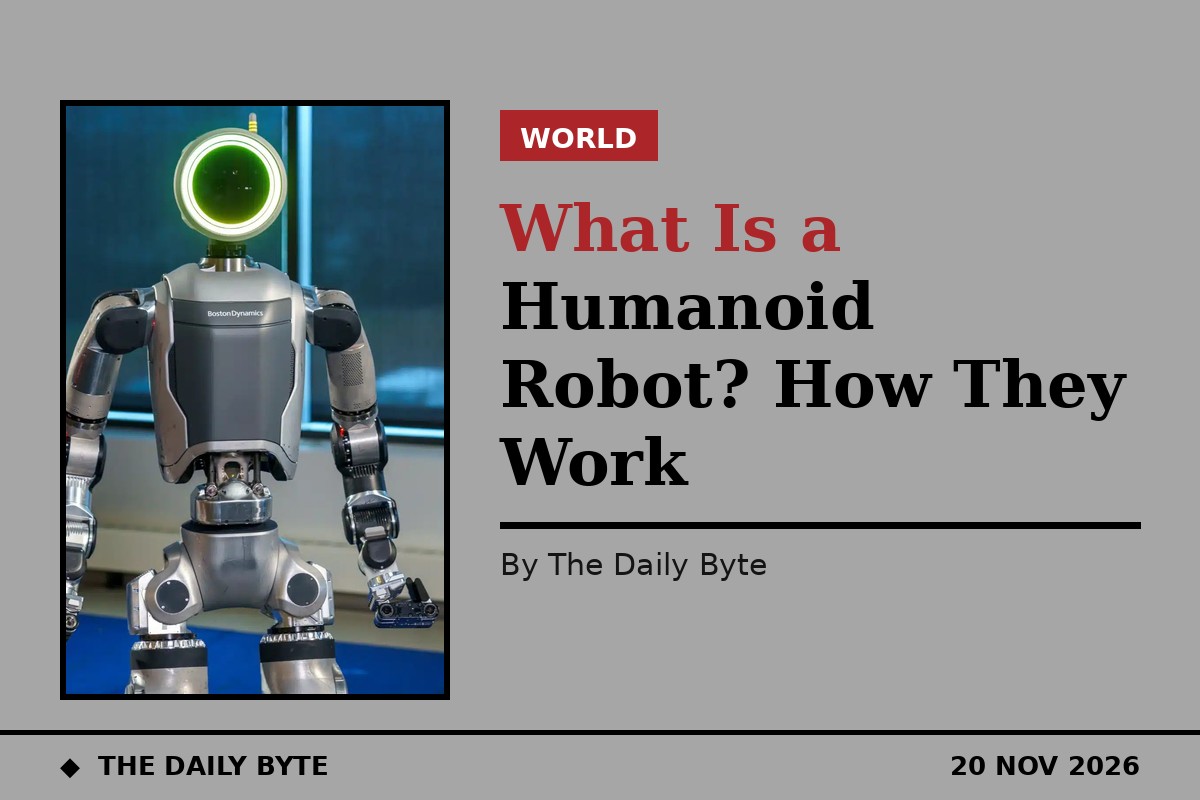
A humanoid robot is a robot built in the shape of a person: a head, a torso, two arms and two legs, designed to walk upright and to work in places made for humans. That human shape is the whole point. Factories, warehouses, offices and homes were all built around human bodies, with stairs, door handles, shelves and tools sized for human hands, so a robot shaped like a person can, in theory, use the world as it already is instead of needing the world rebuilt around it. The idea is old — it appears in science fiction going back a century — but only in the last few years have humanoid robots moved out of research labs and into real trials inside factories, which is why the question is being searched so much in November 2026.
The latest reason for the attention came on 17 November 2026, when Boston Dynamics and the chipmaker GlobalFoundries announced that GlobalFoundries would become the first company outside the car industry to test Boston Dynamics' Atlas humanoid robot. On-site testing is due to begin in early 2027, starting with a skills workshop to work out what jobs Atlas might actually do inside a chip factory, whether the buildings are ready for it, and how it would be trained for specific tasks. No task, factory or number of robots has been named yet, and the announcement is a test, not a rollout. Even so, it matters because it is the first time a humanoid has been pointed at semiconductor manufacturing, one of the most demanding factory environments there is.
What counts as a humanoid robot?
The definition is about the body plan, not about looking human. A humanoid has two legs for walking, two arms for reaching and handling objects, hands or grippers for holding things, and a head that usually carries cameras and sensors. It does not need a face, skin or a human voice, and most working humanoids have none of those. What makes a machine a humanoid is that it balances on two legs and manipulates the world with two arms, the way a person does.
That puts humanoids in a different family from the robots most people already know. A robot arm bolted to a factory floor is powerful and precise, but it cannot move to another workstation. A wheeled warehouse robot can carry shelves across a building, but it cannot climb stairs or pick up a box from a high shelf. A four-legged robot such as Boston Dynamics' Spot, which GlobalFoundries already uses to inspect its factories, is good at walking over rough ground and carrying sensors, but it has no arms and cannot do manual work. The humanoid tries to combine the mobility of a walking machine with the manipulation of an arm, in one body.
There are also machines that look human but are not humanoids in this sense. A talking head on a desk, or a statue-like android built to look like a receptionist, may have a human appearance without being able to walk or lift anything. Engineers generally do not count those as humanoid robots, because the term describes what the machine can do with its body, not how lifelike it looks.
How does a humanoid robot walk without falling over?
Walking on two legs is the hardest part of the design, and it is the reason humanoids took so long to become practical. A person walking is, in engineering terms, constantly falling forwards and catching themselves with the next step. A humanoid does the same thing, thousands of times an hour, using sensors that report where its body is, how fast it is leaning and what the ground is doing underneath it, and a control system that adjusts its joints many times a second to keep it upright.
Inside the robot, electric motors drive the joints at the hips, knees, ankles, shoulders, elbows and wrists. Engineers measure how many independent directions a robot can move in, calling each one a degree of freedom. The more degrees of freedom, the more flexible the movement, but also the harder the control problem. Boston Dynamics' electric Atlas is reported to have 56 degrees of freedom, and its hands alone have become a project in their own right: in October 2026 the company unveiled a redesigned Atlas hand with four fingers and 13 degrees of freedom, up from seven, built to be trained with reinforcement learning, a technique in which the robot improves by practising a task many times in simulation and in the real world.
Balance also depends on sensing. Humanoids carry cameras for vision, depth sensors for judging distance, gyroscopes and accelerometers that act like an inner ear, and force sensors in their feet and hands that report how hard they are pressing on the ground or on an object. The robot's software fuses all of that information into a picture of where its body is in space, and then decides where to put its feet next. When it works, the result can look almost casual. When it does not, the robot falls, which is why early trials happen in controlled spaces with people kept at a distance.
How do humanoid robots see, think and learn?
A humanoid's brain is really two systems working together. The lower system handles movement: keeping balance, placing feet, avoiding obstacles and stopping safely if something goes wrong. It must react in milliseconds, so much of it runs on the robot itself. The upper system handles tasks: recognising an object, deciding how to pick it up, planning a route across a room, and understanding instructions, whether those arrive as spoken words, typed commands or a program written by an engineer.
In recent years that upper system has changed more than any other part of the robot. The same kind of artificial intelligence that powers chatbots and image generators is now being used to help robots understand language and to plan multi-step tasks. Instead of a programmer writing out every motion in advance, a humanoid can increasingly be told to do something in plain words — pick up the box on the second shelf and put it on the trolley, for example — and work out the steps itself. The companies building these systems are careful to say this is still early technology, and much of what the public sees in demonstration videos is a robot repeating a task it has practised many times, sometimes with a human operator guiding it remotely. Teleoperation, in which a person controls the robot from elsewhere, is still a normal part of development and testing, and a polished video is not proof that a robot can do the same job unsupervised on a factory floor.
Training is also a major part of the work. Before a humanoid can do a job, it needs data: recordings of the task, simulations of the workplace and repeated practice runs. Boston Dynamics describes its Atlas programme around this idea, with customers first going through a skills development workshop to evaluate potential uses, assess readiness and begin training for specific tasks. That is the approach GlobalFoundries is taking, and it explains why the chipmaker's announcement talks about evaluation and training rather than about robots already working on the production line.
Who is building humanoid robots?
Three names dominate the field at the end of 2026. Boston Dynamics, owned by Hyundai Motor Group, builds Atlas, which began as a hydraulically powered research machine famous for parkour and backflips and is now an all-electric production platform. Its first deployments are with Hyundai, where Atlas is being trained for parts sequencing and material handling, and with GlobalFoundries, its first customer outside the car industry. Atlas is an industrial machine built for factories, and Boston Dynamics does not publish a retail price for it.
Tesla builds Optimus, also called Tesla Bot, which is designed from the start for mass production on car-factory lines. Optimus stands about 1.73 metres tall and weighs about 57 kilograms, and Tesla has said its target price is between 20,000 and 30,000 US dollars per unit at scale. Its second-generation hands have 22 degrees of freedom, and Tesla says it can walk at up to about 8 kilometres per hour. Optimus units are currently used inside Tesla's own factories for sorting and assembly tasks, and Tesla has talked about much larger production volumes than any other maker, although its earlier production targets were not met.
Figure AI, a smaller American company, builds the Figure robots, which have been trialled at BMW's car plant in Spartanburg in the United States. Figure's machines are designed as general-purpose workers for factories and warehouses, and the company has its own factory for building them. Other makers include Unitree of China, whose smaller G1 humanoid is listed from about 16,000 US dollars, making it one of the cheapest humanoids on sale, and Apptronik and Agility Robotics in the United States, whose Apollo and Digit robots are aimed at warehouses and logistics.
The differences between these machines matter less than the shared bet behind them. Every one of these companies is betting that a general-purpose human-shaped body will eventually be more useful than a collection of specialised machines, because one design can be retrained for many jobs. That bet is still unproven, and the companies disagree sharply about price, speed and how soon the robots will be ready.
What can humanoid robots actually do today?
The honest answer is: a few specific factory jobs, under supervision, and not much else yet. The most realistic tasks are the dull, repetitive and physically tiring ones that factories already struggle to staff. Moving parts from one station to another, known as parts sequencing. Loading and unloading machines, known as machine tending. Picking boxes and building orders in a warehouse. These are jobs where the robot repeats the same motions many times a day, where the environment is controlled, and where the cost of a mistake is limited.
GlobalFoundries already has evidence for the simpler half of this picture. Its four-legged Spot robots, which inspect the areas underneath its chip factories, have covered nearly 900 kilometres and completed more than 90,000 inspections at its Singapore site since April, with a 99 percent mission success rate, according to the companies. Spot does not have arms, so it cannot do manual work, but its record shows that a walking robot can operate reliably inside a working factory. Atlas has to prove the harder half: that a humanoid can do useful manual work, safely, in the same kind of environment.
Outside factories, the picture is thinner. Humanoids have been demonstrated as helpers in warehouses, as guides and greeters, and in research into care work and home assistance, but none of those uses is established at scale. A home is far harder than a factory, because it is cluttered, unpredictable and full of people, including children and pets. A care setting is harder still, because it involves touching people, which brings safety and trust questions that no regulator has fully answered. For now, anyone who sees a humanoid doing housework or looking after an elderly person is almost certainly watching a demonstration, not a product.
What are the limits and safety questions?
Battery life is one of the most practical limits. A humanoid doing physical work uses a great deal of energy, and most current designs run for a few hours before they need charging or a battery change. Atlas is designed so its battery can be swapped, which keeps it working while a flat battery charges, but that still means a factory needs spare batteries, charging stations and staff who know how to handle them.
Cost is the second limit. Industrial humanoids are expensive machines, and the economics only work if the robot can do enough useful work, reliably enough, to justify the price. That is why the early customers are large manufacturers rather than small businesses or households, and why the companies talk about leasing and service contracts as much as about selling robots outright.
Safety is the third and most important limit. A humanoid is a heavy machine, often weighing between 50 and 90 kilograms, with powerful motors and the ability to move quickly. If it collides with a person, or picks up the wrong object, the consequences can be serious. Standards for robots working alongside people are still being written, and some industry reports have suggested that dedicated humanoid safety standards may not be ready until 2028. Until those standards exist, humanoids will mostly work in fenced-off areas, or with people kept at a distance, or under close supervision.
There are also questions about what happens to the data a humanoid collects. Its cameras and microphones see and hear everything around it, which raises privacy questions in any workplace. Employers and regulators will need rules about what is recorded, where it is stored and who can see it, just as they did for CCTV and for workplace monitoring software.
Will humanoid robots take people's jobs?
This is the question that follows every announcement, and the honest answer is that nobody knows yet, because the robots are not yet good enough to replace people at scale. The companies building them say the first jobs to go will be the ones that are dangerous, repetitive or hard to fill, and that humanoids will work alongside people rather than replacing them. Workers' representatives are more sceptical, pointing out that the same promise was made about earlier waves of automation, and that the benefits of new technology have not always been shared with the people whose jobs changed.
What is clearer is that humanoids will change some jobs before they replace any. A factory worker who today spends a shift carrying parts may tomorrow supervise a humanoid that carries the parts, or train it, or fix it when it goes wrong. That shift needs new skills, and GlobalFoundries has linked its Atlas trial to a programme to train its employees in artificial intelligence, which suggests that at least some employers see the change as one to manage rather than simply to impose. The debate about jobs will only get louder as the robots get better, and it is one of the reasons the subject attracts so much attention.
Frequently asked questions
How much does a humanoid robot cost? There is no single price. Smaller research and education models are listed from about 16,000 US dollars, Tesla has said it aims for 20,000 to 30,000 dollars for Optimus at scale, and industrial machines such as Atlas are sold under commercial contracts with no published price.
Can a humanoid robot work on its own? Not yet, in any general sense. Current humanoids can carry out specific tasks they have been trained for, often with supervision or remote help, but they cannot be given a new job in a new place and left to work it out entirely by themselves.
What is the difference between Atlas and Spot? Spot is a four-legged robot that walks around and inspects things with cameras and sensors, but has no arms. Atlas is a two-legged humanoid with arms and hands, built to pick things up and do manual work.
When will humanoid robots be in homes? No company has announced a credible date. Factories and warehouses come first, because they are controlled environments with clear tasks, and homes are likely to be years behind, if they happen at all in the current generation of machines.
Are humanoid robots dangerous? They can be, which is why safety standards, fenced areas and supervision matter. They are heavy, strong machines, and the industry is still developing the rules for how they should work safely around people.
Sources: Boston Dynamics — Boston Dynamics & GlobalFoundries Expand Robotics Collaboration and The Robot Report — Boston Dynamics' Atlas humanoid lands first non-automotive trial.