What is a hung parliament in New Zealand?
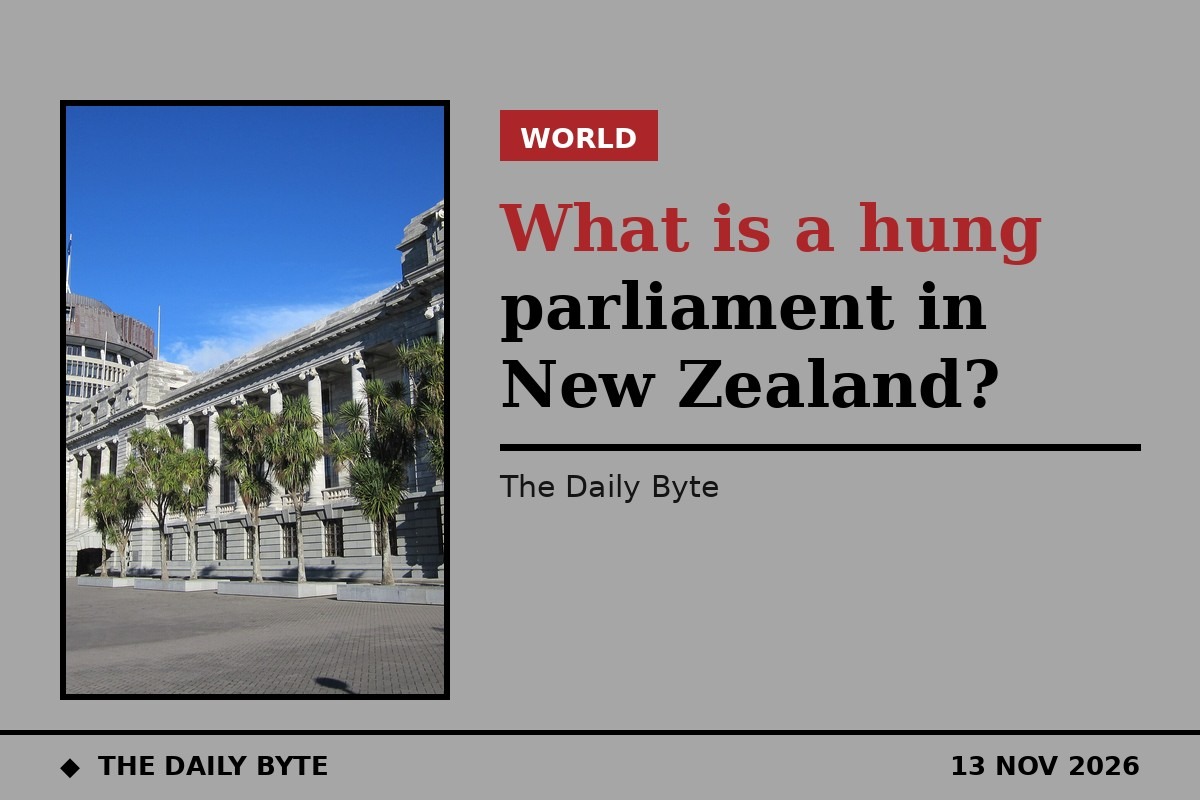
A hung parliament is a parliament in which no party, or group of parties, wins enough seats to form a majority government. New Zealand's general election on Saturday 7 November 2026 has left the country facing exactly that possibility. The preliminary count gives Prime Minister Christopher Luxon's National Party and its partners 67 seats in a 131-seat parliament, just one more than the 66 needed for a majority. But about 399,365 special votes have yet to be counted, and the official result is not due until Friday 27 November. Until then, nobody knows for certain who will govern New Zealand. A second election is possible in theory if no government can be formed, but constitutional experts describe it as an absolute last resort that nobody wants.
This explainer sets out what happened in the election, what a hung parliament actually means under New Zealand's voting system, why the result is so close, what special votes are, who is running the country in the meantime, and how a new election could happen if the deadlock cannot be broken.
What happened in the New Zealand election?
New Zealanders voted on Saturday 7 November 2026 in one of the closest elections in the country's history. The preliminary count, published by the Electoral Commission, produced a strange split. Labour won the most party votes, with 710,330 votes, or 29.36 per cent, against 706,680 votes, or 29.21 per cent, for National. The gap between the two biggest parties was just 3,650 votes.
But seats in parliament tell a different story. National won 42 local electorate seats, far more than its share of the party vote would normally deliver. On the preliminary allocation, National holds 42 seats, its current governing partners ACT hold 13 and New Zealand First hold 12, giving the three parties 67 seats between them. Labour holds 36 seats, the Greens 16 and Te Pāti Māori 5, a total of 57. The centrist Opportunity Party, entering parliament for the first time, holds 7 seats. Adding Opportunity to Labour's side still leaves it on 64 seats, two short of a majority.
| Party | Party votes | Share | Seats (preliminary) |
|---|---|---|---|
| Labour | 710,330 | 29.36% | 36 |
| National | 706,680 | 29.21% | 42 |
| ACT | - | - | 13 |
| New Zealand First | - | - | 12 |
| Greens | - | - | 16 |
| Opportunity Party | - | - | 7 |
| Te Pāti Māori | - | - | 5 |
Both leaders were careful on election night. Luxon told supporters in Auckland that the result was too close to call and that the final shape of the next government would only become clear after the official results on 27 November. Labour leader Chris Hipkins struck the same note of patience, saying: "Tonight, New Zealand has spoken. It may take us a little bit longer to figure out exactly what it is that you've said." He added that the next parliament would require parties to compromise and work together.
What is a hung parliament?
Quite simply, a hung parliament is one that is evenly divided between factions, so that no one group can form a majority on its own. In most cases that just means a coalition must be formed to create a majority, as happened after New Zealand's elections in 2017 and 2023. The difficulty arises when the parliament stays hung even after the votes are counted, and no combination of parties can agree on a government.
New Zealand's parliament normally has 120 members, which means a 60-60 tie between two blocs is mathematically possible. The voting system, known as MMP, or mixed-member proportional representation, is marking its 30th anniversary this year. Under MMP, each voter casts one vote for a party and one vote for a local candidate, and the party vote is meant to decide each party's overall share of seats. Hung parliaments are not unique to MMP. Under the old first-past-the-post system, the elections of 1922 and 1928 both left no single party with a parliamentary majority, and governments were subsequently formed with support from other MPs or parties.
A hung parliament is therefore not the same thing as a failed election. It is a normal, if uncomfortable, outcome of a proportional voting system, and the system has rules and conventions for dealing with it. The problem in 2026 is the combination of an exceptionally close result and a parliament whose size has been swollen by overhang seats, which makes the arithmetic unusually fragile.
Why does New Zealand have 131 MPs this time?
The 2026 parliament is projected to have 131 seats instead of the usual 120, and the reason is a quirk of MMP called the overhang. When a party wins more local electorate seats than its share of the party vote entitles it to, parliament grows so that the extra seats can be added rather than taken away from anyone else.
That is what happened to National. Its 706,680 party votes would normally entitle it to about 35 seats, but it won 42 electorates, so it keeps all 42 and gets no list MPs at all. Te Pāti Māori did the same thing on a smaller scale, winning five electorate seats on a much smaller party vote. Together, those overhang seats push parliament from 120 members to 131, and that changes the number needed for a majority from 61 to 66.
The overhang is also why the result is so finely balanced. On the preliminary count, the governing bloc of National, ACT and New Zealand First holds 67 seats, just one more than the 66 needed. A shift of only a few seats when the special votes are counted would erase that edge entirely, and it is not yet known whether the final parliament will have an even or an odd number of members. Even numbers make the possibility of a hung parliament considerably higher, because a tie becomes possible.
What are special votes and why do they matter?
Special votes are ballots cast outside a voter's home electorate, and the Electoral Commission estimates that about 399,365 of them remain to be processed, including about 96,947 votes cast from overseas or by dictation. They include votes cast by New Zealanders living abroad, people who voted outside their own electorate, and people who enrolled or updated their details on election day.
Special votes matter for two reasons. First, there are a lot of them: roughly 14 per cent of all the ballots cast in the election. Second, they have historically favoured parties on the left, according to Reuters, which means they could narrow or even overturn the governing bloc's one-seat lead. Several local races were also decided by very small margins and could change when the special votes are counted, and each electorate that changes hands can shift the overhang and the size of parliament itself.
The Electoral Commission says the preliminary count is not a formal declaration. Officials will check the electoral rolls, recount ordinary votes and count the special votes before publishing the official results, which the Commission aims to release on Friday 27 November. Only then will coalition talks rest on final numbers, and a new government could still take weeks to form after that.
Who is running New Zealand right now?
While the result is unresolved, the current government remains in office under what is called the caretaker convention. That means the government is still in charge, but significant decisions are deferred or handled with a light touch, as political scientist Grant Duncan has written. In the event of a hung parliament, the caretaker convention would simply continue until the results are resolved.
"Our beautiful caretaker convention gives the negotiations the time and space needed to deliver an outcome, however long that takes," said Dean Knight, an expert in constitutional law at Te Herenga Waka Victoria University of Wellington. Coalition talks are intended to create the next government, and they have been known to last anything from just over a week to nearly two months.
One thing the parties cannot do is break the deadlock by poaching each other's MPs. New Zealand's waka-jumping, or party-hopping, law prevents MPs from going rogue and crossing the floor to break a stalemate. If a prime minister was holding up the formation of the next government, they could also be removed by their own party. "PMs serve as long as they maintain the confidence of their cabinet colleagues, their party caucuses and, ultimately, the House on behalf of the electorate," Knight said. "If a PM's stubbornness is not supported by their colleagues, they could roll the PM, and replace them with someone more prepared to deal or to return to the polls."
Could New Zealand really have another election?
Yes, in theory, but almost everyone involved says it is the last thing they want. In a speech in March this year, Governor-General Dame Cindy Kiro said that "if it... became clear that no government could be formed, another election may be required". If a hung parliament persists, there are mechanisms to hold a new election, but they are deliberately difficult to use.
Such a step would be subject to the caretaker convention and would require effective majority support in the House, Knight said. A request from the prime minister for a new election would then go to the governor-general. "The caretaker prime minister would be expected to consult other parties and seek majority support for calling a new election," Dame Cindy said in her own remarks. "The governor-general won't accept a request for a fresh election during the caretaker period unless the PM demonstrates a majority of MPs in the incoming Parliament support such a course," Knight said.
The governor-general does also have reserve powers to dismiss a prime minister, to force a dissolution of parliament and call new elections, to refuse a prime minister's request for an election and to refuse assent to legislation. But those powers are reserved for the most extreme situations. "It is the responsibility of the members of Parliament to resolve matters, so that the governor-general is not required to consider dissolving Parliament and calling an election without ministerial advice," the Cabinet Manual notes. With the exception of the appointment of a prime minister following an election, no New Zealand governor-general has ever needed to use them.
"There should be no need for a fresh election," Duncan wrote. "It's up to the parties now to find a majority. There are strong incentives for them to do so and no party wants to be blamed for forcing the country to return to the polls." The governor-general could gently remind the parties and their leaders of their obligation to the country to try and reach some negotiated solution, Otago University law professor Andrew Geddis has written, but she cannot force anyone to do anything and should not try to engineer any particular outcome, because she needs to remain politically neutral.
What has happened in other countries?
Many countries have had elections where no one party won a majority, and some have ended up voting again. Israel is currently wrestling with its most recent election, where opposition leader Gadi Eisenkot has been tasked with forming a new government. Israel had to hold two new elections after an April 2019 vote repeatedly failed to result in a coalition. Bulgaria, Spain and Greece have also held repeat elections after governments failed to form.
The record for going without a formed government belongs to Belgium, which went more than 500 days without settling its next government in 2010 and 2011. "Precedents abroad like Belgium and Northern Ireland show us [we] could be in a twilight for an extended period without the sky falling," Knight said. "Importantly, while we haven't needed the caretaker convention for a long period or even after Parliament's first sitting, it is capable of managing a long period of throttled-back government and does so in a way faithful to democratic principle." While nobody knows for sure what will happen as final results come in and serious talks begin, one goal is clear: nobody wants to be like Belgium.
What happens next?
The key date is Friday 27 November, when the Electoral Commission is due to declare the official result. Until then, the parties have said they will wait before beginning formal coalition negotiations, so the coming weeks will bring positioning rather than deal-making. The Opportunity Party, which entered parliament for the first time with seven seats, could hold the balance of power: its leader, Qiulae Wong, has said she will negotiate first with whichever side secures the most seats, which on the current count means Luxon's side. Luxon, who had previously ruled out working with Opportunity, told public broadcaster RNZ on Monday that he wanted to talk to Wong.
| Date | What happens |
|---|---|
| 7 November 2026 | General election held; preliminary count gives Luxon's bloc 67 of 131 seats |
| 8-27 November 2026 | Electoral Commission checks rolls, recounts ordinary votes and counts about 399,365 special votes |
| 27 November 2026 | Official results due to be published |
| After 27 November 2026 | Formal coalition negotiations begin on final numbers; a new government could take weeks to form |
If the final count confirms the preliminary arithmetic, Luxon's bloc will have a one-seat majority and the focus will shift to the terms of a new coalition agreement, with the smaller parties setting out their demands. If the special votes flip even a couple of seats, the country could be left with a genuinely hung parliament, and the negotiations would become much harder. Either way, the parties, not the voters, will decide the outcome now: the election is over, and the government will be formed in the negotiating room.
Frequently asked questions
What is a hung parliament? A hung parliament is a parliament in which no party or group of parties wins enough seats to form a majority government. In New Zealand, that usually means a coalition must be formed, as happened after the 2017 and 2023 elections.
Who won the New Zealand election? Nobody yet. Labour won the most party votes, but National and its partners hold a preliminary one-seat majority of 67 seats in a 131-seat parliament. The result is not final until the official count on 27 November.
When will New Zealand know the final result? The Electoral Commission aims to publish the official results on Friday 27 November 2026, after counting about 399,365 special votes and checking the electoral rolls.
Could there be another election in New Zealand? It is possible if no government can be formed, and the governor-general has said so. But it would require majority support in the House, and experts describe it as an absolute last resort that no party wants.
What is the Opportunity Party? The Opportunity Party is a centrist party that entered New Zealand's parliament for the first time in the 2026 election, winning a projected seven seats. Its leader is Qiulae Wong, and it could hold the balance of power in coalition talks.
Sources: Farmers Weekly (RNZ) and Electoral Commission preliminary results via Zark News


