What is a nor'easter? East Coast storm explained
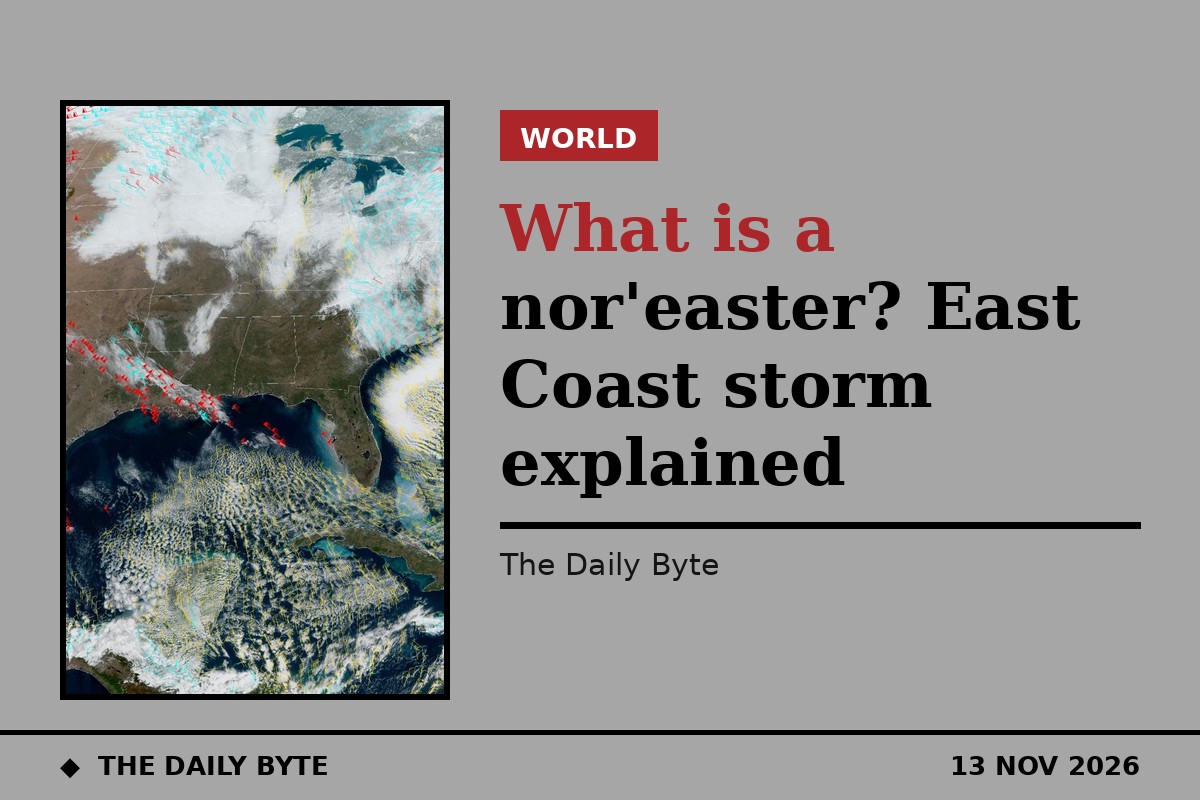
A nor'easter is a storm along the East Coast of North America, named for the direction of its winds: the strongest winds over the coastal area typically blow from the northeast. That is the whole definition, in the words of the National Weather Service, which calls a nor'easter “a storm along the East Coast of North America, so called because the winds over the coastal area are typically from the northeast”. The name is a compass reading, not a strength rating — it says nothing about how powerful the storm is, only where it forms and which way its winds blow.
Nor'easters are back in the news on 13 November 2026, when a nor'easter moving up the East Coast brought a tornado warning for JFK Airport and Queens in New York, showing how a storm known for snow and coastal flooding can also spin up severe weather. This explainer sets out how a nor'easter forms, when it strikes, what damage it can do and how it differs from a hurricane and a blizzard.
Why is it called a nor'easter?
The name is a New England contraction of “northeaster” — a wind out of the northeast. When a low-pressure system sits just off the East Coast, air spirals anticlockwise into it, and on the western side of the system, over the coast, that air arrives from the northeast. Coastal communities felt those winds first and hardest, so the storm took its name from them.
The name confuses people because it sounds like a regional label, as if any storm in the northeast were a nor'easter. It is not. A storm in New England that does not meet the definition — a coastal storm with north-easterly winds driven by an offshore low — is simply a storm. And a nor'easter is not a warning category: the National Weather Service does not issue a “nor'easter warning”. What it issues are the warnings the storm's effects call for — winter storm warnings, blizzard warnings, high wind warnings, coastal flood warnings and, as on 13 November at JFK Airport, tornado warnings.
How does a nor'easter form?
A nor'easter forms where two very different air masses meet. In winter, the polar jet stream carries cold Arctic air south across Canada and the United States and then east towards the Atlantic Ocean, while warm air from the Gulf of Mexico and the Atlantic tries to move north. Offshore, the Gulf Stream — a warm, powerful ocean current — keeps the coastal waters mild. The temperature difference between the warm air over the water and the cold Arctic air over the land is the fuel that feeds the storm.
That contrast creates a low-pressure system, usually developing in the latitudes between Georgia and New Jersey, within about 100 miles east or west of the East Coast. As the low strengthens, it draws in more warm, moist air from the ocean, and that moisture falls as heavy rain or snow, depending on the temperature. The storm then generally moves north-eastward along the coast, typically reaching its maximum intensity near New England and the Maritime Provinces of Canada. Because it moves slowly and draws on a constant supply of ocean moisture, a nor'easter can sit over one area for a day or more, dumping far more snow or rain than a fast-moving storm would.
The ingredients explain why nor'easters are a cold-season phenomenon. They need the sharp temperature contrast between Arctic air and warm ocean water, and that contrast is strongest in the colder months. They can happen at any time of year, but the National Weather Service says they are most frequent and most violent between September and April.
When do nor'easters happen?
Nor'easters can occur at any time of year, but they are most frequent and most intense between September and April, with the strongest typically arriving in the depths of winter. The season matters because the storms need cold Arctic air, and in summer that air is too far north to meet the warm ocean water in the right place.
There is no fixed number per year. Some winters bring a string of nor'easters, one after another, while others bring few. What matters for any single storm is the position of the jet stream, the temperature of the coastal waters and the track of the low-pressure system — a storm that tracks 50 miles further offshore brings rain and wind to the coast but little snow, while one that hugs the coast can bury cities.
What damage can a nor'easter cause?
A nor'easter nearly always brings heavy precipitation, in the form of heavy rain or snow, along with gale-force winds, rough seas and, in places, coastal flooding, according to the National Weather Service. The combination is what makes them destructive: snow loads collapse roofs and bring down trees and power lines, wind drives sea water over coastal roads and into homes, and the heavy surf erodes beaches and undermines sea defences.
The effects depend on the season and the track. A winter nor'easter brings heavy snow and ice, which can shut down transport and leave hundreds of thousands of people without power. A nor'easter in the warmer months brings heavy rain and coastal flooding instead. And because the storm's winds blow onshore for hours at a time, pushing water against the coast, the flooding can arrive in repeated high tides rather than a single surge. Past nor'easters have caused billions of dollars in damage, and the 13 November 2026 storm showed another face of the hazard, with a tornado warning issued for JFK Airport and Queens as the system moved through the New York area.
Nor'easter vs hurricane: what is the difference?
| Nor'easter | Hurricane | |
|---|---|---|
| Where it forms | Off the East Coast of the United States, in cold northern waters | In tropical waters of the Atlantic Ocean, or more rarely the eastern Pacific |
| What drives it | Temperature contrast between cold Arctic air and warm ocean water | Warm ocean water, at least 27°C, feeding a tropical cyclone |
| Season | Most frequent and violent September to April | Most common June to November |
| Structure | Extratropical cyclone, with cold and warm fronts | Tropical cyclone, with a warm core and an eye |
| Size and speed | Broad, slow-moving, can linger for days | More compact, moves faster |
The two can look alike from above — both are large, spiralling storm systems — but they are not the same type of cyclone. A hurricane is a tropical cyclone; a nor'easter is an extratropical cyclone. That distinction is about where the storm gets its energy, not about how dangerous it is: a strong nor'easter can be as destructive as a hurricane, and in some cases more so, because it moves slowly and affects a larger area for longer.
Nor'easter vs blizzard: are they the same?
No. A nor'easter is a type of storm, defined by where it forms and which way its winds blow. A blizzard is a warning classification, defined by what the storm does: the National Weather Service requires visibility below a quarter of a mile and sustained winds of at least 35 miles per hour for three or more consecutive hours. A nor'easter can become a blizzard if it meets those criteria — and many of the most famous nor'easters did — but a nor'easter that brings rain rather than snow, or snow without the wind and visibility thresholds, is not a blizzard. Equally, a blizzard can be caused by a storm that is not a nor'easter. The two words describe different things, and they are often used together only because the same storm can be both.
Famous nor'easters
| Storm | What happened |
|---|---|
| Blizzard of 1888 | One of the most notorious nor'easters, burying the north-east in snow in March 1888 |
| Ash Wednesday storm, March 1962 | Severe coastal storm remembered for its flooding and beach erosion |
| New England blizzard, February 1978 | Paralysed New England with deep snow and hurricane-force winds |
| March 1993 “Superstorm” | A huge storm system that struck the entire eastern United States |
| Boston snowstorms, January–February 2015 | A series of nor'easters that buried Boston under record snow |
| February 2021 winter storm | Buried the north-eastern United States in snow, seen in satellite images across the region |
These storms are remembered because they combined heavy snow, high winds and coastal flooding over a wide area, and because their slow movement meant the worst conditions lasted for a day or more rather than a few hours.
How to stay safe in a nor'easter
The official advice from the National Weather Service and state emergency agencies is straightforward: follow the warnings for your area, avoid travelling while the storm is at its worst, stay away from coastal roads and low-lying areas during high tide, and keep clear of downed power lines. If you must drive, keep an emergency kit in the vehicle, and if you lose power, never run a generator indoors. The most dangerous moments in a nor'easter are often not the snowfall itself but the combination of wind, flooding and falling trees, so the safest place during the peak of the storm is indoors, away from windows facing the wind.
Frequently asked questions about nor'easters
What is a nor'easter? A storm along the East Coast of North America, named because the winds over the coastal area are typically from the northeast, according to the National Weather Service.
When is nor'easter season? They can happen at any time of year, but they are most frequent and most violent between September and April.
Is a nor'easter a hurricane? No. A nor'easter is an extratropical cyclone driven by the contrast between cold Arctic air and warm ocean water; a hurricane is a tropical cyclone driven by warm ocean water.
Is a nor'easter the same as a blizzard? No. A nor'easter is a type of storm; a blizzard is a warning classification requiring low visibility and sustained winds of 35 miles per hour or more for at least three hours. A nor'easter can cause a blizzard, but not every nor'easter is one.
Can a nor'easter bring a tornado? Yes. Severe weather, including tornadoes, can occur with a nor'easter — on 13 November 2026 a tornado warning was issued for JFK Airport and Queens in New York as a nor'easter moved up the coast.
Sources: National Weather Service, “Winter — Nor'easter”; NOAA SciJinks, “What is a nor'easter?”; USA Today, “What exactly is a nor'easter?”