What Is a Smart Motorway? UK Rules Explained
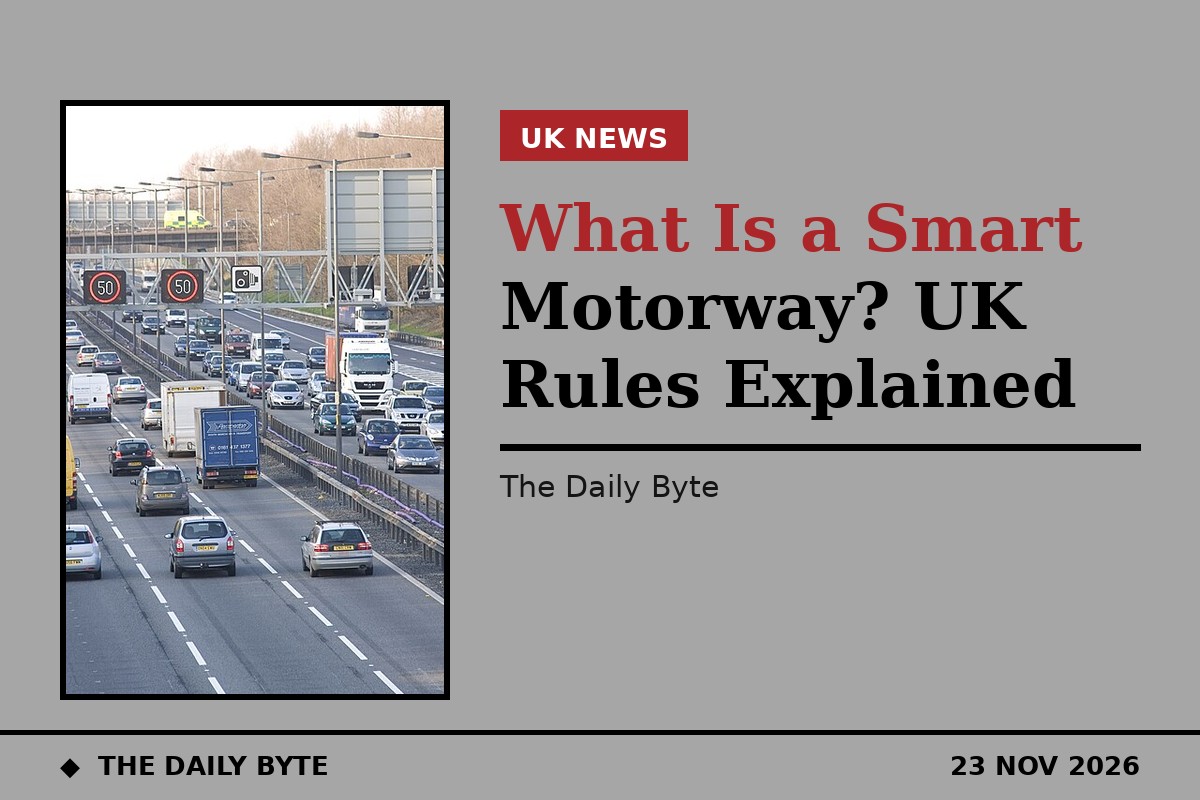
A smart motorway is a section of motorway in the UK that uses technology to manage traffic flow, usually by using the hard shoulder as a running lane and by setting variable speed limits on overhead signs. The first full smart motorway opened in 2006 on the M42 in the West Midlands, and smart motorways now cover around 10% of England's motorway network, roughly 375 miles of road. This guide explains the three types, what the signs mean, and the rules for driving on one, as they stand on 23 November 2026.
Why were smart motorways built?
Smart motorways were developed as a cheaper alternative to widening a motorway. Instead of building new lanes, technology is used to squeeze more capacity out of the existing road. Overhead gantries carry electronic signs that can lower the speed limit when traffic builds up, close a lane when there is an incident, and warn drivers about congestion ahead. Control centres watch the road with cameras and sensors and can respond in real time.
The first section opened on the M42 in 2006, and the idea was then rolled out to some of England's busiest routes, including the M1, M6, M25 and M62. The technology includes variable speed limits, lane control signals and motorway incident detection systems that spot stopped vehicles and warn drivers behind them.
The three types of smart motorway
There are three types, and the difference matters because it decides whether there is a hard shoulder to stop on.
Controlled motorways have three or more lanes with variable speed limits shown on overhead gantries, but they keep a permanent hard shoulder for emergencies. If a gantry shows no limit, the national speed limit of 70 mph applies. This is the least controversial type, because the hard shoulder is always there.
Dynamic hard shoulder motorways open the hard shoulder as a running lane during busy periods. Gantry signs show whether the lane is open or closed. If a red X is displayed, or the signs are blank, you must not use the hard shoulder as a live lane.
All-lane running motorways are the most common type and the most controversial. The hard shoulder has been permanently removed and turned into a running lane. There is no permanent place to stop, so orange-surfaced laybys called emergency refuge areas are provided at the side of the road instead.
What do the overhead signs mean?
A speed limit shown in a red circle above a lane is a mandatory limit, and it is enforced by cameras. It can change from gantry to gantry as conditions change, so you need to watch the signs as you drive. A red X above a lane means that lane is closed, and it is illegal to drive in it. A white arrow pointing down and to the side tells you to move into the lane it points to. Message signs warn of congestion, incidents or roadworks ahead, often with advice such as stay in lane.
Breaking the rules carries real penalties. Driving in a lane marked with a red X or ignoring a variable speed limit can lead to a fine and penalty points, and the cameras on smart motorways are there to enforce exactly that.
Emergency refuge areas
On all-lane running motorways, emergency refuge areas take the place of the hard shoulder. They are orange-surfaced laybys at the side of the carriageway, provided for drivers to use if they break down or have an incident. They are spaced about three-quarters of a mile apart where possible, and no more than one mile apart on newer stretches. If your car develops a problem, the advice is to aim for the nearest refuge area rather than stopping in a live lane.
Stopped-vehicle detection radar was added to smart motorways after the government announced in April 2021 that new schemes would include radar to detect stopped vehicles, with extra cameras to catch drivers using closed lanes. Existing smart motorways were to have the extra safety features fitted by September 2022.
How to drive on a smart motorway
Driving on a smart motorway is much like driving on a normal motorway, with one big difference: you have to keep watching the overhead signs, because the rules for the road in front of you can change from one gantry to the next. A speed limit that was 70 mph can drop to 50 mph without warning when traffic builds up, and a lane that was open can close with a red X when there is an incident ahead. The limits shown in red circles are mandatory, and cameras enforce them, so slowing down late is not just risky, it can also earn you a fine and penalty points.
Stay in lane unless a sign tells you to move, and leave a proper gap to the vehicle in front, because traffic on a smart motorway can slow suddenly when a limit changes. If you see a red X over your lane, move out of it as soon as it is safe to do so. And if your car starts to struggle, do not wait for it to stop in a live lane: aim for the nearest emergency refuge area, which are never more than about a mile apart, and use your hazard lights so other drivers can see you.
Are new smart motorways still being built?
No. In April 2023 the government scrapped plans to build any new smart motorways, citing costs and a lack of public confidence after a series of deaths in which vehicles stopped in live lanes were hit. The roughly 300 miles already in operation were kept, and work continued on safety improvements to the existing network, but no new schemes were started.
The safety debate has not gone away. Critics, including motoring groups and police representatives, argue that removing the hard shoulder leaves broken-down drivers with nowhere safe to go. Supporters point to the technology, including radar detection and refuge areas, and to figures showing that smart motorways can ease congestion. A National Highways report in 2026 found that only three of the UK's 16 smart motorway projects were on track to deliver the value for money expected, with some even costing the taxpayer more than widening the road would have done.
Frequently asked questions
Can I drive on the hard shoulder? Only if the signs say you can. On a dynamic hard shoulder stretch, the hard shoulder is a running lane only when the gantry signs show it open. On all-lane running stretches there is no hard shoulder at all.
What does a red X mean? The lane is closed. You must not drive in it, and cameras enforce the rule.
What should I do if my car breaks down? Aim for the nearest emergency refuge area, which are spaced up to a mile apart on all-lane running stretches. Switch on your hazard lights and call for help.
Is the speed limit still 70 mph? Yes, unless a gantry shows a lower limit. A variable limit shown in a red circle is mandatory and enforced by cameras.
Where are smart motorways found? On some of England's busiest routes, including the M1, M6, M25 and M62. They cover around 10% of the motorway network in England.
How is a smart motorway different from a normal motorway? A normal motorway has a permanent hard shoulder and a fixed 70 mph limit. A smart motorway uses overhead signs to vary the speed limit and control which lanes are open, and on all-lane running stretches the hard shoulder is a permanent traffic lane instead.
Sources: GOV.UK, Smart motorway comparison report: December 2022 and Carsa, What is a Smart Motorway? The Complete 2026 Guide. Always follow the signs and signals on the road in front of you.