What Is a Solar Eclipse? Types and Safety Explained
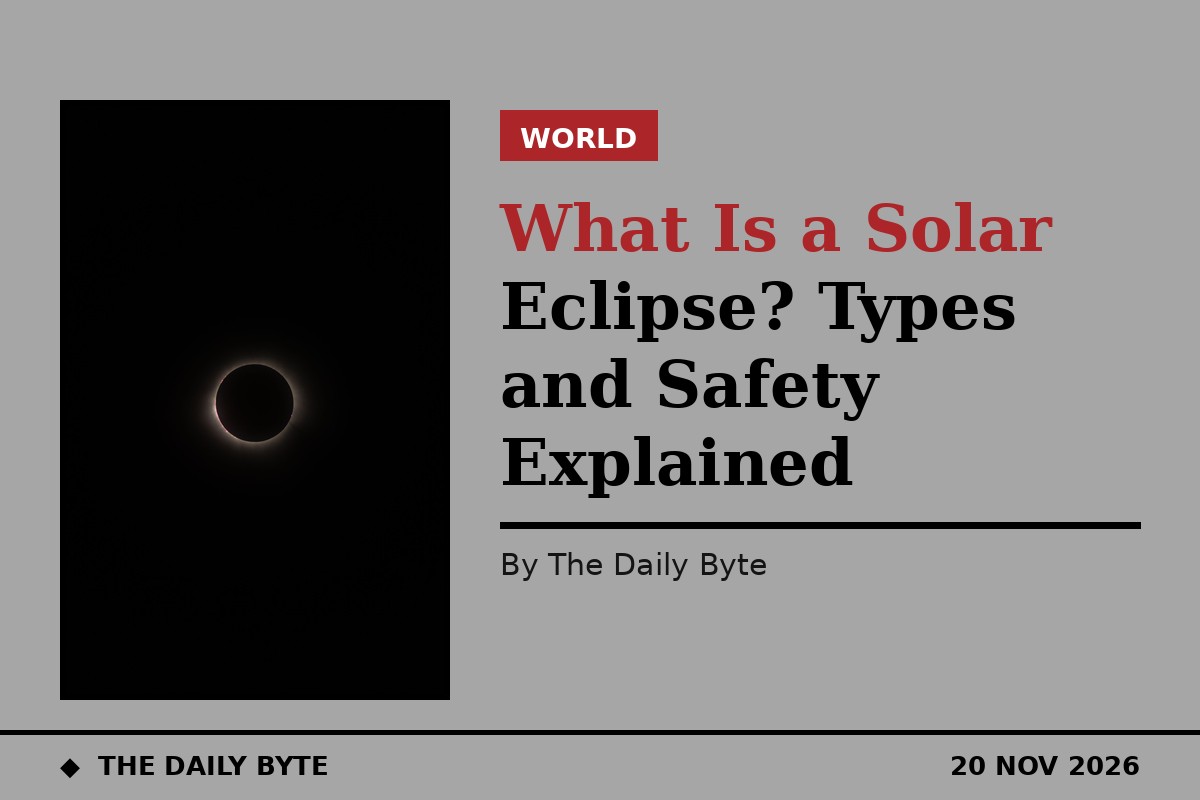
A solar eclipse happens when the Moon passes between the Sun and Earth, casting a shadow on Earth that either fully or partially blocks the Sun's light in some areas. For a few minutes, day turns to an eerie twilight, the sky darkens, and, if you are in the right place at the right time, the Sun's outer atmosphere blazes into view around the black disc of the Moon. It is one of the most dramatic sights in nature, and it is also one of the rarest: although solar eclipses happen somewhere on Earth several times a year, a total eclipse at any one place comes around only once every few centuries. This explainer sets out what a solar eclipse is, why it happens, the four different types, and how to watch one safely.
The short answer is an alignment. The Sun, the Moon and Earth must line up, with the Moon in the middle. But the alignment has to be precise, and the geometry of the Solar System makes precise alignments uncommon. That is why there is not an eclipse every month, even though the Moon passes between Earth and the Sun once every lunar cycle.
Why the Moon can cover the Sun at all
The first surprise is that the Moon can cover the Sun in the first place. The Sun is an enormous star, roughly 400 times wider than the Moon. It can be hidden by something so small only because of a remarkable coincidence: the Sun is also roughly 400 times further away from Earth than the Moon is. As a result, the two bodies appear almost exactly the same size in our sky, each taking up about half a degree, roughly the width of your little fingernail held at arm's length.
NASA describes this as the special coincidence that makes eclipses possible. Because the Sun and the Moon look the same size, the Moon can just cover the Sun's bright face during a total eclipse. If the Moon were a little smaller in the sky, or a little further away, total eclipses would never happen. If it were a little bigger, they would be commonplace and far less spectacular.
Why there is no eclipse every month
The Moon orbits Earth once every 27.3 days, and once in each orbit it passes between Earth and the Sun. That moment is the new moon, and by simple logic you might expect a solar eclipse at every new moon. It does not happen, because the Moon's orbit is tilted by about five degrees relative to the plane of Earth's orbit around the Sun.
Most months, at new moon, the Moon passes slightly above or below the Sun as seen from Earth, and its shadow misses our planet entirely. An eclipse can only occur when a new moon happens close to one of the two points where the Moon's orbit crosses Earth's orbital plane. Astronomers call the periods when this is possible eclipse seasons, and there are two of them each year. That is also why solar and lunar eclipses tend to arrive in pairs a fortnight apart: a solar eclipse at new moon is often followed, or preceded, by a lunar eclipse at full moon during the same season.
The four types of solar eclipse
NASA recognises four types of solar eclipse, and which one you see depends on how precisely the Sun, Moon and Earth line up, and on how far the Moon is from Earth at the time.
A total solar eclipse happens when the Moon passes between the Sun and Earth and completely blocks the face of the Sun. People standing in the centre of the Moon's shadow on Earth, in what astronomers call the path of totality, see the Sun disappear entirely. The sky darkens as if it were dawn or dusk, stars may appear, and the Sun's outer atmosphere, the corona, becomes visible as a wispy halo of light around the black Moon. A total eclipse is the only type during which it is safe to look at the Sun without eye protection, and only for the brief period of totality itself.
A partial solar eclipse happens when the Sun, Moon and Earth are not perfectly lined up, so the Moon covers only part of the Sun's disc. The Sun appears to have a crescent shape, and the sky grows slightly darker depending on how much of the Sun is covered. Most people who see an eclipse see a partial one, because the area that experiences a total eclipse is narrow, while the partial eclipse is visible across a much wider region.
An annular solar eclipse happens when the Moon passes between the Sun and Earth while it is at or near its farthest point from Earth. Because it is further away, the Moon appears slightly smaller than the Sun and cannot cover it completely. Instead, it appears as a dark disc on top of a larger bright disc, leaving a ring of sunlight visible around it. The name comes from the Latin word annulus, meaning ring, and the effect is often called a ring of fire.
A hybrid solar eclipse is the rarest type. Because Earth's surface is curved, an eclipse can shift between annular and total as the Moon's shadow moves across the globe, appearing as one type in some places and the other elsewhere along its path. Hybrid eclipses are also known as annular-total eclipses.
The Moon's shadow: umbra, penumbra and antumbra
Understanding the types is easier once you picture the Moon's shadow. The shadow has three parts. The umbra is the dark central core, where the Sun is completely hidden; anyone standing in the umbra sees a total eclipse. Around it lies the penumbra, a lighter outer shadow where the Sun is only partly covered; anyone standing in the penumbra sees a partial eclipse. Beyond the tip of the umbra lies the antumbra, where the Moon appears smaller than the Sun; anyone standing there sees an annular eclipse.
The umbra is surprisingly small where it touches Earth, typically only around a hundred kilometres wide, and it races across the planet's surface at more than 1,500 kilometres per hour. That is why totality at any one spot lasts only a few minutes at most, and why eclipse chasers travel across the world to stand in its path. The penumbra, by contrast, can cover thousands of kilometres, which is why a partial eclipse is visible to far more people.
What happens during a total eclipse
A total solar eclipse unfolds in stages, and each one has its own character. It begins with a partial eclipse as the Moon first takes a bite out of the Sun's disc. The light grows strange and thin, shadows sharpen, and the temperature may drop noticeably. In the final minute before totality, two striking effects can appear: shadow bands, rapidly moving ripples of light and dark on the ground, and Baily's beads, points of sunlight shining through valleys on the edge of the Moon.
Then comes the diamond ring, a single brilliant point of light flaring at one edge of the Moon just as the last of the Sun disappears, and then totality itself. The corona streams out around the black disc, pink prominences of solar gas may glow along the edge, and the sky takes on a deep twilight blue. Animals often fall silent or behave as if night has fallen. After a few minutes at most, the diamond ring flashes again on the opposite side, totality ends, and the partial eclipse runs in reverse until the Sun is whole again.
How often do solar eclipses happen?
At least two solar eclipses happen every year, and there can be as many as five, although no more than two of them can be total. That sounds frequent, but total eclipses are spread thinly across the globe. On average, a total solar eclipse occurs somewhere on Earth about every 18 months, yet for any given place on the planet, a total eclipse returns only once every 360 to 410 years. The last total solar eclipse visible from the United Kingdom was in 1999, and the next is not expected until 2090, which is why British eclipse watchers so often travel abroad.
The timing of eclipses is so regular that they can be predicted centuries in advance. NASA maintains a catalogue of solar eclipses covering five thousand years, from 1999 BC to AD 3000, and eclipse chasers plan expeditions years ahead around its dates. The same regularity once made eclipses terrifying: in ancient and modern cultures alike, the sudden darkening of the Sun was attributed to supernatural causes or regarded as a bad omen, long before astronomers understood the geometry behind it.
How to watch a solar eclipse safely
Watching an eclipse is safe only if you protect your eyes. The Sun's light can damage the retina, the light-sensitive tissue at the back of the eye, and that damage can happen without pain, so you may not realise it is occurring. Ordinary sunglasses are not enough, and neither are smoked glass, photographic film or improvised filters.
The safe way to watch a partial or annular eclipse is through certified eclipse glasses, which are far darker than ordinary sunglasses and are designed to block harmful light. They should be put on before looking at the Sun and kept on throughout, except during the brief period of totality in a total eclipse, when the Sun is fully covered and it is safe to look directly. As soon as the first point of sunlight reappears, the glasses must go back on immediately. An indirect method, such as projecting the Sun's image through a pinhole onto a piece of card, is a safe alternative that needs no special equipment at all.
Children should be supervised closely, and anyone using binoculars, a telescope or a camera should fit a proper solar filter to the front of the instrument, never look through it unfiltered. The rules are simple, but they matter: every total eclipse brings reports of eye injuries from people who looked at the partial phases without protection.
Solar eclipse versus lunar eclipse
It is easy to confuse the two kinds of eclipse, but they are mirror images of each other. A solar eclipse happens at new moon, when the Moon passes between the Sun and Earth and the Moon's shadow falls on Earth. A lunar eclipse happens at full moon, when Earth passes between the Sun and the Moon and Earth's shadow falls on the Moon, turning it a deep copper red. A solar eclipse is visible only from a narrow strip of Earth, while a lunar eclipse can be seen from anywhere on the night side of the planet. Both are the same geometry seen from opposite sides, and both are reminders of how precisely the Sun, Moon and Earth move together.
A solar eclipse is, in the end, a matter of alignment and coincidence: a Moon just the right size, at just the right distance, crossing just the right point in its tilted orbit, at just the right moment. Most months the geometry misses. But when it lines up, the result is the most awe-inspiring event the sky has to offer, and one that has been watched, feared and celebrated for as long as people have looked up.