What Is a Super-Injunction? UK Law Explained
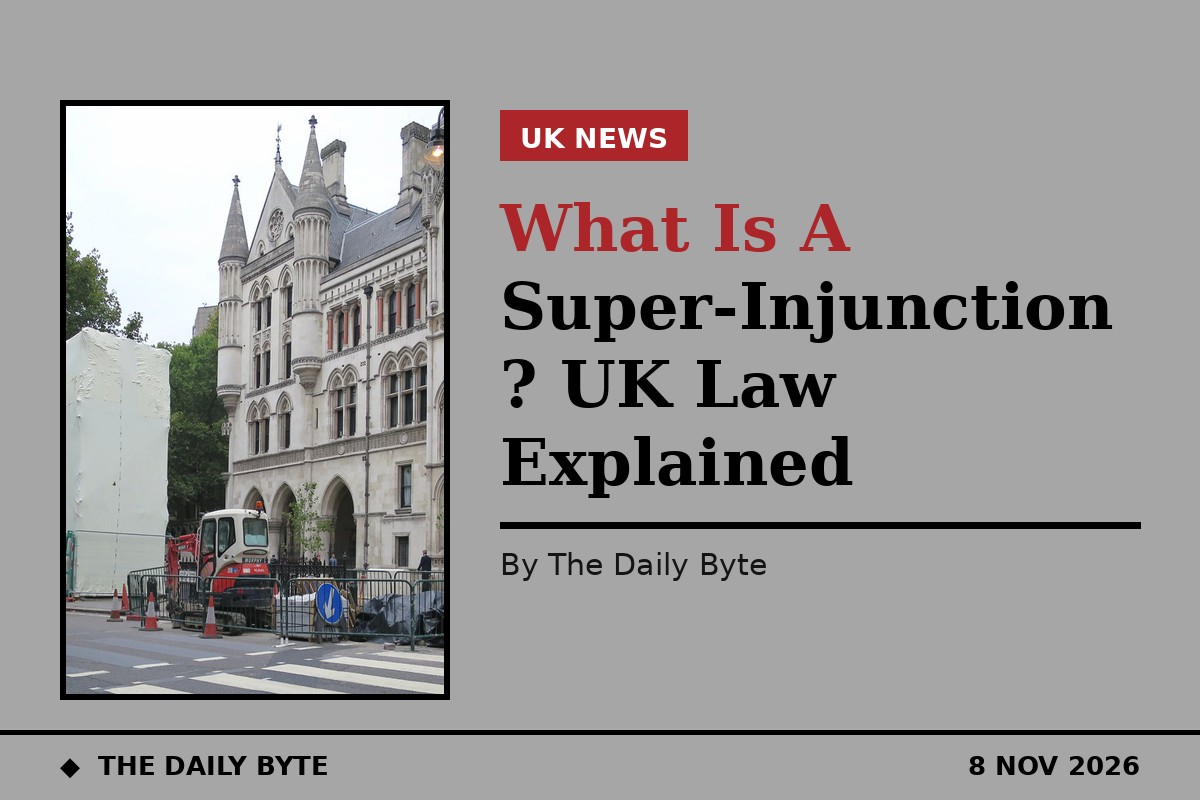
A super-injunction is a court order that stops the publication of private or confidential information — and also bans anyone from revealing that the order itself exists. It is the most secretive court order in England and Wales, granted only in rare cases where revealing it would defeat its purpose. It is an exception to open justice, the principle that court proceedings should be public.
What makes an injunction “super”?
The definition comes from the Report of the Committee on Super-Injunctions, published in 2011 and chaired by Lord Neuberger. It is an interim injunction restraining a person from publishing information said to be confidential or private, and from revealing that the order or the proceedings exist. That second part — the ban on mentioning the order at all — is the “super” element.
How is it different from a normal injunction?
A standard privacy injunction stops publication of the information, but the fact that the order exists is a matter of public record. An anonymity order hides the names of the parties but not the fact that proceedings exist. A super-injunction hides both. Newspapers often misuse the term “super-injunction” to describe anonymity orders, which are far more common.
When do courts grant one?
Only the High Court can grant a super-injunction. The applicant must show that revealing the order would frustrate its purpose — for example, by tipping off a defendant who might publish the information or destroy evidence — or that another unusual and compelling reason exists. The court weighs the right to privacy under Article 8 of the European Convention on Human Rights against freedom of expression under Article 10. Only two had been granted since January 2010, the Neuberger Committee reported in 2011.
How long does a super-injunction last?
It is an interim, temporary order with a return date, when the matter comes back before the court. It is normally discharged at the return date or once the defendant is served, whichever comes first. Breaching one is contempt of court. Estimates put the cost of obtaining one at roughly £50,000 or more in legal fees.
Famous examples
An early example is Goldsmith and Khan v BCD (2008), over emails hacked from the claimants’ personal accounts. The best-known case is CTB v News Group Newspapers in 2011, in which a married footballer obtained an injunction over an alleged affair. His identity spread on social media, then a Liberal Democrat MP named him in the House of Commons under parliamentary privilege: Ryan Giggs.
Frequently asked questions
Can anyone apply for a super-injunction? Yes, but the applicant must meet a strict legal test and the costs are high.
Is a super-injunction permanent? No — it is interim, and is discharged at the return date or once the defendant is served.
Does it work outside the UK? Enforcement is difficult against overseas websites and social media, as the Giggs case showed.
What happens if someone breaks one? It is contempt of court, punishable by a fine or imprisonment.