What Is a Total Allowable Catch? EU Fishing
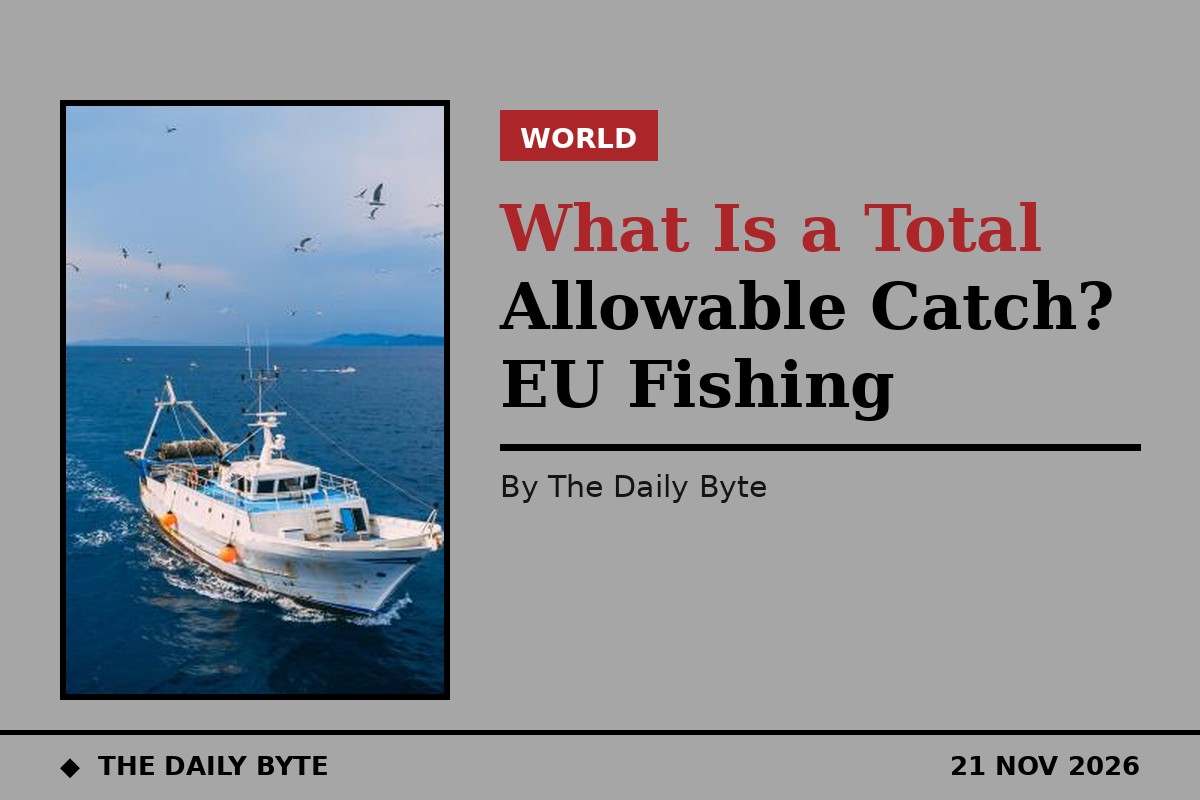
A total allowable catch, known as a TAC, is the maximum amount of fish that can be caught from a particular stock over a given period. It is a catch limit, usually expressed in tonnes or in numbers of fish, and it is the central tool the European Union uses to keep commercial fishing within sustainable bounds. Once a TAC is set, it is divided into national quotas, and each EU country must make sure its fishers do not exceed their share.
TACs are set for most commercial fish stocks. In the EU they are normally set annually, while deep-sea stocks are set every two years. The limits follow the rules of the Common Fisheries Policy and the multi-annual plans for each sea basin, and they are based on scientific advice about the state of each stock. When a country's available quota for a species is exhausted, it must close that fishery.
The question matters right now because the European Commission has just proposed the fishing opportunities for 2027. On 20 November 2026 it proposed fishing days for trawlers in the western Mediterranean, and on 5 November it adopted its proposal for 11 fish stocks managed by the EU in the Atlantic, the Kattegat and the Skagerrak. Fisheries ministers will discuss the proposals at the AGRIFISH Council on 14 and 15 December 2026, with a view to reaching a political agreement on fishing opportunities for 2027.
How is a TAC decided?
Setting a TAC is a long process that runs through scientists, the European Commission and national ministers. The scientific advice comes from the International Council for the Exploration of the Sea, known as ICES, which assesses the state of the main commercial stocks using biological data collected by national research institutes, research surveys and landing records. The Commission's own advisers, the Scientific, Technical and Economic Committee for Fisheries, known as STECF, examine that advice.
The European Commission then draws up a proposal for the following year's fishing opportunities, and the Council of the EU, made up of fisheries ministers from the member states, takes the final decision. For stocks shared with non-EU countries, the limits are agreed with those countries first, through negotiations and regional fisheries management organisations.
Once the Council has fixed the TAC for a stock, it is shared between EU countries in the form of national quotas. The division follows the principle of relative stability, a formula devised when the Common Fisheries Policy was established that gives each member state a fixed percentage share of the fishing opportunities for commercial species, based largely on its past catch record. EU countries can exchange quotas with each other, but they must use transparent and objective criteria when distributing national quotas among their fishers, and each country is responsible for ensuring its quota is not exceeded.
What is the difference between a TAC and a quota?
A TAC is the total limit for a whole stock: the maximum that can be caught from it in a given period. A quota is a share of that total allocated to a country, and then further divided within that country among vessels or fishers. In the EU, a quota is therefore a portion of a TAC, while the TAC itself is the overarching fishing limit for the stock.
Some fisheries are managed by effort rather than by catch. In the western Mediterranean, for example, trawling is managed through fishing days: the number of days each fleet may spend fishing. For 2027 the Commission has proposed 54,995 fishing days for trawlers in Italy, 54,127 days in Spain and 8,575 days in France. Member states may still apply additional conservation measures to reach the maximum of 73,391 days for Spain and 59,076 days for Italy, except for France, which is already at the maximum level of 8,575 days. Those additional days should be conditional on measures that reduce fishing mortality of the most vulnerable stocks.
Other rules sit alongside TACs. The landing obligation requires all catches of regulated species to be landed and counted against the quota, so undersized fish cannot be sold for human consumption and prohibited species, such as the basking shark, must be returned to the sea. EU countries report their catches and fishing effort to the EU for control purposes, and the EU reports its catches under international agreements to regional fisheries management organisations.
What did the Commission propose for 2027?
The Commission's 20 November 2026 proposal for the western Mediterranean says it proposes the highest number of fishing days compatible with recovering the most endangered fish stocks. The figures are based on the best available scientific advice and take account of measures fishers have applied in recent years, including selective gear and closed areas.
The pressure on stocks remains severe. Of the 14 fully assessed stocks in the western Mediterranean, 13 are still fished above sustainable levels and seven remain below precautionary biomass levels, meaning safeguard measures are required to return them to sustainable levels. According to the latest STECF advice, no assessed stock is now below the limit at which its ability to reproduce is at risk, compared with one stock last year.
The Commission also proposes fishing opportunities in line with the latest decisions of the General Fisheries Commission for the Mediterranean, known as the GFCM, which implement regionally agreed management plans in the Mediterranean and Black Sea. These cover catch and effort limits for small pelagic and demersal stocks in the Adriatic Sea, common dolphinfish in the Mediterranean Sea, turbot in the Black Sea, blackspot seabream in the Alboran Sea, and deep-water shrimps in the Strait of Sicily, the Ionian and Levant Seas.
The proposal implements increased quotas for member states for 2027 that the EU secured during the last GFCM annual session, most notably for common dolphinfish, up 14.33 percent, and deep-water shrimps in the Strait of Sicily, up 4.46 percent for giant red shrimp and 28.42 percent for blue and red shrimp, and sole in the Adriatic, up 5 percent. It also implements the carry-over of unused EU quotas for turbot in the Black Sea, an extra 3.5 tonnes. In the Alboran Sea, the EU and Morocco agreed joint catch limits to respond to the depleted state of the stocks.
Why are TACs controversial?
TACs sit at the meeting point of science, economics and politics, and ministers do not always follow the scientific advice. Analysis cited by FutureLearn found that between 2010 and 2017 the Council set catch limits above scientific advice on average for 60 percent of the TACs analysed. More recently the record improved: in 2020 the EU Council set 62 out of 78 fish stock TACs in line with scientific advice. The tension is structural, because a TAC that protects a stock in the long term can mean smaller catches and lower incomes for fishers in the short term.
Fishers and coastal communities argue that abrupt cuts can destroy livelihoods, while scientists and conservation groups argue that exceeding the advice risks the collapse of the stock itself, which would end the fishery altogether. The Commission's framing of its 2027 western Mediterranean proposal, offering the highest number of fishing days compatible with recovery, is an attempt to hold both aims at once.
Enforcement is another point of debate. Member states are responsible for policing their own quotas, and the system depends on accurate reporting of catches and effort. The landing obligation was designed to close the loophole of discarding unwanted catch at sea, but it only works if catches are recorded honestly and checked.
How does this affect the UK?
The UK is no longer part of the Common Fisheries Policy, so EU TACs do not set UK quotas directly. But many of the same stocks are shared, and the UK negotiates its own catch limits with the EU and with Norway and other coastal states each year. The science behind those negotiations comes from the same ICES assessments, and the same arguments about following the advice, protecting stocks and supporting fishing communities play out in the UK's own annual talks.
For consumers, TACs are one reason why the fish on sale changes from year to year: when a stock is under pressure, its quota falls, supply tightens and prices can rise, while stocks that have recovered can see their limits increased, as with the higher 2027 quotas for common dolphinfish and deep-water shrimps in the Mediterranean.
Frequently asked questions
What does TAC stand for? Total allowable catch: the maximum amount of fish that can be caught from a particular stock over a given period, usually a year.
Who sets TACs in the EU? The European Commission proposes them on the basis of scientific advice from ICES and STECF, and the Council of the EU, the fisheries ministers, takes the final decision.
How often are TACs set? Annually for most fish stocks, and every two years for deep-sea stocks. Fishing opportunities for the Baltic Sea are decided in October, for the Black Sea in November or December, and for the Atlantic and North Sea in December.
What happens when a quota runs out? The country concerned must close the fishery for that species. Quotas can be exchanged between EU countries, but the total catch must stay within the TAC.
What is a fishing day? In fisheries managed by effort, such as western Mediterranean trawling, a fishing day is a day a vessel is allowed to spend fishing. The Commission proposed 54,995 fishing days for Italy, 54,127 for Spain and 8,575 for France for 2027.