What Is a UK Family Visa? Rules Explained
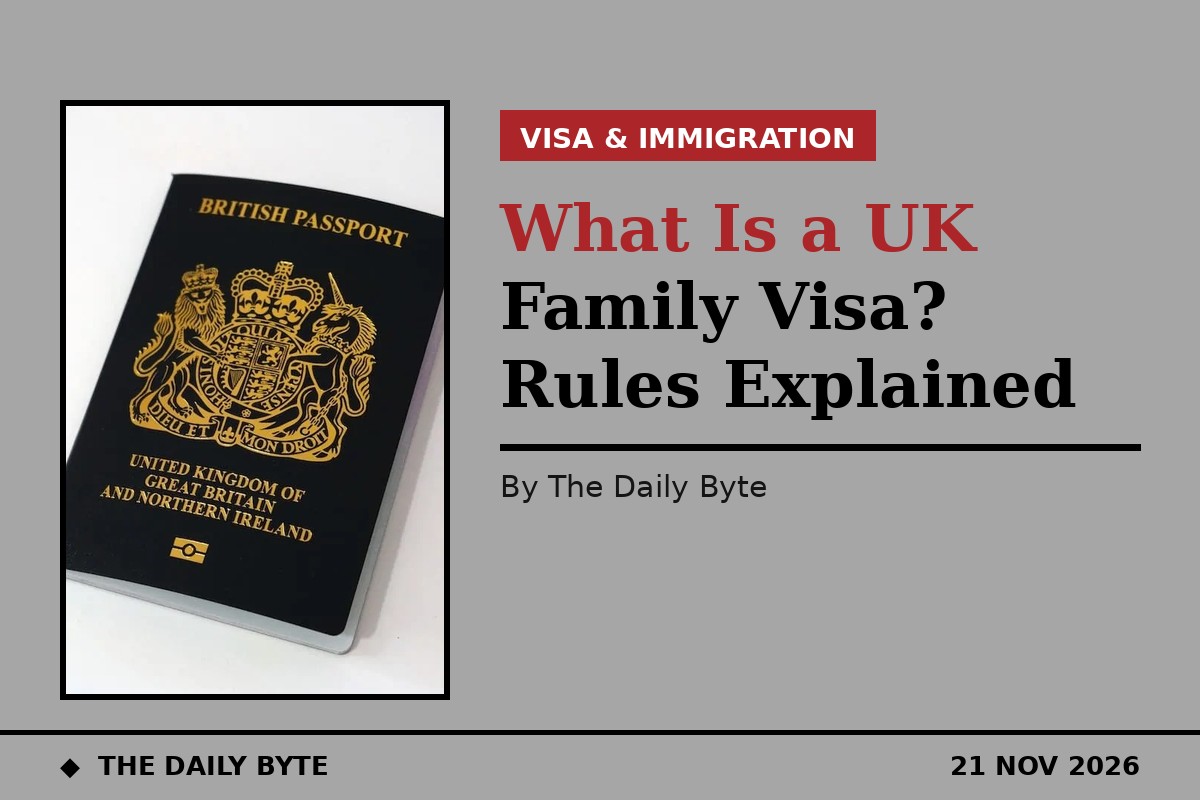
A UK family visa is the route that lets someone live in the United Kingdom with a close family member for more than six months. It is the visa used by husbands, wives and partners of British citizens and settled residents, by fiances and fiancees coming to marry in the UK, and by parents, children and relatives who need long-term care from a family member already here. The rules are detailed, the fees are high, and the financial test catches many applicants out. This explainer sets out who can apply, what the Home Office asks for, what it costs, how long it takes, and what changed in November 2026.
Family visas matter to a large number of people. They are one of the main legal routes into the UK, and they sit at the centre of the government's wider immigration reforms. On 2 November 2026 the government published its response to the consultation on earned settlement, confirming that partners of British citizens will keep a five-year route to permanent settlement even as most workers face a wait of ten years. That decision makes the family visa more important than ever for couples planning a life in Britain.
Who can apply for a family visa?
According to GOV.UK, you need a family visa to live with a family member in the UK for more than six months. From outside the UK, you can apply to live with your spouse or partner, your fiance, fiancee or proposed civil partner, your child, your parent, or a relative who will provide long-term care for you. If you are already in the UK on a family visa, you can apply to extend your stay, and if you arrived on a different visa you may be able to switch to a family visa to stay with a spouse, partner, child or parent.
The person you are joining must have a particular status. For a partner application, your partner must be a British or Irish citizen, or settled in the UK, for example with indefinite leave to remain or settled status. A partner with pre-settled status under the EU Settlement Scheme can also sponsor a partner, provided they started living in the UK before 1 January 2021. Partners with protection status, as refugees or people with humanitarian protection, and holders of Turkish Businessperson or Turkish Worker visas can also be joined under the route. The rules differ slightly for each category, and the GOV.UK guidance sets out the full list.
There are two situations in which a family visa is not the right route at all. If your family member is in the UK temporarily on a work visa or a student visa, you cannot apply for a family visa. You would apply instead as their dependant, which is a separate route tied to their visa. And if you hold a visitor visa, or a visa for six months or less, you will usually need to leave the UK before applying, although there are exceptions for people holding a six-month fiance visa and for people involved in a family court case or divorce.
The partner route: relationships and English
Most family visas are partner visas, and the partner route has the most detailed requirements. Both you and your partner must be 18 or over, and you must intend to live together permanently in the UK after you apply. You must prove the relationship in one of several ways: that you are in a marriage or civil partnership recognised in the UK, that you have been living together in a relationship for at least two years, that you are a fiance, fiancee or proposed civil partner who will marry or enter a civil partnership in the UK within six months of arriving, or that you have been in a relationship for at least two years but cannot live together, for example because you work or study in different places or because living together is not accepted in your culture.
Evidence matters. GOV.UK expects documents from official sources, such as a marriage certificate, a tenancy agreement, utility bills or Council Tax bills showing a shared address, a joint bank account, or a letter from a doctor or dentist confirming you live at the same address. The evidence should generally be less than four years old. If you cannot live together for work, study or cultural reasons, you will need to show an ongoing commitment instead, through regular communication, financial support for each other, care for children you have together, and time spent together as a couple.
You must also show a knowledge of English. For a first partner application the requirement is level A1 in speaking and listening, the most basic level. It rises to A2 when you extend your visa after two and a half years, and to B1 when you apply to settle permanently. The government has also announced that, for settlement applications made on or after 26 March 2027, the English requirement under the settlement rules will rise from B1 to B2, subject to exemptions and the rules on acceptable evidence.
The money test: the 29,000 pound rule
The part of the family visa that causes the most refusals is the minimum income requirement. If you apply for a family visa as a partner, you and your partner usually need to prove a combined income of at least 29,000 pounds a year. That figure has applied to new applicants since 11 April 2024, when it rose from 18,600 pounds. The planned further increases to 34,500 pounds and then 38,700 pounds were paused after a review by the Migration Advisory Committee, and the threshold remains 29,000 pounds.
There is an important transitional protection. If you first applied as a partner before 11 April 2024 and you are extending that visa with the same partner, the old threshold of 18,600 pounds a year normally continues to apply, with extra amounts for children who need it: 3,800 pounds for a first child and 2,400 pounds for each further child, up to an overall cap of 29,000 pounds. Under the current rules for new applicants there is no extra amount for children at all. The 29,000 pound figure is flat regardless of how many children are included.
Savings can cover a shortfall. The general formula is that you need 16,000 pounds in savings plus two and a half times the gap between your income and the threshold. So a couple earning 25,000 pounds a year, a gap of 4,000 pounds, would need 26,000 pounds in savings held for at least six months. A couple relying on savings alone would need 88,500 pounds. The income can come from employment, self-employment, pensions, maternity pay and some other sources, and the evidence rules for each source are set out in Appendix FM of the Immigration Rules.
There is one broad exemption. You do not need to meet a minimum income requirement if your partner receives certain disability or carer benefits, including Disability Living Allowance, Personal Independence Payment, Attendance Allowance or Carer's Allowance. In that case you must still show that you can house and support yourselves without relying on additional public funds, and the caseworker will look at your income and housing costs together.
Fees and the healthcare surcharge
Family visas are expensive, and the cost has several parts. The visa fee itself depends on who you are joining and where you apply from. Joining a partner, parent or child costs 2,064 pounds if you apply from outside the UK and 1,407 pounds if you apply from inside the UK, with the same amount for each dependant added to the application. The fee for an adult coming to be looked after by a relative is higher: 3,635 pounds from outside the UK, or 452 pounds if the relative has protection status.
On top of the fee comes the immigration health surcharge, which pays for use of the NHS. For each adult it costs 2,587.50 pounds for a stay of two years and six months, 3,105 pounds for two years and nine months, and 5,175 pounds for five years. For each child under 18 the figures are 1,940 pounds, 2,328 pounds and 3,880 pounds. A couple applying from abroad therefore faces a combined bill of more than 5,000 pounds before any other costs. There is a fee waiver for people who cannot afford the fee, for example because they have no place to live or cannot afford essential living costs, but the test is strict. Applicants inside the UK can also pay an extra 1,000 pounds for the super priority service to get a faster decision, although it is not available for adult dependent relative cases.
How long it takes, and the road to settlement
Decision times are published by the Home Office and have become a sore point for applicants. If you apply from outside the UK you will usually get a decision within 12 weeks. If you apply inside the UK and you meet the financial and English language requirements, the usual time is eight weeks. If you apply inside the UK and do not meet those requirements, it currently takes about 12 months. Official figures reported in November 2026 showed that applications from outside the UK slowed sharply during 2026, with almost a third of standard applications in early 2026 classed as non-straightforward, so many families wait considerably longer than the published times.
A partner visa initially lets you stay for up to two years and nine months. After that you apply to extend for a further two years and six months, and you can extend more than once. The earliest you can apply to settle permanently, for indefinite leave to remain, is after five years living in the UK continuously on a family visa as a partner. Time spent on any other visa does not count, and neither does time as a fiance or fiancee. A fiance visa lasts only six months, during which you must marry or enter a civil partnership, and you cannot work or study in the UK during the engagement. Once you have married, you apply to extend your stay, and only then do you gain the right to work and study.
What changed in November 2026
The biggest recent change to the family route is not a change to the visa itself but to what comes after it. On 2 November 2026 the Home Secretary, Shabana Mahmood, published the government's final response to its consultation on earned settlement and made a statement to Parliament. The consultation, launched in November 2025, proposed that settlement should depend on contribution, integration, character and compliance rather than simply on time spent in the UK.
Under the final framework, the standard qualifying period for settlement will rise from five years to ten years for most migrant workers, with faster routes for higher earners and for specified health and education workers. But partners, parents and children of British citizens keep a five-year pathway, because they are treated as having a recognised British connection. That is the key point for family visa holders: the five-year road to settlement survives for them.
There are other details that matter to families. Partners may combine their household income to meet a minimum contribution threshold of 25,142 pounds, rather than each having to meet an individual threshold of 12,571 pounds. Dependants who accompany the main applicant will generally be able to settle at the same time. The changes are expected to be introduced through a statement of changes to the Immigration Rules in December 2026 and rolled out during 2027, and nothing has yet changed in law. Applications made today are still decided under the existing rules.
What a family visa does not do
It is worth being clear about the limits. A family visa does not let you join a relative who is only visiting the UK, or one who is here on a short-term visa. It does not give you access to public funds in most cases, and breaching that condition can affect later applications. A fiance visa does not allow you to work while you wait to marry. And holding a family visa does not guarantee settlement: you must still meet the residence, English language and other requirements in force when you apply for indefinite leave to remain, and those requirements are being tightened.
The rules also change frequently. The income threshold rose sharply in 2024, the planned further rises were paused in 2025, and the settlement framework was rewritten in November 2026. Anyone planning an application should treat this article as general information, not as immigration advice for their own case, and should check the current GOV.UK guidance and the Immigration Rules before applying or paying any fee.