What Is a War Powers Resolution? Iran Vote Explained
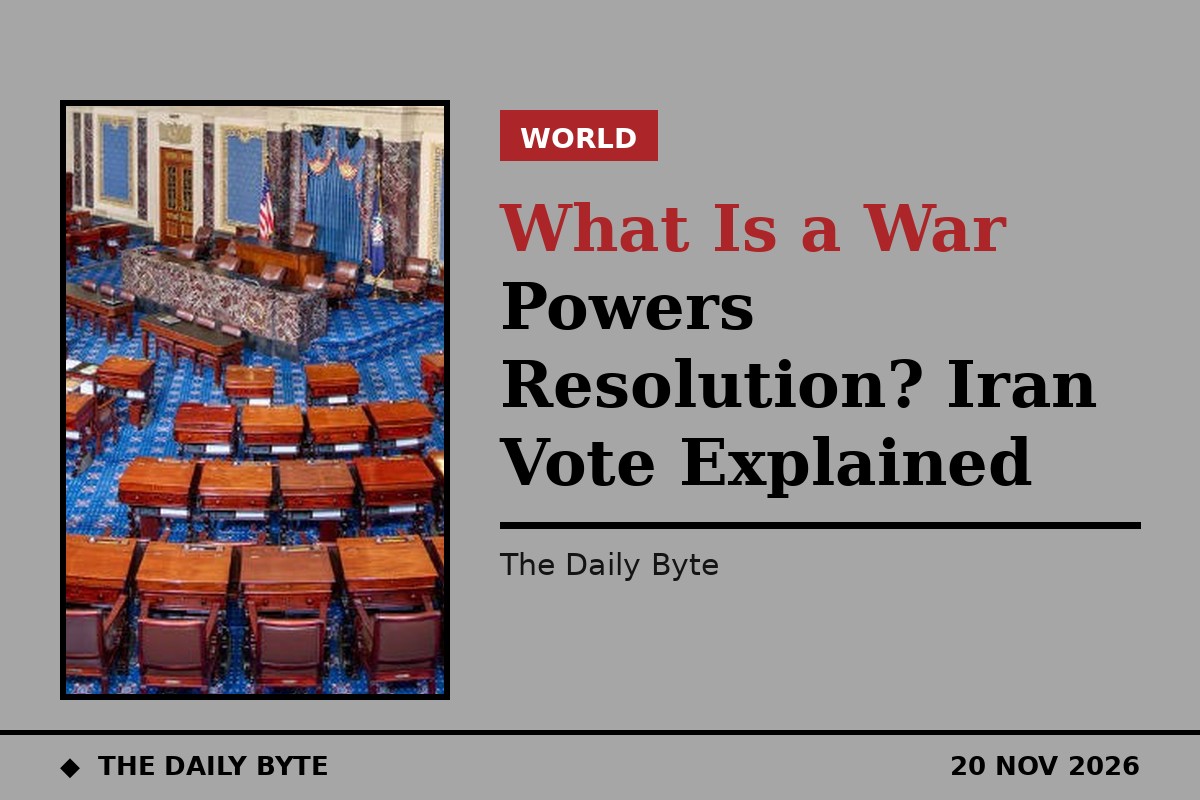
The United States Senate voted 48-51 on Thursday 19 November 2026 to reject a resolution that would have directed President Donald Trump to end the war in Iran, or to get Congress's approval to continue it. The vote was the first time the Senate had considered a major Iran war measure since the midterm elections of 3 November, in which Democrats won both chambers of Congress. It was also a test of a law that is now more than half a century old, and that has never settled the argument it was written to end: who gets to decide when America goes to war?
The measure, H.Con.Res. 93, had already passed the House of Representatives on 15 September, by 220 votes to 204. Its defeat in the Senate means that particular congressional directive will not take effect. It does not mean Congress has approved the war. Understanding the difference means understanding what a war powers resolution is, and why the law behind it is still disputed.
What is a war powers resolution?
The War Powers Resolution is a federal law passed by Congress in 1973, over the veto of President Richard Nixon, after the Vietnam War. Its purpose, set out in its own text, is to make sure that "the collective judgment of both the Congress and the President will apply" before American armed forces are sent into hostilities. The Constitution gives Congress the power to declare war, and makes the president commander-in-chief, and the 1973 law was Congress's attempt to draw the line between the two.
The law does three main things. First, it says the president should consult Congress "in every possible instance" before committing forces to hostilities. Second, it requires the president to report to Congress in writing within 48 hours of sending troops into hostilities, or into a situation where hostilities are imminent, explaining the circumstances, the legal authority and the expected scope and duration. Third, it sets a clock: within 60 days of that report, the president must end the use of force unless Congress has declared war, passed a specific authorisation, or extended the period. The president may add 30 more days by certifying that it is militarily necessary for the safety of the troops.
The law also contains a shortcut, section 5(c): at any time American forces are engaged in hostilities abroad without a declaration of war or specific authorisation, Congress may direct the president to remove them by passing a concurrent resolution. That is the provision the Iran resolution invoked, and it is the most contested part of the law.
What did this resolution say?
H.Con.Res. 93 invoked section 5(c) and directed the president to remove United States armed forces from hostilities against Iran, unless a declaration of war or a specific authorisation for military force against Iran was enacted. It was a concurrent resolution, which matters for two reasons. It had to pass both the House and the Senate to take effect, which is why the Senate vote killed it. And it would not have gone to the president for signature, and would not have had the force of law in the ordinary sense. Its power, had it passed, would have been political and constitutional rather than statutory: a formal direction from Congress to the commander-in-chief.
The resolution's supporters, led by Senator Tim Kaine of Virginia, argued that the war was unpopular and expensive, and that voters had just said so. "The American people want us to lower costs and make their lives better, not waste their taxpayer dollars on endless wars that don't make us safer," Kaine said after the vote. "They made that clear when they overwhelmingly voted for change earlier this month."
How did the vote break down?
The Senate rejected the resolution by 48 votes to 51, largely along party lines. Only three Republicans voted for it: Susan Collins of Maine, Lisa Murkowski of Alaska and Rand Paul of Kentucky. One Democrat, John Fetterman of Pennsylvania, voted against it. Senator Chris Murphy of Connecticut did not vote. The roll call, number 269, began at 2:01 p.m. Eastern time and was recorded at 2:42 p.m.
The politics around the vote were complicated. Two Republican critics of the Iran war voted against the resolution for reasons of process rather than substance. Senator Thom Tillis of North Carolina, who had backed earlier war powers measures, said he did not want to support what he saw as a politically motivated effort by Democrats that would not meaningfully change the administration's actions. Senator Josh Hawley of Missouri said he opposed the process, rather than the substance of the measure. The Senate remains under Republican control until the new Congress convenes in January 2027, when Democrats will hold a 56-44 majority.
What does the vote change, and what does it not?
The vote changes nothing on the ground. It stops one congressional directive, and it supplies no new legal authority for military action: the Senate did not vote to authorise the war, it voted not to order it ended. That distinction is often lost in the reporting, but it is the heart of the story. The war continues on whatever authority the administration claims for it, and the argument over that authority continues with it.
It also leaves the underlying question open. The 1973 law has never worked as its authors intended. Every president since Nixon has questioned parts of it, no president has accepted the 60-day clock as binding, and no court has ever enforced it. The section 5(c) mechanism is disputed in particular, because the Supreme Court's 1983 decision in INS v. Chadha struck down the legislative veto, the device by which Congress used to direct the executive without passing a law the president signs. Whether a concurrent resolution can still order troops home is, more than fifty years after the law was passed, an argument rather than a settled answer.
What happens next?
Nothing in the vote stops a new resolution being introduced, and the politics will look different in January, when the new Congress takes its seats with a Democratic majority in both chambers. For now, though, the position is as it was before the vote: the House has said the war should end without authorisation, the Senate has declined to say the same, and the question of who decides — the president, or Congress — remains where the War Powers Resolution left it in 1973, unresolved.
Frequently asked questions
Does the vote mean Congress approved the Iran war? No. The Senate rejected a resolution directing the president to end hostilities. It did not vote to authorise the war, and the vote supplied no new legal authority for military action.
What is a concurrent resolution? A measure passed by both the House and the Senate that does not go to the president for signature and does not have the force of law in the ordinary sense.
What is the 60-day rule? Under the War Powers Resolution, the president must end the use of armed forces within 60 days of reporting their deployment, unless Congress declares war, authorises the action, or extends the period. The president may add 30 days for the safety of the troops.
Could the Senate vote on this again? Yes. Nothing prevents a new war powers resolution being introduced, and the new Congress convenes in January 2027 with a Democratic majority.