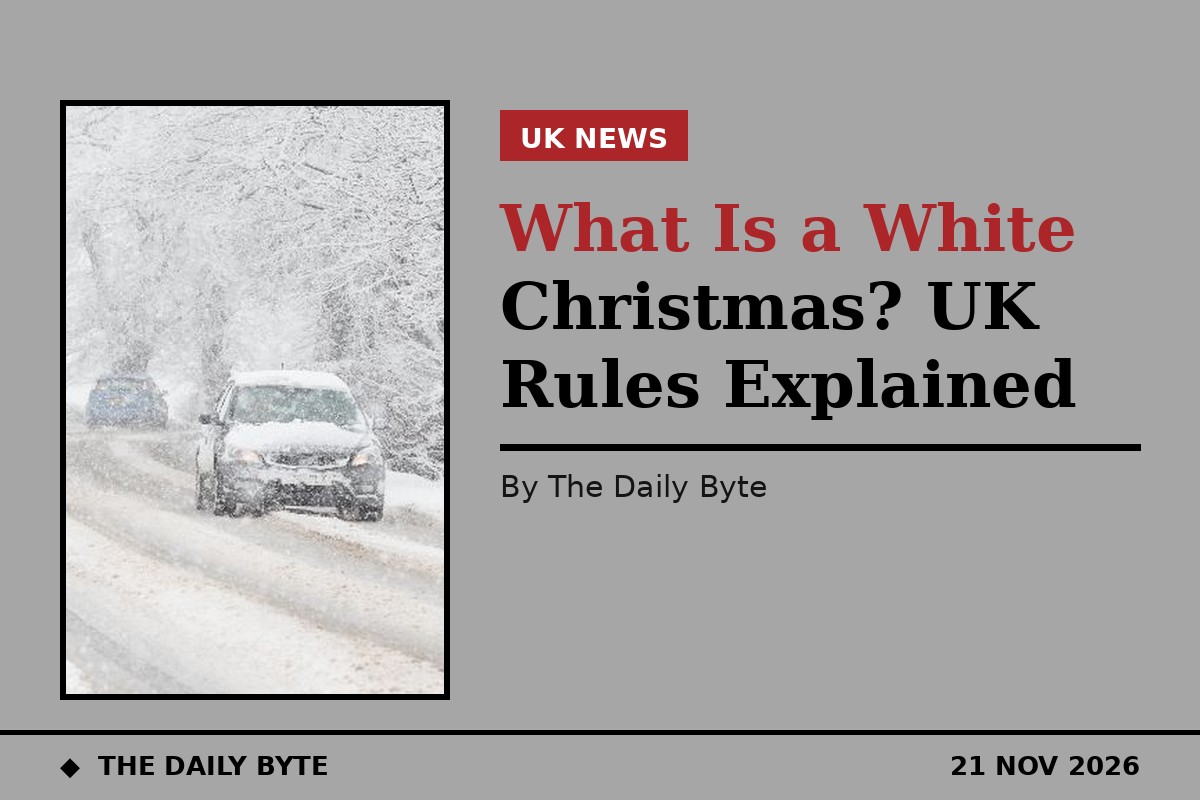
What Is a White Christmas? UK Rules Explained
Every year, as December approaches, the same question starts appearing in search boxes across the UK: what is a white Christmas, and will we get one? The answer is more surprising than most people expect. For the Met Office to declare a white Christmas, a single snowflake has to be observed falling at some point during the 24 hours of 25 December, by an official Met Office observer or by an automated weather station. There does not need to be any snow on the ground at all. This explainer sets out the official definition, how often the UK actually gets a white Christmas, the records for snow, warmth, rain and wind on Christmas Day, and why the picture-postcard scene of a country blanketed in snow is far rarer than the technical definition suggests.
The question is already being asked this year because the UK has just had its coldest night of the autumn, with temperatures falling to around minus 9C or minus 10C in parts of rural Scotland, widespread frost, and patches of freezing fog. A cold snap in November, however, says nothing about Christmas Day itself. The Met Office is clear that it cannot say whether snow will fall on 25 December until the week before, and that long-range hints about a white Christmas should be treated with caution. The definition, though, is fixed, and it has a history that goes back to the bookmakers.
What is a white Christmas?
For the Met Office to declare a white Christmas, a single snowflake has to be observed falling in the 24 hours of 25 December, by either an official Met Office observer or by a Met Office automated weather station. The Met Office explains that the rule exists because the event needs to be officially verified, both for its climate records and to provide consistency and certainty. One flake, seen by one official observer, is enough. It does not matter whether the snow settles, whether it falls at midnight or at midday, or whether it is mixed with rain.
That narrow definition surprises people because most of us picture something else when we hear the phrase: a deep covering of snow, streets hushed and white, children building snowmen. The Royal Meteorological Society puts it plainly, saying the official definition is one snowflake observed falling in the 24 hours of 25 December somewhere in the UK. The Dickensian scene is a different thing entirely, and the Met Office keeps the two separate: snow falling, which is what the definition measures, and snow lying, which is what most of us actually want to see.
Why is the definition so modest?
The definition comes from betting, not from poetry. Since 1973, bookmakers have offered odds on a white Christmas, and they needed a test that could be settled cleanly. In the past, the criteria were set at snow falling at midday on 25 December at the Met Office building in London. As betting on Christmas weather grew, with festive specials offering odds on many towns and cities, the list of locations grew too. The Royal Meteorological Society notes that the locations now range from Penzance to Aberdeen, and the Met Office lists examples including Buckingham Palace, Belfast Aldergrove Airport, Aberdeen's Pittodrie Stadium, Edinburgh Castle, Coronation Street in Manchester and the Millennium Stadium in Cardiff.
The Met Office also analyses the data from its observing stations around the UK to provide a complete picture of where snow has fallen or was lying on Christmas Day. That station network is what turns a bookmaker's bet into a climate record. A single flake at a single station counts for the record books, even if the rest of the country stays dry, which is why the Met Office can say that more than half of all Christmas Days have technically been white, while most of us remember very few snowy Christmases.
How often does the UK get a white Christmas?
More often than you might think. Since 1960, around half of the years have seen at least five percent of the weather station network record snow falling on Christmas Day, the Met Office says, which means we can probably expect more than half of all Christmas Days to be a white Christmas in the technical sense. The recent record bears that out. Technically, 2023 was the last white Christmas in the UK, with 11 percent of stations recording snow falling, although none reported any snow lying on the ground. Before that, 2022 saw nine percent of stations recording falling snow, but none with any snow settling, and 2021 and 2020 were also technically white Christmases, both with six percent of stations recording snow falling.
There are gaps, too. There was no record of snow falling at any station in the UK in 2018, or in 2019. And the technical definition can be misleading in the other direction: a Christmas can be officially white while almost nobody sees a flake, because the snow fell in a remote corner of the country, or overnight, or as a brief flurry mixed with rain. That is why the Met Office always reports the percentage of stations involved, so that a white Christmas with 11 percent of stations recording snow, like 2023, is not confused with a genuinely snowy day.
What about snow on the ground?
The picture most people have in mind, a widespread covering of snow lying on the ground on Christmas morning, is much rarer. The Met Office counts a widespread covering as one where more than 40 percent of stations in the UK reported snow on the ground at 9am, and that has happened only four times since 1960: in 1981, 1995, 2009 and 2010. The last widespread white Christmas, in 2010, was extremely unusual. Not only was there snow on the ground at 83 percent of stations, the highest amount ever recorded, but snow or sleet also fell at 19 percent of stations. We also had a white Christmas in 2009, when 20 percent of stations recorded snow or sleet falling, and 57 percent reported snow lying on the ground.
Part of the reason is timing. For most parts of the UK, Christmas comes at the beginning of the period when snow is likely, and we are more likely to see snow in January and February than in December. The Met Office's figures show snow actually settling on the ground for an average of three days in December, compared with 3.3 days in January, 3.4 days in February and 1.9 days in March, based on the 1991 to 2020 long-term averaging period. Latitude and height matter too: snow falling on Christmas Day is generally more common the further north you go and the higher up you are.
Why were white Christmases more common in the past?
White Christmases were more frequent in the 18th and 19th centuries, the Met Office says, even more so before the change of calendar in 1752, which effectively brought Christmas Day back by 12 days, moving it closer to the coldest part of the winter. Climate change has also brought higher average temperatures over land and sea, and that has generally reduced the chances of a white Christmas. Christmas Day is, climatologically, like any other winter day in the UK: the weather is strongly driven by the air mass we are under at the time and by the behaviour of the jet stream, the fast-moving band of air that steers weather systems towards Britain.
That is also why forecasting snow on Christmas Day is famously difficult. The Met Office says that forecasting impactful snow is famously tricky in the UK, because there are many factors that all have to be exact for snow to actually fall. Sometimes just a fraction of a degree in temperature can make the difference between a beautifully formed snowman and a sleety, slushy day. Single computer model runs, run once and quoted in excitable headlines weeks in advance, are not reliable enough to work out a detailed forecast. Instead, meteorologists run the models many times and look for where they agree and where they disagree, and even then, a confident forecast is only possible a few days beforehand.
UK Christmas weather records
Christmas Day has produced some remarkable weather records, and the Met Office keeps figures for each of the four nations. The deepest lying snow on Christmas Day was recorded back in 1981, when Kindrogan in Perthshire recorded 47 centimetres. England's deepest was 43 centimetres, at Buxton in Derbyshire and Malham Tarn in North Yorkshire in 1981 and 2009, while Wales recorded 45 centimetres at Cae Poeth in Gwynedd in 2010, and Northern Ireland 17 centimetres at Hillsborough in County Down in 2010.
The warmest Christmas Day on record reached 15.6C at Killerton in Devon in 1920, a figure that shows how mild a British Christmas can be. The wettest was in 2015, when 165.4 millimetres of rain fell at Capel Curig in Gwynedd. The windiest was at Sella Ness in Shetland in 2011, when gusts of up to 101 miles per hour were recorded. The coldest Christmas Day was at Gainford in Durham, which recorded minus 18.3C in 1878, while the sunniest saw 7.5 hours of sunshine, recorded at Penzance in Cornwall and Aberporth in Dyfed in 1944, at Faversham in Kent in 1979, and at Camborne in Cornwall in 2010.
Will there be a white Christmas in 2026?
It is too early to say, and anyone who tells you otherwise is guessing. The Met Office says it starts being asked about a white Christmas in October, sometimes earlier, but that it is not until the week before Christmas that it has a real idea about the chances of seeing flurries on the big day. Its long-range forecast covers the festive period, but only as a broad description of the weather that is likely to be affecting the UK, not as a detailed forecast, and many outcomes remain possible until much closer to the time.
What can be said is that the odds are in favour of a technical white Christmas, if history is any guide: more than half of Christmas Days since 1960 have met the one-flake test. The odds of the snow-covered scene most people dream of are far longer. Only four Christmases in 65 years have had snow lying across more than 40 percent of the country at 9am. So if you are placing a bet, check which definition the bookmaker is using, and if you are dreaming of a white Christmas, remember that the Met Office's version needs just one flake, falling somewhere, at any hour of the day.
Frequently asked questions
Does there need to be snow on the ground for a white Christmas? No. The Met Office definition only requires one snowflake to be observed falling during the 24 hours of 25 December. Snow on the ground is a separate measure. Has London ever had a white Christmas? Snow has been recorded falling in London on Christmas Day in several years, but the official record is based on the whole station network, not on one city. When was the last white Christmas? Technically, 2023, when 11 percent of stations recorded snow falling, although none reported snow lying. The last widespread white Christmas, with snow on the ground across most of the country, was in 2010. Can the Met Office forecast a white Christmas in advance? Accurately, only a few days beforehand. Its long-range outlook gives a broad indication of the pattern, but the chaotic nature of the atmosphere means many outcomes remain possible until much closer to the time.