What Is an Interpol Red Notice? Explained
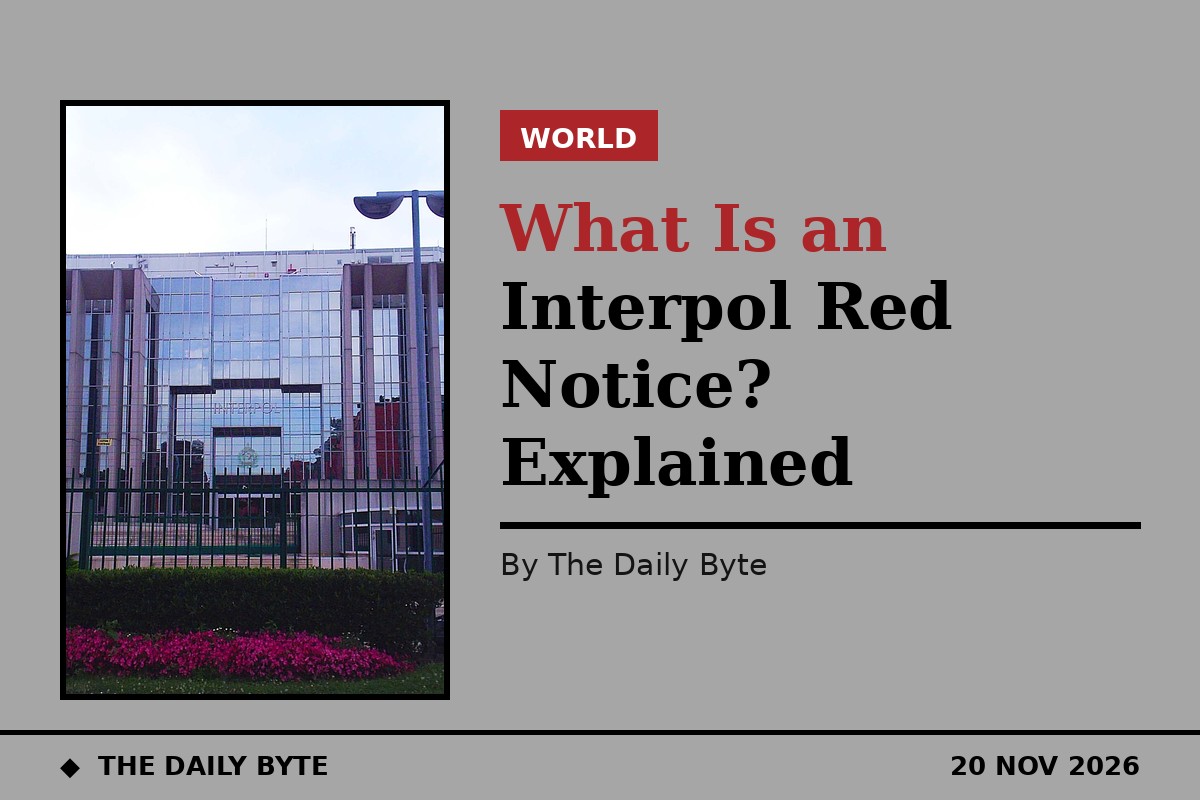
An Interpol Red Notice is a request to police forces around the world to locate a wanted person and provisionally arrest them pending extradition, surrender or similar legal action. It is not an international arrest warrant, and Interpol cannot order any country to make an arrest.
The notice is based on an arrest warrant or court order already issued by the courts of the country that wants the person. Interpol circulates that country's request to its 196 member countries through its secure police communications network, and each country then applies its own laws in deciding whether to act on it.
Red Notices are in the news again after Spain's High Court freed the US media heir James "Fergie" Chambers on conditional bail on 20 November 2026 while it considers a US extradition request. Chambers was arrested in Ibiza on 10 July 2026 at the request of the US authorities, and his case has become a vivid example of how far one country's request for help can reach across borders.
What information does a Red Notice contain?
A Red Notice contains two main types of information, according to Interpol. The first identifies the wanted person: name, date of birth, nationality, hair and eye colour, and photographs and fingerprints where they are available. The second sets out the crime the person is wanted for, which will typically be a serious offence such as murder, rape, child abuse, armed robbery or fraud.
The notice also makes clear which of two situations applies. A person wanted for prosecution has not been convicted and should be considered innocent until proven guilty. A person wanted to serve a sentence has already been found guilty by a court in the country that requested the notice.
| What the notice holds | Examples |
|---|---|
| Identity details | Name, date of birth, nationality, physical description, photographs, fingerprints |
| Crime details | Offence, the facts alleged, and whether the person is wanted for prosecution or to serve a sentence |
How is a Red Notice issued?
A Red Notice is not issued automatically, and Interpol does not generate it on its own initiative. The process runs in five stages.
First, criminal proceedings must be under way in the requesting country, and a judge or court there must have issued an arrest warrant or court order. Second, that country's National Central Bureau — its national Interpol office — asks Interpol's General Secretariat in Lyon to publish a notice. International tribunals can also make requests. Third, every request is reviewed for compliance with Interpol's rules by its Notices and Diffusions Task Force, a multilingual team of lawyers, police officers and operational specialists. The task force looks at the information from the requesting country, other member countries and open sources. Fourth, if the request passes, the notice is circulated to all member countries at once through Interpol's I-24/7 secure network. Fifth, the notice stays under review: if it is later assessed as no longer complying with Interpol's Constitution and rules, it is cancelled and all member countries are told to remove it from their national databases.
Most Red Notices are visible only to law enforcement. Only a selection is published on Interpol's public wanted-persons pages, so a person cannot assume that no notice exists simply because they cannot find one online.
Is a Red Notice an international arrest warrant?
No, and the distinction matters. An arrest warrant carries legal force inside the country that issued it. A Red Notice carries no legal force anywhere: it is a request for cooperation, and each country decides for itself what legal value to give it and whether its officers may arrest on the strength of it. Interpol itself stresses that the people named are wanted by a country or an international tribunal, not by Interpol.
That does not make a Red Notice harmless. The US Justice Manual describes it as an international lookout and the closest instrument to an international arrest warrant in use today. In practice, a hit at an airport or border crossing can lead to a traveller being detained on the spot while the details are verified, and a provisional arrest can then lead to formal extradition proceedings under the law of the country where the person was found.
What other Interpol alerts exist?
The Red Notice is the best known of Interpol's colour-coded alerts, but it is only one of them. Each colour does a different job.
| Alert | Purpose |
|---|---|
| Red Notice | Locate and provisionally arrest a person pending extradition or surrender |
| Blue Notice | Collect information about a person's identity, location or activities in a criminal investigation |
| Green Notice | Warn about a person considered a possible threat to public safety |
| Yellow Notice | Help locate missing persons, often children |
| Black Notice | Seek information on unidentified bodies |
| Orange Notice | Warn of an imminent threat, for example from weapons or explosives |
| Purple Notice | Share information on criminal methods, objects and concealment techniques |
There is also a related tool called a diffusion. A diffusion is an alert sent directly from one member country to others through Interpol's system, rather than being published centrally by Interpol. Fair Trials, a criminal justice watchdog that has campaigned on Interpol since 2012, notes that diffusions are checked by Interpol after they have been circulated, unlike Red Notices, which are vetted before publication.
What stops Red Notices being abused?
Interpol's Constitution, in Article 3, forbids the organisation from undertaking any intervention or activities of a political, military, religious or racial character. Its Rules on the Processing of Data add a further filter: under Article 83, a Red Notice may be published only for a serious ordinary-law crime. It may not be published for offences that raise controversial issues in some countries relating to behavioural or cultural norms, such as prostitution or offences related to damaging honour; for offences relating to family or private matters, such as adultery or bigamy; or for conduct arising from administrative rules or private disputes, such as traffic violations or defamation, unless the criminal activity is aimed at facilitating a serious crime or is suspected of being connected to organised crime.
Even so, the system has been criticised. Fair Trials told Parliament that Red Notices and other alerts have sometimes been misused to harass and intimidate political activists, journalists and human rights defenders, and to export persecution across borders. The Council of Europe's Parliamentary Assembly warned in 2017 that some member states had abused the system to pursue political opponents abroad, and that targeted people could not effectively challenge notices before national or international courts.
Reforms since 2015 have tightened the process: requests are now vetted by the Notices and Diffusions Task Force before publication, Interpol adopted a policy to protect recognised refugees from notices issued by the country they fled, and the independent Commission for the Control of Interpol's Files was rebuilt to give binding, reasoned decisions. Fair Trials' reading of Interpol's published figures puts the number of Red Notices and diffusions rejected or deleted at roughly 1,000 a year, which it treats as evidence that the filter works — and as only the tip of the iceberg.
Can a Red Notice be challenged?
Yes. Anyone who believes a notice has been issued for them can apply to the Commission for the Control of Interpol's Files (CCF), an independent body. Applications to the CCF are free of charge and treated confidentially, and a person can ask both what data Interpol holds about them and for that data to be deleted. The CCF decides the case on Interpol's rules — its Constitution and its data-processing rules — rather than on whether the person is guilty or innocent, which it cannot decide.
National courts also provide a check. An arrest on a Red Notice is only the start: whether the person is actually surrendered is decided by extradition proceedings in the country where they were arrested, under that country's law and its treaties, and those proceedings can test the fairness and reliability of the underlying request.
The Fergie Chambers case
The case that put Red Notices back in the headlines concerns James Cox Chambers Jr., known as Fergie, whose family owns the Cox Enterprises media group. Chambers was arrested in Ibiza on 10 July 2026 at the request of the US authorities and had been held in custody at Aranjuez prison near Madrid. He faces accusations of riot, conspiracy to commit riot and international money laundering, and he denies wrongdoing. The US complaint alleges that about $7.2 million was moved in ten bank transfers to Tunisia in 2024, and links the riot allegations to protests in late 2023 against Elbit Systems, the Israeli arms maker.
Spain's National Court heard the extradition request on 13 November, and its judges had been expected to rule in the coming weeks. But on 20 November the High Court freed Chambers on conditional bail after US authorities acknowledged what the court described as substantial and unintentional errors in the Spanish translation of an FBI agent's sworn statement supporting the extradition request. The court said the errors could delay a final decision and could be relevant to the outcome, because they raised questions about the accuracy of documents provided by the US authorities.
Chambers must report weekly to a local court, surrender his passport, remain in Spain, provide an address and appear before the High Court whenever summoned. He is also seeking political asylum in Spain, and he cannot be extradited while that claim is pending. If the court approves the extradition, Spain's cabinet would make the final decision.
Frequently asked questions
Is a Red Notice the same as being convicted?
No. A Red Notice issued for prosecution means the person has not been convicted and should be considered innocent until proven guilty. Only a notice issued to serve a sentence follows a conviction.
Can Interpol arrest me?
No. Interpol has no police officers with powers of arrest. Only national police can arrest someone, and only under their own country's law.
Can I find out if a Red Notice has been issued for me?
Some Red Notices are published on Interpol's public wanted-persons pages, but most are restricted to law enforcement. The route for finding out is the Commission for the Control of Interpol's Files, which handles applications free of charge and in confidence.
What is the difference between a Red Notice and a diffusion?
A Red Notice is published centrally by Interpol after its task force has checked the request. A diffusion is sent directly between member countries through Interpol's system and is checked by Interpol after it has been circulated.
What happens after someone is arrested on a Red Notice?
The arrest is provisional. The requesting country must then follow with a formal extradition request, and the courts of the country where the person was arrested decide whether to surrender them, under that country's law and treaties.
Can a Red Notice be issued for a political offence?
No. Interpol's Constitution bars activities of a political, military, religious or racial character, and its rules exclude offences that are not serious ordinary-law crimes.
Sources: Interpol; Reuters; Fair Trials.