What Is Anthropic? Claude Maker Explained
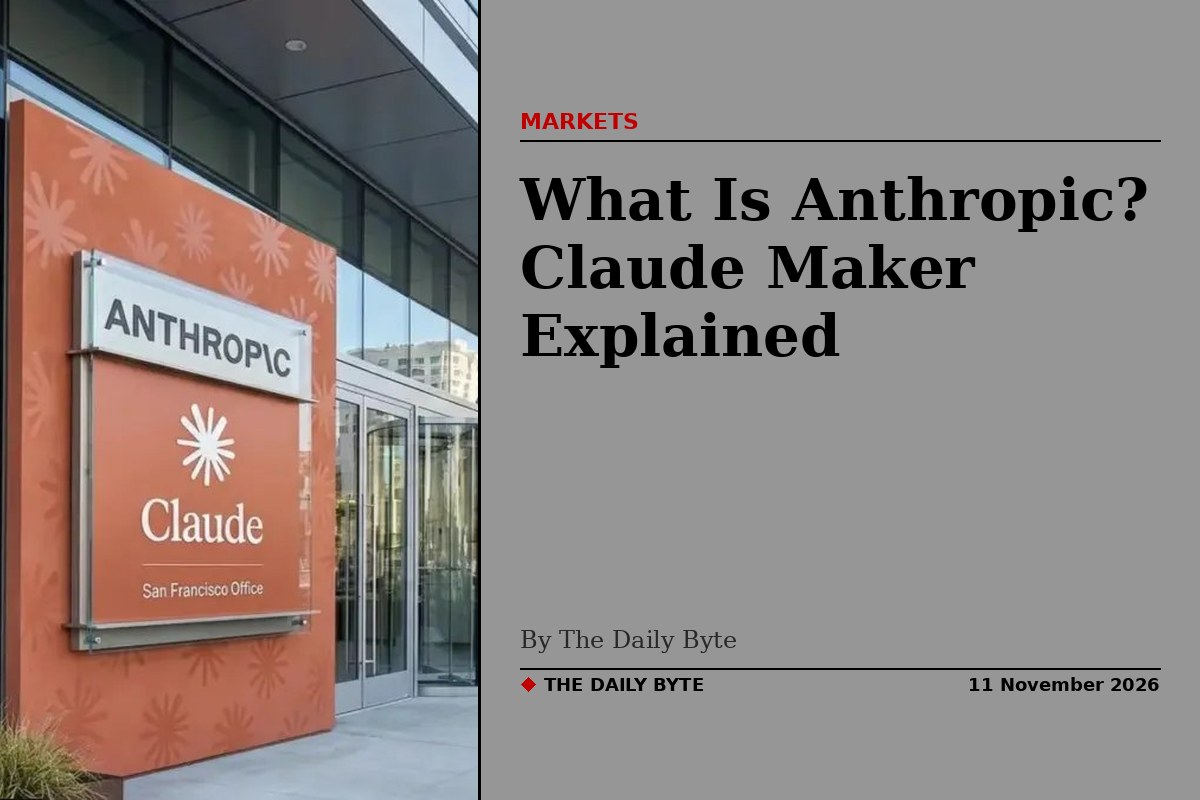
Anthropic is the artificial intelligence company behind Claude, one of the world's most widely used AI assistants. It describes itself as an AI safety and research company, and it is in the news because it began marketing its stock market flotation — an initial public offering (IPO) — on 10 November 2026, with shares priced at $70 to $78 each.
The company was founded at the beginning of 2021 by seven former OpenAI researchers and executives, including siblings Dario Amodei, its chief executive, and Daniela Amodei, its president. It is based in San Francisco, California, and its best-known product is the Claude family of AI models, which powers a chatbot, a coding tool and a service that other businesses can build into their own software.
Who founded Anthropic and why?
Anthropic was set up in early 2021 by Dario Amodei, Daniela Amodei, Jared Kaplan, Tom Brown, Sam McCandlish, Chris Olah and Jack Clark. All seven had previously worked at OpenAI, the company behind ChatGPT. The founders left over disagreements about the direction and governance of AI development, and they set out to build a company that put safety research at the centre of its work rather than treating it as an afterthought.
That history matters because it shapes how Anthropic presents itself today. Unlike a conventional software start-up, the company is organised as a Delaware public benefit corporation. That is a for-profit legal structure, but one whose stated purpose is the responsible development and maintenance of advanced AI for the long-term benefit of humanity. Its directors are expected to weigh that public benefit alongside commercial results.
What is Claude?
Claude is Anthropic's family of large language models — the AI systems that can read, write, reason, analyse documents and images, write computer code and answer questions in natural language. Anthropic introduced Claude publicly in March 2023, and it has since released successive versions, including Claude Sonnet and Claude Opus models aimed at different uses, from everyday conversation to heavy-duty coding work.
For most people, Claude is a chatbot available on the web, on phones and on desktop computers, in free and paid tiers. For businesses, Claude is also available through an application programming interface (API), which lets developers build Claude into their own products, and through cloud platforms such as Amazon Web Services and Google Cloud. Claude Code, its coding assistant, is one of its fastest-growing products, and Anthropic has said that Claude itself now writes a large share of the company's own software code.
Anthropic named Claude after Claude Shannon, the mathematician and electrical engineer widely regarded as the father of information theory. The name is a deliberate nod to the science behind the technology, and it is also a practical distinction: Anthropic is the company, Claude is the product.
What is Constitutional AI?
One of Anthropic's best-known research ideas is Constitutional AI. In simple terms, it is a training approach in which the model is guided by a written set of principles — a kind of constitution — rather than relying only on feedback from human raters. Anthropic has published Claude's constitution openly, so outsiders can see the rules the company says its models are trained to follow.
The company also publishes a Responsible Scaling Policy, which sets out the safety evaluations its models must pass before they are released. The policy includes capability thresholds, known as AI Safety Levels, that are meant to trigger extra safeguards as models become more powerful. Supporters argue this makes Anthropic's approach more transparent than that of rivals. Critics point out that the policy is self-imposed, and that Anthropic itself decides when its thresholds have been met — a point that drew attention in the November 2026 IPO filing, which said the company had met its AI research and development threshold based on what it expects from future models.
Why is Anthropic in the news now?
On 10 November 2026, Anthropic launched the roadshow for its IPO — the round of presentations in which a company and its banks pitch shares to large investors before setting a final price. It plans to sell 825 million Class A shares at $70 to $78 each, which would raise between $57.75 billion and $64.35 billion before fees. The shares are expected to list on the Nasdaq Global Select Market under the ticker symbol ANT, although no trading date has been confirmed and the registration statement had not yet become effective when the roadshow began, so no shares could yet be sold.
Alongside the public offering, Anthropic has lined up a separate $26 billion private placement, with Google, Nvidia, Advanced Micro Devices, Broadcom, Micron Technology, Microsoft and TSMC Partners agreeing to buy shares at the IPO price. Reuters reported that the listing targets a valuation of about $1.4 trillion, which would make it one of the largest stock market debuts ever attempted.
The filing also gave a rare look at the company's finances. Anthropic reported $33.2 billion in revenue for the first nine months of 2026, alongside a $1.3 billion operating loss. A day earlier, on 9 November, it released two new models, Claude Fable 5.2 and Claude Mythos 5.2.
How is Anthropic different from OpenAI?
Anthropic and OpenAI are the two best-known independent makers of frontier AI models, alongside Google DeepMind, and they compete directly. Both sell chatbots, coding tools and APIs, and both are racing to build more capable models. The main differences are in structure and emphasis: OpenAI operates under a hybrid for-profit and non-profit structure, while Anthropic is a public benefit corporation that puts its safety research and published constitution at the front of its public identity.
For users, the practical choice is usually between Claude and ChatGPT, and many people and businesses use both. The IPO will not change Claude's plans or prices on its own. What it will change is scrutiny: as a listed company, Anthropic will have to publish regular financial results and answer to public shareholders as well as to its own safety commitments.
Frequently asked questions
Is Anthropic the same as Claude? No. Anthropic is the company; Claude is its family of AI models and products. It is the same distinction as between a car maker and a car model.
Who owns Anthropic? It is a privately held company for now, owned by its founders, employees and investors, including Google and Amazon. That will change if the IPO goes ahead and its shares begin trading on Nasdaq.
Can I buy Anthropic shares? Not yet. The registration statement had not become effective when the roadshow began on 10 November 2026, so no shares could be sold and no purchase offers could be accepted. The final price and the first day of trading will be set after the roadshow.
Is Claude free? Claude is available in free and paid tiers. The free version has usage limits, while paid plans offer higher limits and access to more capable models. Businesses pay separately for the Claude API, based on how much they use.
Where is Anthropic based? Anthropic is headquartered in San Francisco, California. Its office there carries both the Anthropic name and the Claude brand.