What Is ASEAN? Manila Summit 2026 Explained
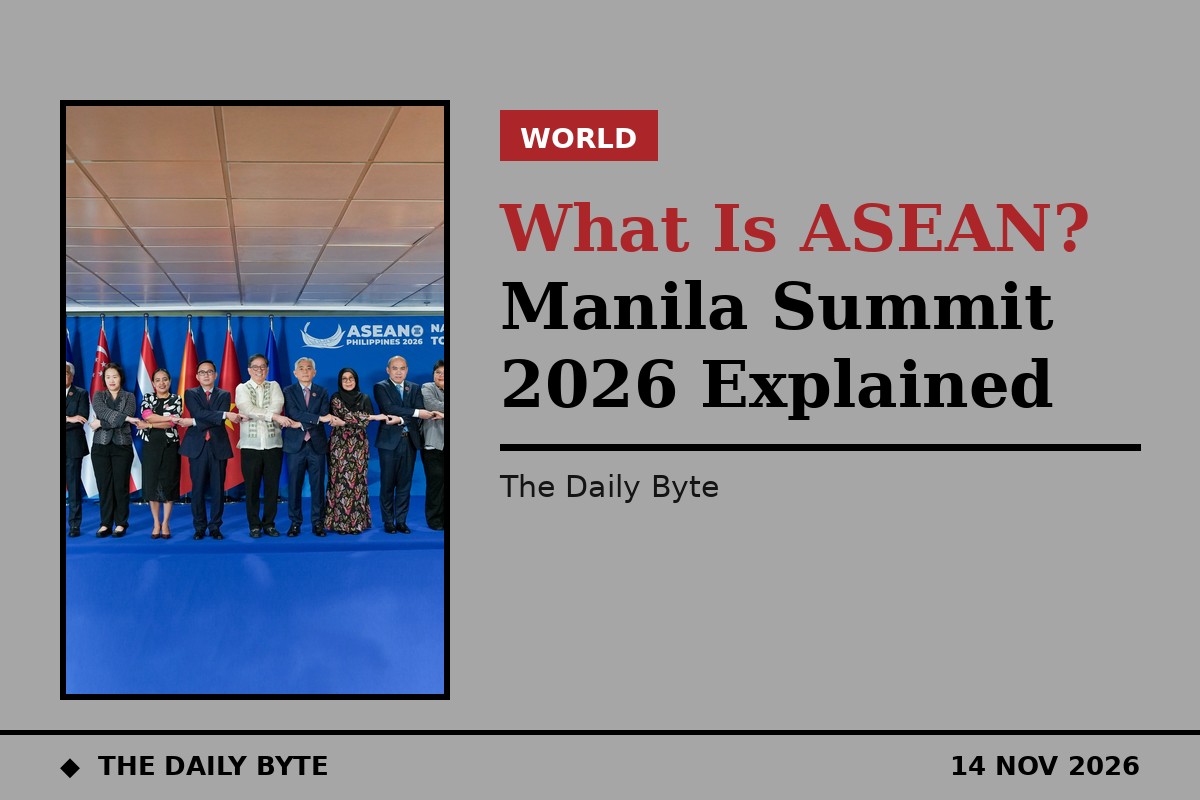
ASEAN is the Association of Southeast Asian Nations, a regional bloc of 11 countries in Southeast Asia with a combined population of 693.2 million people and a combined economy worth 4.3 trillion US dollars. Its 49th summit and related meetings take place in Manila, in the Philippines, from 15 to 17 November 2026, chaired by Philippine president Ferdinand Marcos Jr. Leaders will discuss energy security, a code of conduct for the South China Sea, a digital economy pact and the war-driven pressures on fuel supplies, and the meeting will close with a special summit attended by US president Donald Trump.
What does ASEAN stand for?
ASEAN stands for the Association of Southeast Asian Nations. It was founded on 8 August 1967, when the foreign ministers of five countries, Indonesia, Malaysia, the Philippines, Singapore and Thailand, signed the Bangkok Declaration. The declaration set out aims that still define the bloc today: to accelerate economic growth, social progress and cultural development in the region, and to maintain regional peace and political stability. The bloc has grown in stages since then. Brunei joined in 1984, Vietnam in 1995, Laos and Myanmar in 1997, Cambodia in 1999, and Timor-Leste became the 11th member in October 2025. ASEAN is not a government and it is not a parliament. It has a small secretariat in Jakarta, in Indonesia, but unlike the European Union it has no body that can impose decisions on its member states. Instead it works through summits, ministerial meetings and hundreds of working groups, and its central rule is consensus: decisions are taken only when all members agree. That model keeps very different countries at the same table, but it also means ASEAN often moves slowly, especially in a crisis, and critics regularly point to that consensus rule when the bloc fails to act quickly.
How big is ASEAN?
ASEAN's scale is the main reason it matters. Its combined population reached 693.2 million in 2025, equal to 8.4% of the world's population. Its combined output of 4.3 trillion dollars would make it the world's fifth-largest economy if it were a single country, and its trade in goods stands at 4.4 trillion dollars, according to ASEAN data. The bloc has built a network of free-trade agreements and helped to establish the Regional Comprehensive Economic Partnership, the world's largest trade deal, with China, Japan, South Korea, Australia and New Zealand. ASEAN also promotes what it calls centrality: the idea that Southeast Asian countries should act together and stay at the centre of the region's institutions, rather than allowing larger powers to dictate the agenda. By convening forums that include China, the United States, Russia, Japan and India, the bloc gives its smaller members a stronger collective platform than any of them would have alone.
How does ASEAN work with the rest of the world?
ASEAN works with the outside world through dialogue partnerships, which are formal relationships with countries and organisations that engage the bloc through regular dialogue and practical cooperation on political and security affairs, economic integration and social and cultural development. To date it has established dialogue partnerships with Australia, Canada, China, the European Union, India, Japan, New Zealand, South Korea, Russia, Türkiye, the United Kingdom and the United States. The most important of these relationships are staged as summits alongside the main ASEAN leaders' meeting, known as the Plus One summits, in which ASEAN meets each partner in turn. There are also wider forums built around ASEAN, including the ASEAN Plus Three summit with China, Japan and South Korea, and the East Asia Summit, the leaders-level forum for dialogue on strategic, political and economic issues, which brings in the United States, Russia, India, Australia and New Zealand as well.
What is happening at the Manila summit?
The 49th ASEAN Summit and Related Summits open in Manila on 15 November 2026, with the Philippines chairing under the theme Navigating Our Future, Together. The high-level engagements begin on 15 November with the opening ceremony at the Philippine International Convention Center, followed by plenary and retreat sessions in which ASEAN leaders take stock of the Philippines' year as chair and discuss how to strengthen their collective capacity to deal with regional and global challenges, including the situation in Myanmar. President Marcos Jr. will be joined by the leaders of Brunei, Cambodia, Laos, Indonesia, Malaysia, Singapore, Thailand, Timor-Leste and Vietnam. Myanmar will be represented by the Director-General of the ASEAN Affairs Department of its foreign ministry, rather than by its head of government, reflecting the bloc's decision to limit the junta's representation. The related summits, or Plus One summits, follow on 16 and 17 November, co-chaired by the leaders of Australia, China, India, Japan, New Zealand, South Korea, Russia, the United Nations and the United States. On 17 November Marcos will also convene the 29th ASEAN Plus Three Summit and the 21st East Asia Summit, and the day will end with the ASEAN-United States Special Summit attended by President Donald Trump, who is scheduled to arrive in the country at 5.30pm, just 30 minutes before the summit formally closes. Marcos will then hand over the ASEAN chair to Singapore.
What is on the agenda in Manila?
Energy security tops the agenda. The war involving Iran is battering economies across the region and raising concern about fuel supplies and prices, and leaders are expected to discuss how to shield their economies from further shocks. The long-running consultations for a code of conduct in the South China Sea are also central, amid continuing tensions and confrontations in the disputed waters, although Philippine reporting indicates the code is not expected to be concluded at the Manila meeting. On the economy, leaders are expected to sign the ASEAN Digital Economy Framework Agreement, which aims to double the region's digital economy to 2 trillion dollars by 2030. Other issues on the table include artificial intelligence, transboundary pollution from haze, Thai-Cambodian tensions and the situation in Myanmar. The Philippine foreign affairs department says leaders will also discuss measures that ordinary people can feel, including food security, transnational crime and online scams, and the welfare of migrant workers, many millions of whom work across the region and in the Gulf states. The wider context is the intensifying rivalry between the United States and China, with both powers courting Southeast Asia. For more detail, see the Vera Files guide to who is coming and what is on the agenda and the Philippine News Agency report on the confirmed attendance.
Frequently asked questions
Is ASEAN like the European Union?
No. The EU can make laws that bind its members, while ASEAN has no body that can impose decisions. ASEAN works by consensus and non-interference, which keeps diverse members together but often slows collective action.
Does ASEAN include China?
No. China is not a member of ASEAN. It is one of ASEAN's dialogue partners, and it takes part in the ASEAN Plus Three summit and the East Asia Summit alongside ASEAN leaders.
Why is Myanmar's leader not attending?
Myanmar is represented by a senior foreign ministry official rather than its head of government, reflecting ASEAN's decision to limit the military government's representation while its five-point peace plan remains unfulfilled.
When did Timor-Leste join ASEAN?
Timor-Leste became ASEAN's 11th member in October 2025, completing the bloc's expansion to cover all of Southeast Asia.
What is the ASEAN Digital Economy Framework Agreement?
It is the pact leaders are expected to sign in Manila, aiming to double the region's digital economy to 2 trillion dollars by 2030 by harmonising rules for digital trade, payments and data.